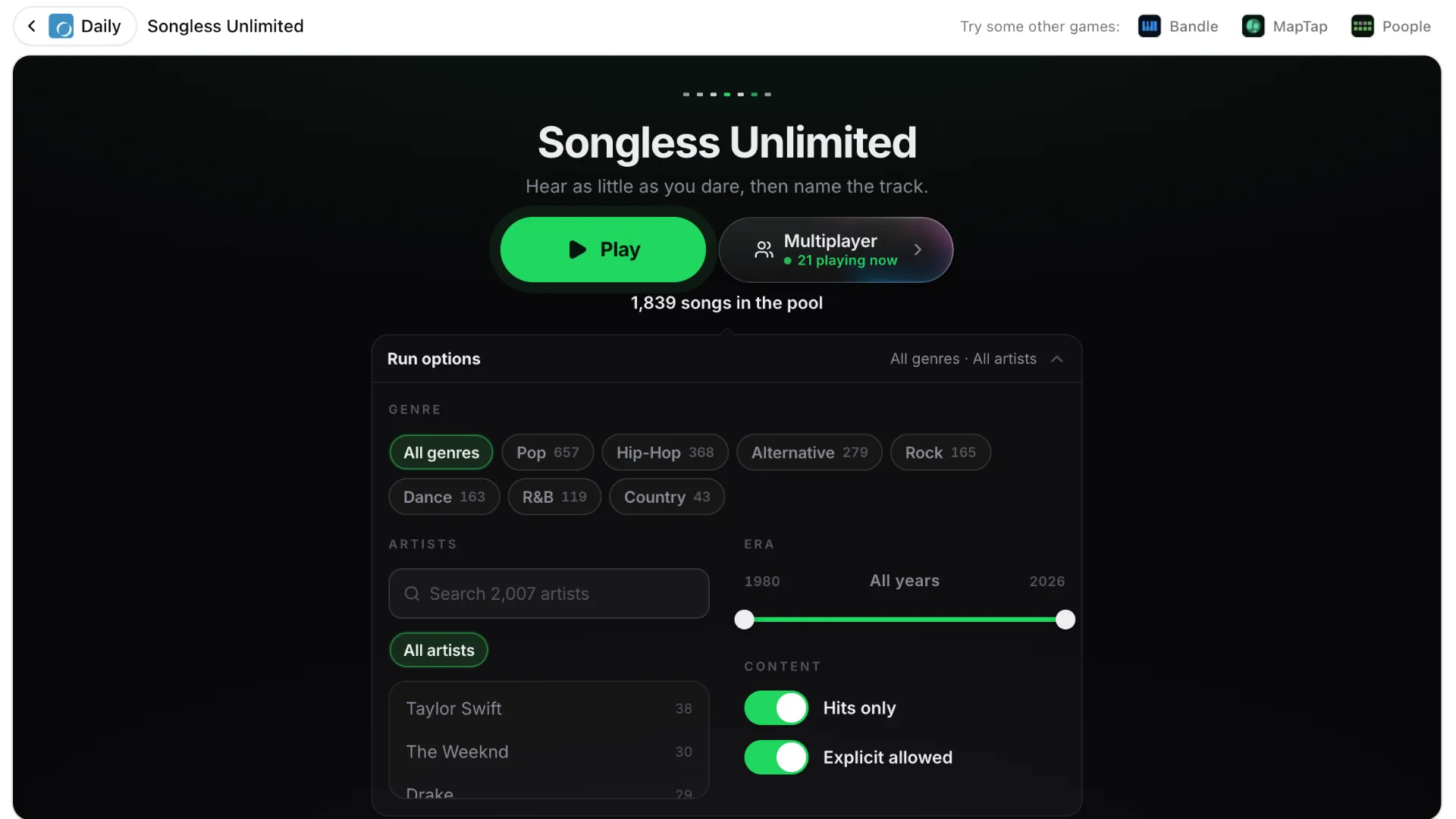

What Is Songless Unlimited?
Songless Unlimited is a browser-based music guessing game built around one simple challenge: how little of a song do you need before you recognize it?
Every song begins with only 0.1 seconds of audio. That may be nothing more than a drum hit, a tiny vocal sound, a guitar attack, or the start of a synth. If you cannot identify the track immediately, you can drag the playhead forward and hear more of it.
The catch is that more audio means fewer points. Recognizing a familiar track almost instantly is therefore much more valuable than waiting until the chorus makes the answer obvious.
A standard run contains five songs, and Songless Unlimited can be replayed without waiting for a daily reset. The game currently draws from more than 6,000 charting tracks spanning music from 1980 through 2026, with filters for genres, artists, years, and explicit content.
Rules and Core Twist
The defining mechanic is a continuous trade-off between information and score.
- Each song starts at 0.1 seconds.
- Press play to hear the currently revealed portion of the track.
- Drag the playhead farther forward whenever you need more audio.
- The more of the song you reveal, the fewer points that song is worth.
- Type a song title and select the intended track from the suggestion list.
- A wrong answer costs 500 points, but it does not end the song.
- Correctly identifying a track at the minimum reveal can be worth 10,000 points.
- Opening the full available clip reduces its base value to 3,500 points.
- Five perfect songs produce a maximum run score of 50,000.
The five songs become progressively tougher based on their overall streaming popularity, so later rounds generally require broader music knowledge.
A typical round feels like this:
0.1s ▶ drum hit → maybe familiar
0.6s ▶ beat and production texture → possible artist
1.8s ▶ recognizable instrument or vocal → strong guess
Guess submitted → correct → score based on audio used
Unlike games where a wrong guess automatically reveals a fixed next clue, Songless gives you control over how much additional audio you want to buy with your score.
How to Play Songless Unlimited
1. Start a five-song run
Open Songless Unlimited and choose your run settings. You can leave the entire catalogue enabled or narrow the pool using genre, artist, era, and content filters.
For a first game, using all genres and artists gives the best sense of the normal difficulty curve.
2. Listen to the 0.1-second clue
Press play before touching the scrubber.
At 0.1 seconds, do not expect a melody. Listen instead for distinctive details such as a snare sound, guitar tone, vocal texture, bass hit, synth patch, or recording style.
If something immediately clicks, submit the song while its value is still close to the maximum.
3. Reveal only as much audio as you need
If the opening fragment is not enough, drag the playhead slightly farther forward and listen again.
Instead of jumping straight to several seconds, reveal small amounts at first. Half a second may expose the rhythm, while another second might reveal the beginning of a vocal or instrumental hook.
Every extra bit of audio makes identification easier but lowers the available score.
4. Search for the track and submit your guess
Start typing the title and choose the matching song from the game's suggestions.
A correct answer completes that song. A wrong answer deducts 500 points, but you can continue listening and guessing rather than immediately losing the round.
After all five tracks, Songless totals your score out of 50,000 and assigns a performance rank.
Example Round
Imagine the mystery track opens with a sharp electronic drum sound.
At 0.1 seconds: You recognize the production style but cannot place the song.
At 0.5 seconds: A second percussion hit suggests a modern pop track.
At 1.2 seconds: The start of a familiar synth line appears and you think you know the artist.
Player action: Type the suspected song title and select it from the results.
Result: If correct, the round ends with a relatively high score because only a small portion of the track was revealed. If wrong, 500 points are deducted and you can reveal a little more before trying again.
That risk-versus-information decision is the main skill in Songless Unlimited.
Strategy Tips
Listen for production before melody. At 0.1 seconds there usually is not enough time for a tune to develop, but the texture of a drum, vocal, or instrument can reveal an era or genre immediately.
Reveal audio in small increments. Moving from 0.1 seconds to a slightly longer clip can provide a major clue without sacrificing as much score as opening several seconds at once.
Avoid random guesses. A wrong answer costs 500 points, so repeatedly throwing out song titles can be more expensive than revealing a little additional audio first.
Identify the era before the exact song. Production styles can narrow the possibilities quickly. An 80s drum sound, 90s sampling style, 2000s pop-rock guitar, or modern trap hi-hat can point you toward the right group of artists.
Use filters for focused practice. Songless lets you build runs around genres, year ranges, or selected artists. Artist-only or decade-specific sessions are useful for learning how quickly you can recognize music you already know well.
Expect the run to get harder. The five-song sequence moves from extremely popular tracks toward songs with lower streaming totals, so saving concentration for the final songs can matter.
Is Songless Unlimited Worth Playing?
Songless Unlimited is a strong choice for players who enjoyed Heardle-style music recognition but want more control and unlimited replayability. Its 0.1-second starting point creates unusually satisfying moments when a single sound is enough to trigger recognition, while the movable playhead means difficult songs never become completely dependent on blind guessing.
It is especially suited to pop-music fans, playlist obsessives, and anyone who enjoys competing over who can identify a familiar recording from the shortest possible clue.