
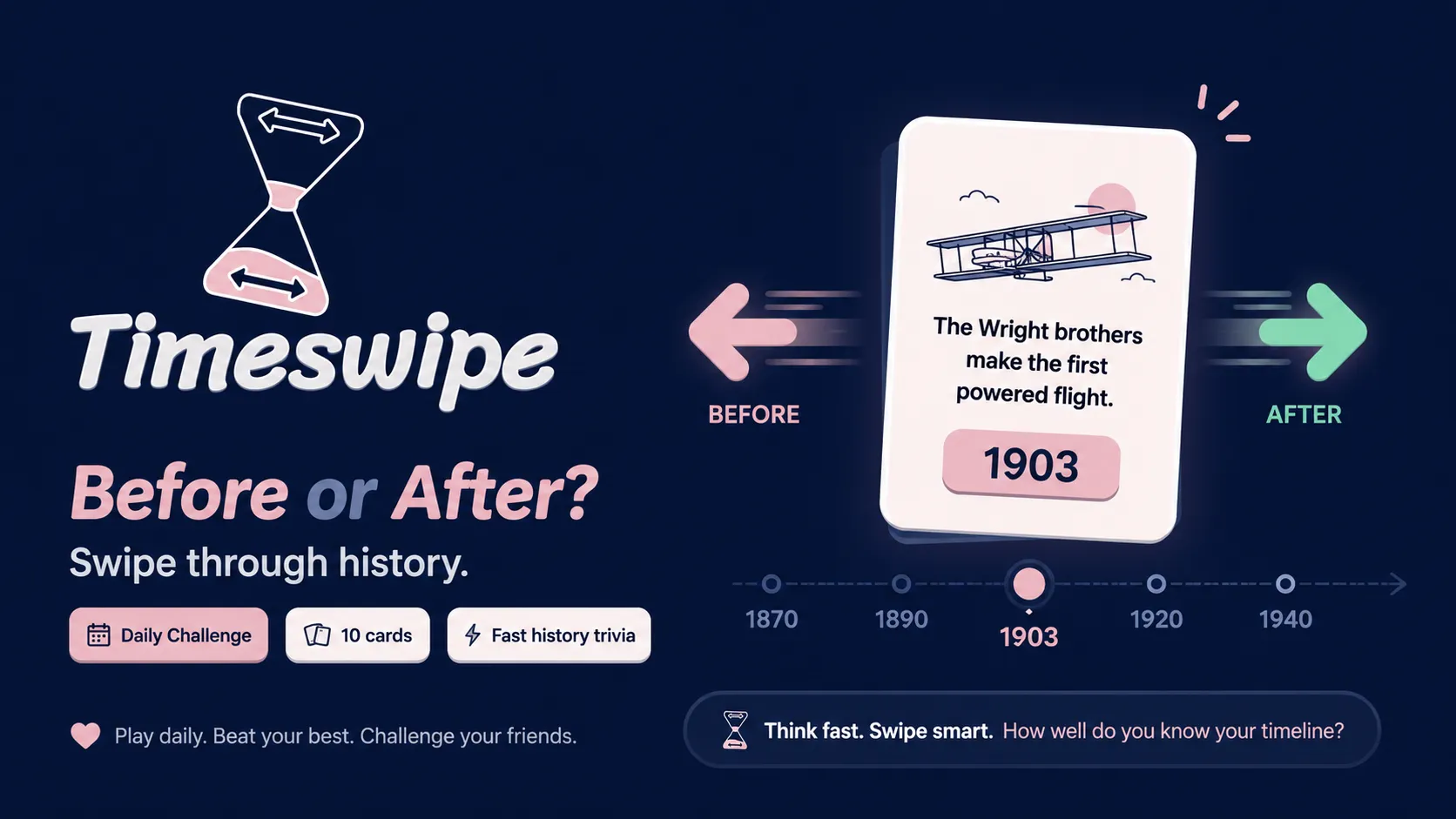
What is Timeswipe?
Timeswipe turns history into a split-second duel. Each card names an event, invention, cultural release, or famous moment alongside a reference year. Your job is to make one clean decision: did it happen before or after that year?
The choice sounds easy until the dates become dangerously close. You may know an event belongs to the 1960s without remembering which side of 1965 it falls on. The Daily Challenge gives every player the same 10 cards, making Timeswipe a quick test of memory, deduction, and whether you can resist second-guessing yourself.

Timeswipe Game Rules (The Catch / The Trap)
Every card follows the same rapid sequence:
EVENT + REFERENCE YEAR → BEFORE or AFTER → DATE REVEAL → NEXT CARD
- Read the event: Each card describes something that happened at a specific point in history.
- Study the reference year: This is not necessarily the event's real date—it is the dividing line for your decision.
- Choose Before or After: Swipe in the matching direction or use the available answer controls.
- One decision per card: Once submitted, your answer is LOCKED IN.
- Immediate result: The game shows whether your choice was correct and reveals the event's actual year.
- Ten daily cards: Everyone receives the same set in the Daily Challenge.
- Build your score: Correct answers increase your final result, which can be shared and compared with other players.
The trap is that Timeswipe does not ask for the exact date. It asks something psychologically worse: whether your uncertain memory is accurate enough to place the event on the correct side of one specific year.
Event: World War I ends
Reference year: 1915
Correct choice: AFTER → 1918
A three-year gap feels comfortable. A one-year gap can destroy a perfect run.
How To Play Timeswipe?
Step 1: Inspect the first card
Event: The Lion King is released in cinemas
Reference year: 2000
You remember the film as a major 1990s release.
Step 2: Make the swipe
Player chooses: ← BEFORE
Game response: Correct — 1994
What this means: Your answer earns credit, and the real year confirms how far the event sat from the dividing line.
Step 3: Face a closer call
Next event: World War I ends
Reference year: 1917
You know the war continued beyond 1917, so you commit to the later side.
Player chooses: AFTER →
Result: Correct — 1918
The answer was only one year away, but the direction was enough to survive.
Step 4: Complete the daily run
Continue through all 10 cards:
Card 1 ✓ Card 2 ✓ Card 3 ✗ ... Card 10 ✓
Once the final event is judged, Timeswipe totals your score and lets you compare or share the day's performance.
Timeswipe Strategy & Tips
Start by placing the event inside a broad era. Decide whether it belongs to the ancient world, industrial age, twentieth century, or digital era before comparing it with the displayed year.
Look for dependency clues. A movie cannot be released before its production technology existed, a treaty usually follows the conflict it resolves, and a product launch must come after the invention that made it possible.
Do not confuse the age of an object with the date of an event. An invention may have existed for decades before becoming popular, and a famous work may have been created long before its most recognizable adaptation.
Finally, trust strong memories and question vague ones. Timeswipe rewards directional certainty, not perfect recall. You do not need the exact year—you only need to land on the correct side of history.