
What Is Totally Normal Chess?
Totally Normal Chess is a free browser-based chess variant built around one deliberately abnormal idea: the rules do not stay fixed.
A game begins as recognizable standard chess. You have the familiar board and pieces, and normal chess knowledge is useful at first. Then, every three turns, a player chooses a new rule from a random selection. That rule becomes part of the game and can substantially change what happens next.
The official game describes possible rules that change how pieces move, cause explosions, summon new pieces, or even rewrite the board. The result is less about memorizing openings and more about repeatedly adapting to a position whose underlying rules keep evolving.
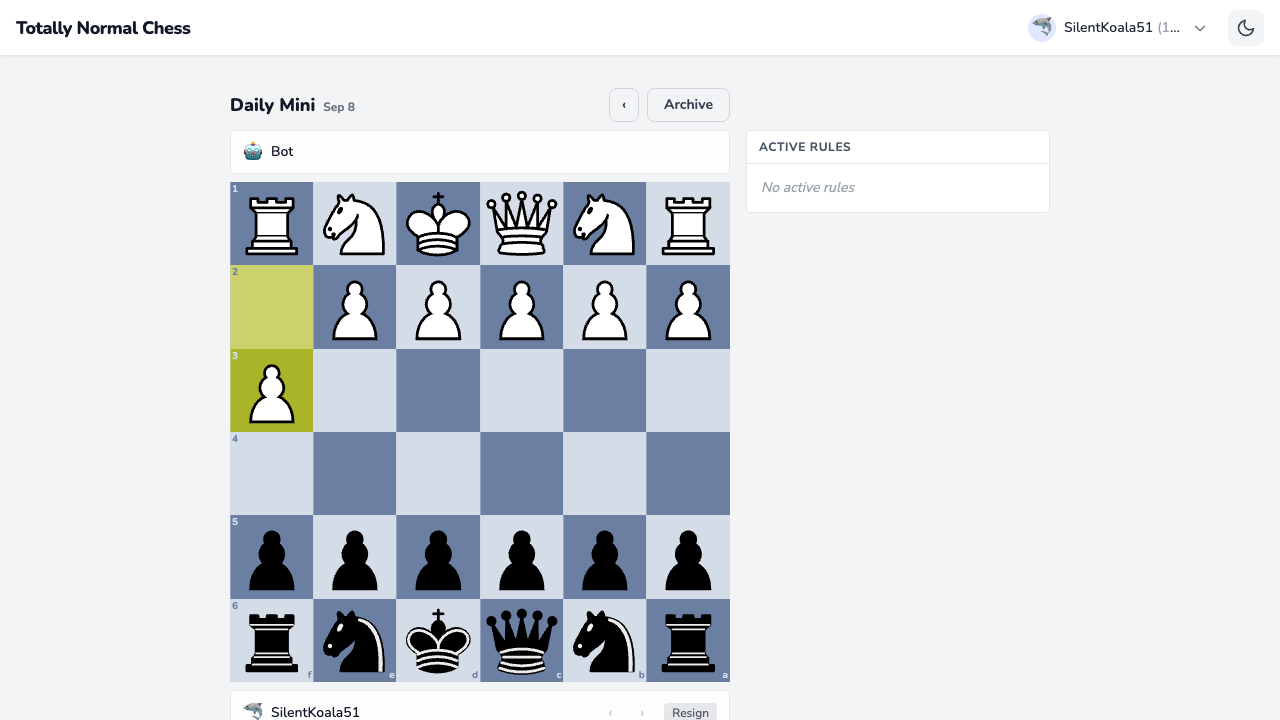
The site offers several ways to play, including playing a bot and inviting a friend, plus a separate Daily Mini mode.
The Core Twist: Chess Rules Keep Changing
The important difference from ordinary chess is that a position cannot be evaluated only by looking at the pieces currently on the board. You also need to understand the active rule changes.
A typical flow looks like this:
Normal chess → 3 turns → Choose a random new rule → Adapt → 3 more turns → Another rule change
For example, you might begin by developing pieces exactly as you would in a normal chess game. A later rule can change how a piece moves. Another can introduce an explosive effect or summon additional material. Once multiple changes accumulate, a position that originally looked strategically familiar can become completely different.
That unpredictability is the point: Totally Normal Chess rewards chess instincts, but it also rewards players who can abandon those instincts when the current rules demand it.
How to Play Totally Normal Chess
Start the game and make normal chess moves. At the beginning, treat the board like a conventional chess position: develop pieces, watch threats, and avoid giving away material unnecessarily.
Reach the next rule-selection interval. Every three turns, a player is presented with a random selection of new rules and chooses one to introduce into the game.
Read the new rule before planning your next move. Do not assume pieces still behave exactly as they did a few moves earlier. The new effect may alter movement, create explosions, summon pieces, or modify the board itself.
Re-evaluate the whole position and continue playing. Make moves using the rules that are now active, then prepare for the next three-turn interval and another possible disruption.
Because the rules can accumulate and reshape the match, two games can develop very differently even when they begin from the same standard chess setup.
Strategy Tips
Recalculate after every rule change
A strong-looking piece or safe-looking square can become much less valuable after a new rule appears. Treat each rule selection almost like the start of a new tactical puzzle.
Do not rely too heavily on standard opening theory
Normal development principles are useful while the board is still conventional, but long prepared opening lines become less reliable once movement rules and board effects begin changing.
Keep flexible options
When several moves look equally good, positions with multiple available pieces and escape routes can be safer than plans depending on one precise sequence. Future rules may disrupt that sequence immediately.
Read effects literally
The unusual rules are not cosmetic bonuses. They can alter the mechanics of the position, so understanding the currently active effects is often more important than applying ordinary chess pattern recognition.
Expect chaos
Explosions, summoned pieces, altered movement, and board-changing effects mean material advantages may not remain stable. Totally Normal Chess is best approached as an improvisational chess variant rather than a conventional competitive chess game with one small gimmick.