
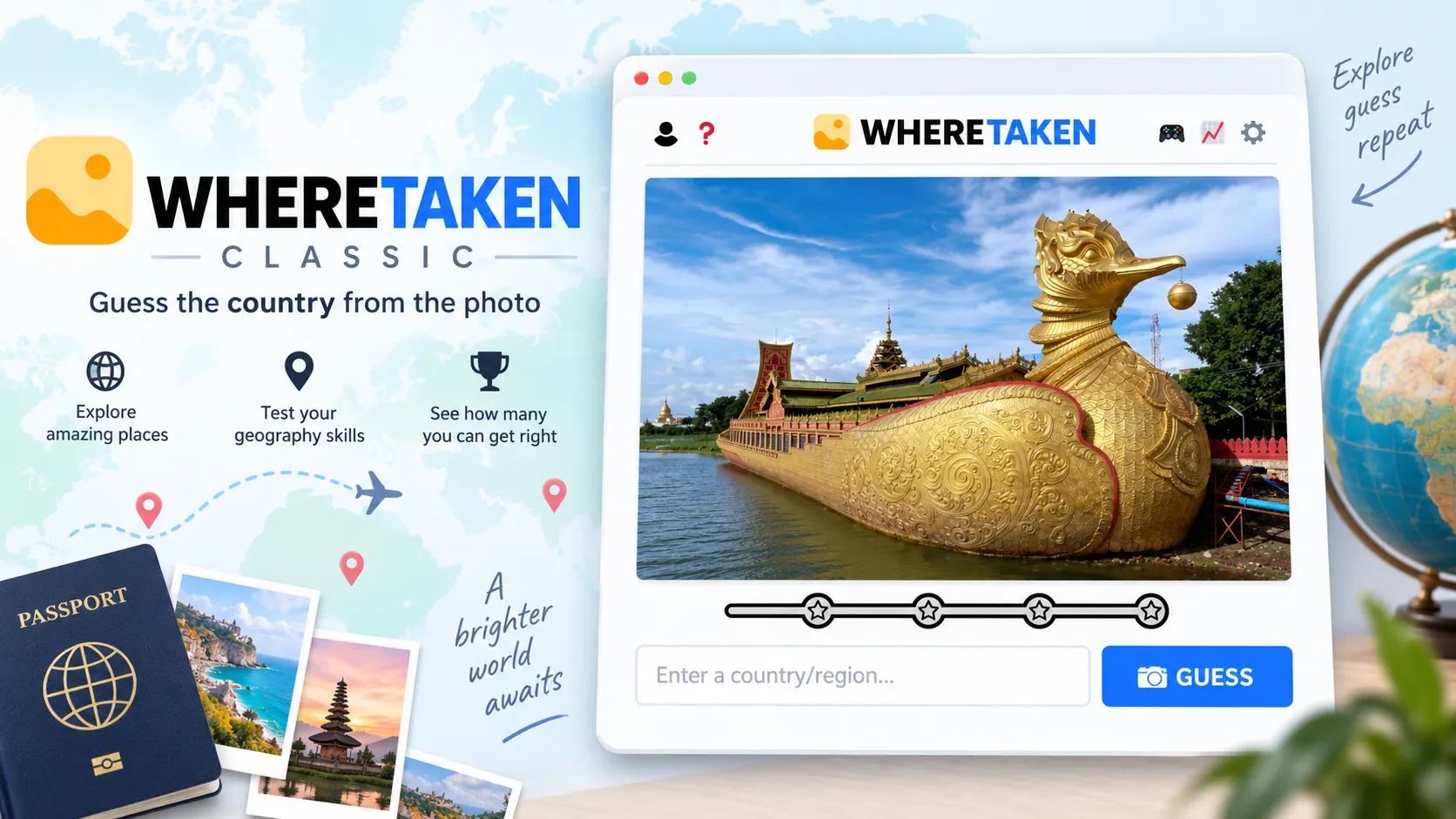
What Is WhereTaken Classic?
WhereTaken Classic is the original daily photo-based geography game from Teuteuf Games. Each day's main puzzle shows a photograph from a mystery country or territory and asks you to identify where it was taken.
The Classic version is different from the newer WhereTaken. Instead of placing a pin on a world map and earning points for precision, the main Classic round is a country-or-territory deduction game. After an incorrect guess, the game tells you how far your answer is from the target, shows an arrow pointing toward the correct location, and gives a proximity percentage.
A fresh puzzle becomes available every day at midnight according to your device's local time.
WhereTaken Classic Rules and Core Twist
The goal of the main round is simple: identify the country or territory shown in the photo.
What makes the puzzle useful rather than purely visual is the feedback after a miss:
- Distance: how far your guessed territory is from the target, measured between territory centers.
- Direction: an arrow pointing from your guess toward the correct country or territory.
- Proximity: a percentage that rises as your guess gets closer to the answer.
- Country list: valid answers follow the ISO 3166-1 country and territory list, so some familiar geographic names are represented under a larger sovereign state.
The loop looks like this:
Photo clues → country guess → distance + direction + proximity → refined guess
For example:
Coastal photo + Romance-language signs → Spain → 1,000+ km southeast → shift toward the central or eastern Mediterranean
The numbers will vary by puzzle, but the important part is combining the photograph with the geographic feedback instead of treating every guess as a fresh shot in the dark.
Finishing the main round unlocks the bonus sequence. The Classic game can then test related knowledge through landmark, capital/map, and city challenges. Bonus rounds are unlocked in order, so completing one opens the next.
How To Play WhereTaken Classic
- Study the photograph before guessing. Look for language, road signs, driving side, architecture, vegetation, terrain, coastlines, weather, and distinctive infrastructure.
- Enter a country or territory. Choose the place that best matches the visible clues and submit it.
- Read the feedback after a wrong guess. Use the distance, direction arrow, and proximity percentage together. A nearby result means your regional read may be right; a huge distance usually means you need to rethink the continent or hemisphere.
- Adjust geographically, not randomly. If your guess is west of the target, move east. If the distance is small, compare neighboring countries and territories rather than jumping across the map.
- Solve the country and continue into the bonus rounds. Once the main answer is correct, work through the unlocked landmark, capital/map, and city challenges for a longer daily session.
Bonus Rounds
WhereTaken Classic continues after the main photo puzzle with geography challenges tied to the day's country.
- Landmark round: identify the relevant landmark from a set of choices, then identify the landmark itself.
- Map round: work with the country's capital, including identifying it and locating it on a map.
- City round: use another photograph from a city in the target country and identify the city.
These rounds make WhereTaken Classic more than a single country guess. Players who solve the main image quickly still get extra geography and travel knowledge to test.
Strategy Tips
Start broad, then go narrow. Climate, road direction, alphabet, terrain, and architecture are usually better first-pass clues than a tiny shop sign you can barely read.
Use the arrow as a compass. If two countries both fit the image, the direction from your previous guess can eliminate one immediately.
Treat distance as scale information. A small distance suggests a neighboring country or territory, while a very large one is evidence that your original regional assumption was probably wrong.
Do not ignore territory answers. Islands and overseas territories can produce photos that look culturally connected to one country while being geographically far from it.
Finally, remember that WhereTaken Classic measures distance between territory centers rather than nearest borders. Two neighboring countries can therefore return a larger distance than their shared border might make you expect.
Is WhereTaken Classic Worth Playing?
WhereTaken Classic is a strong fit for players who enjoy GeoGuessr-style visual deduction but want a shorter, country-focused daily challenge. The combination of photography and directional feedback makes it approachable for casual geography fans while still rewarding players who notice small environmental and cultural clues.
Choose the Classic version if you prefer narrowing down a country through repeated guesses and geographic hints. Choose the newer WhereTaken if you would rather place precise pins on a map and be scored by how close you are to the photographed location.