What is Wikitrivia?
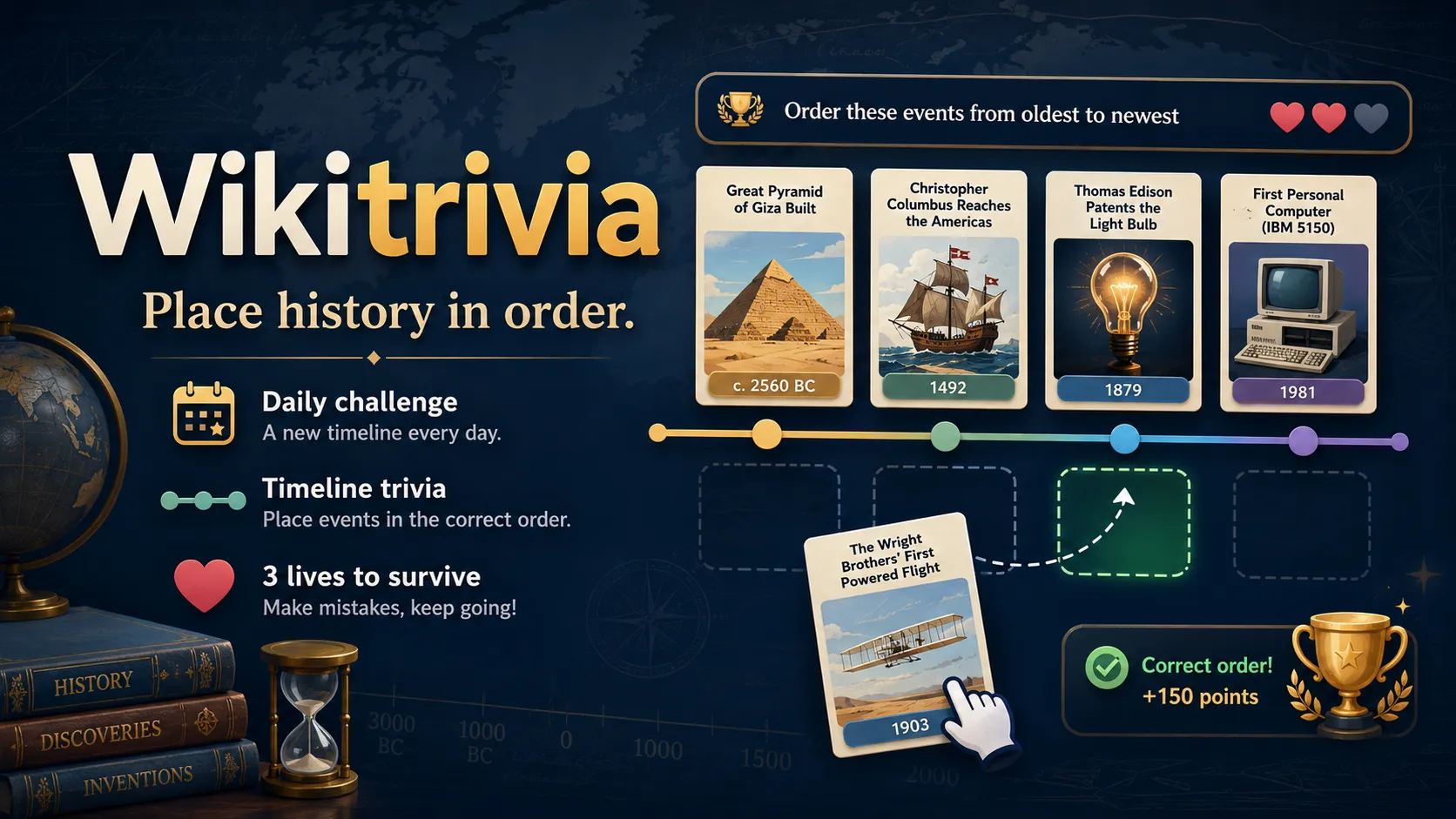
Wikitrivia takes the enormous, chaotic knowledge of Wikipedia and turns it into one deceptively simple challenge: where does this card belong in history? Each new card describes a person, event, invention, organization, or cultural milestone, and you must drag it into the correct position on an expanding timeline.
The longer you survive, the more dangerous the timeline becomes. Early decisions create useful anchors, but they also produce increasingly narrow gaps where later cards must fit. Wikitrivia offers both a shared Daily challenge and a Free Play mode, with its game data sourced from Wikidata and Wikipedia.
Wikitrivia Game Rules (The Catch / The Trap)
The core loop is:
NEW CARD → CHOOSE A GAP → DROP IT → GREEN or RED → NEXT CARD
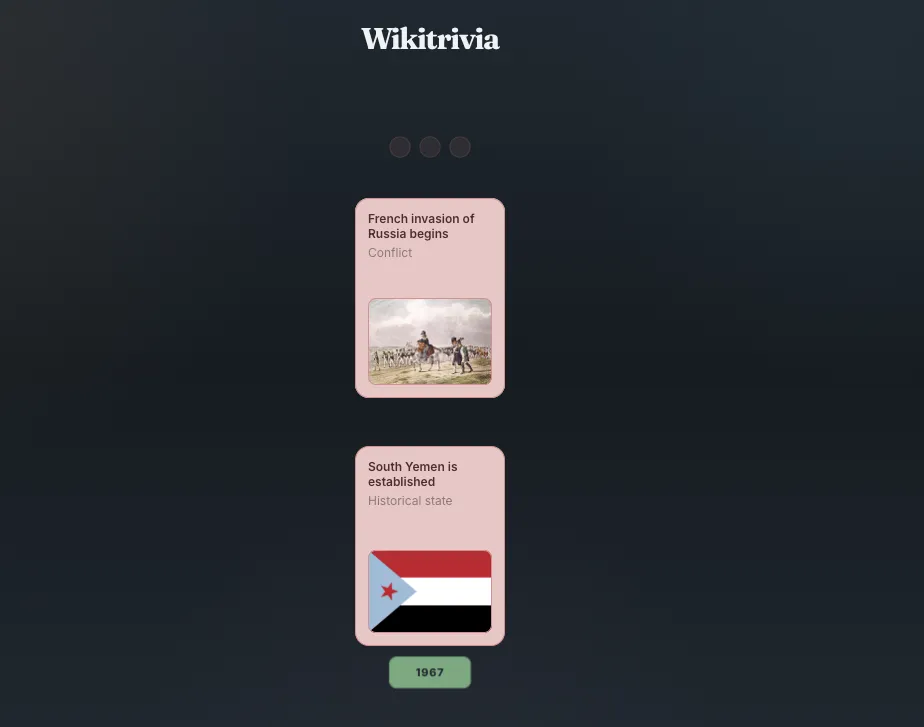
- Start with a dated anchor: The opening card gives your timeline a known point in history.
- Place one card at a time: Drag the new card before, after, or between the events already visible.
- Green means correct: The card remains in your chosen position and your streak grows.
- Red means incorrect: The card moves to its actual position and reveals where it truly belonged.
- Three mistakes end the game: Lose all three lives and the current Free Play run is over.
- Cards become anchors: Correct and corrected cards both help you judge every event that follows.
- Explore the source: Placed cards can provide access to more information about their subjects.
The trap is that Wikitrivia mixes completely unrelated topics. You might need to position an ancient kingdom, a rock band, a scientific discovery, and a website launch on the same timeline. Exact dates help, but survival mostly depends on understanding relative chronology.
How To Play Wikitrivia?
Step 1: Read the opening timeline
Existing anchor:
Moon landing — 1969
New card: Magna Carta signed
This one is safely medieval, so you drag it to the older side.
Step 2: Make the first placement
Player drops:
Magna Carta → Moon landing
Result: GREEN — Correct
What you learn: The Magna Carta card becomes a permanent anchor for everything that follows.
Step 3: Judge a modern event
New card: Wikipedia launched
Current timeline:
Magna Carta → Moon landing
You place Wikipedia after the Moon landing.
Result: GREEN — Correct
The timeline now stretches from medieval politics to the internet age.
Step 4: Fall into a narrow gap
New card: World Wide Web proposed
Player places:
Magna Carta → Moon landing → Wikipedia → World Wide Web proposal
Result: RED — Incorrect
The card automatically moves between the Moon landing and Wikipedia:
Magna Carta → Moon landing → World Wide Web proposal → Wikipedia
What this means: You lose one life, but the corrected event becomes a valuable new anchor.
Step 5: Protect the remaining lives
Continue placing cards while the timeline grows:
❤️❤️○ | Streak: 2 | Timeline expanding…
Survive by making careful comparisons. A third wrong placement ends the run.
Wikitrivia Strategy & Tips
Begin by identifying the broad era rather than hunting for an exact year. Ancient, medieval, industrial, twentieth-century, and internet-era labels are often enough to eliminate most gaps.
Use the nearest anchors. When placing an event from the 1990s, ignore the ancient cards and compare it with the modern events surrounding its likely position.
Look for dependencies. A company cannot launch before its founder is born, an adaptation usually follows the original work, and a technology must be invented before products based on it can appear.
Finally, learn from red cards. A mistake costs a life, but the corrected position strengthens your timeline. Treat every failure as a new clue rather than the beginning of panic.