How to Create a DLE Game That Players Actually Want to Replay
Learn how to create a fun DLE game with clear rules, strong clues, daily replay value, and a satisfying guessing loop.
Quick Answer
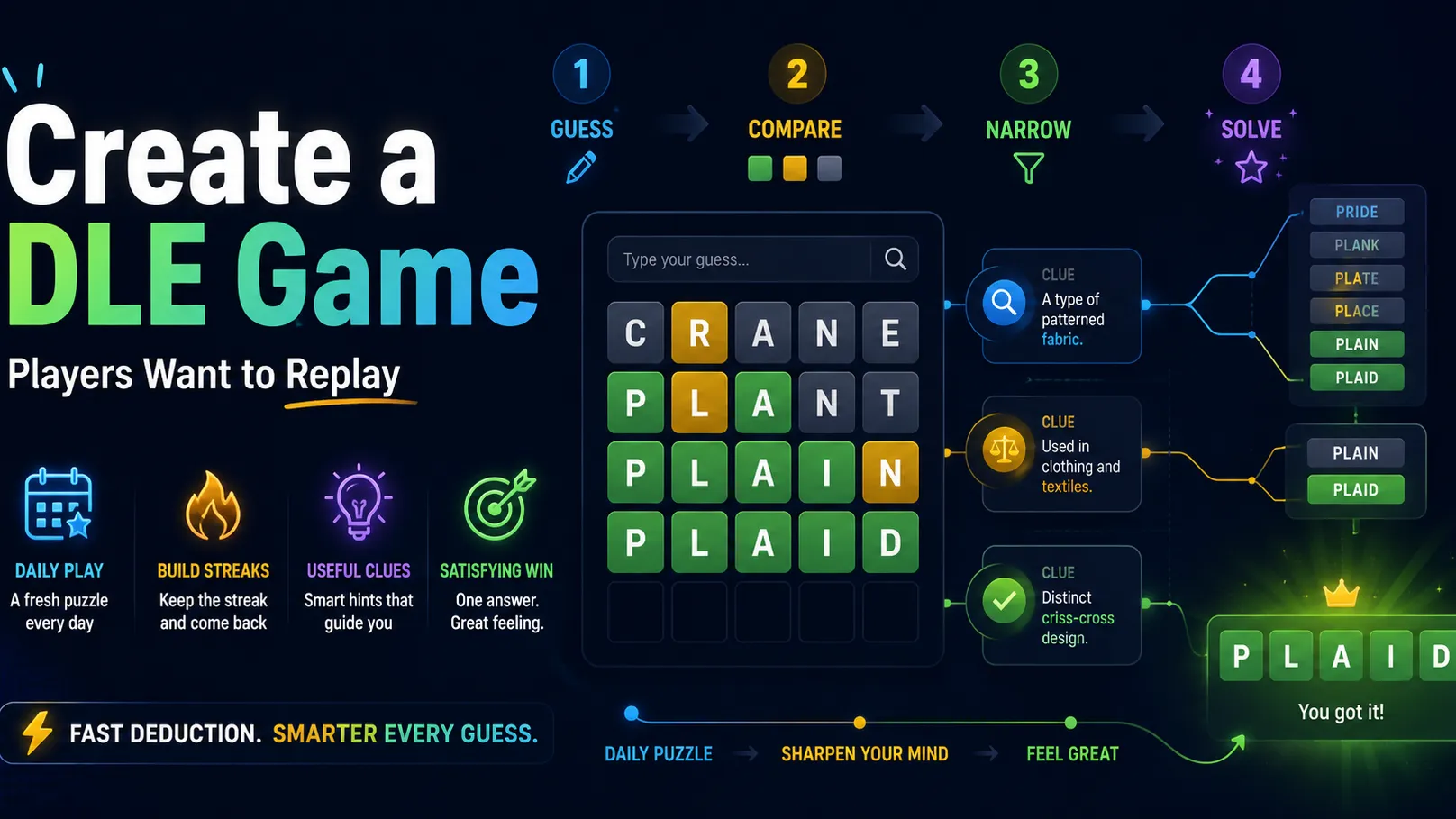
To create a DLE game, start with a simple daily guessing loop: players make a guess, receive clear feedback, narrow the answer space, and try to solve the mystery before running out of attempts.
The best DLE games are not just Wordle clones. They work because they have:
- One easy-to-understand goal
- Fast guesses
- Useful clues after every attempt
- A satisfying reveal
- A reason to come back tomorrow
A strong DLE game can be about words, countries, songs, movies, characters, colors, sports, games, or almost any topic with enough guessable answers.
What Is a DLE Game?
A DLE game is a daily guessing game inspired by Wordle-style puzzle design. The name usually ends in “dle” to signal that players are solving one hidden answer through repeated guesses and feedback.
The core idea is simple:
- There is a secret answer.
- The player makes a guess.
- The game gives clues.
- The player uses those clues to guess again.
- The puzzle ends when the player solves it or runs out of tries.
What changes from game to game is the subject. A DLE game might ask players to guess:
- A hidden word
- A country
- A movie
- A video game character
- A song
- A sports player
- A color
- A quote
- A ranked item
- A daily trivia answer
The format works best when players can say, “I was wrong, but now I know something useful.”
How To Create a DLE Game
Creating a good DLE game starts with the gameplay loop, not the name.
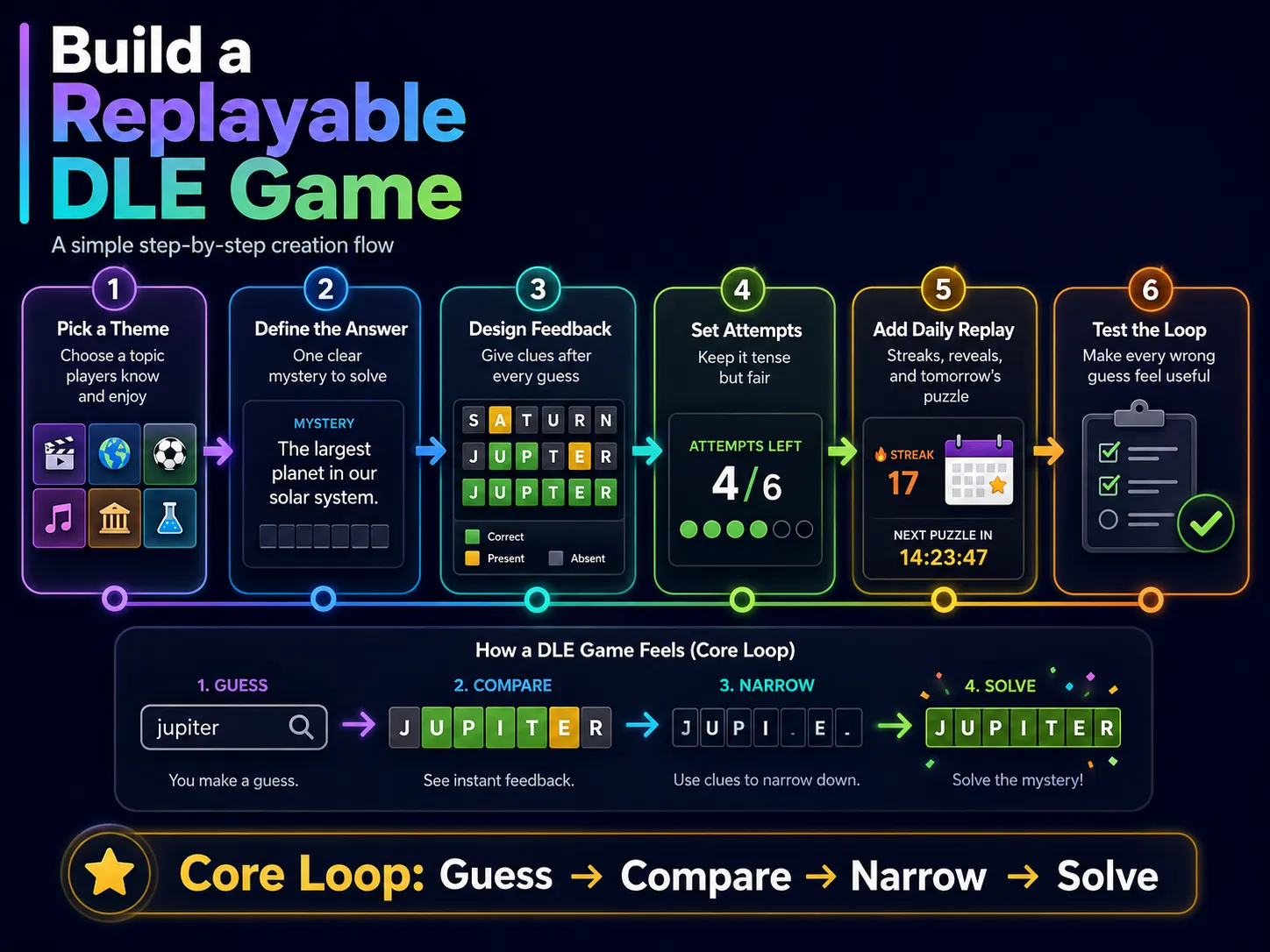
1. Pick a Guessable Theme
Choose a topic with enough recognizable answers. The theme should be specific enough to feel focused but broad enough to support many daily puzzles.
Good themes include:
- Movies: Guess the film from cast, year, genre, or screenshot clues.
- Music: Guess the song from lyrics, audio snippets, artist clues, or release year.
- Geography: Guess the country from distance, direction, flag, borders, or population.
- Gaming: Guess the character, weapon, map, franchise, or release year.
- Sports: Guess the athlete from team, position, nationality, stats, or era.
- Trivia: Guess a fact, rank, brand, object, or historical answer.
Avoid themes where only a tiny audience can make meaningful guesses. A niche can work, but the clues must help players learn their way toward the answer.
2. Define the Secret Answer
Every puzzle needs one clear correct answer.
Before designing the clues, decide exactly what players are trying to solve:
- A single word?
- A person?
- A place?
- A title?
- A number?
- A color?
- A ranked item?
The answer should not feel ambiguous. If two guesses could reasonably be correct, the puzzle will feel unfair.
For example, “guess the superhero” is clearer than “guess the strong character.” “Guess the 2010s animated movie” is clearer than “guess the cartoon.”
3. Build the Guess Feedback
The feedback system is the heart of any DLE game.
Players should get clues that are:
- Immediate after each guess
- Easy to read
- Specific enough to guide the next guess
- Not so strong that the answer becomes obvious too early
Common feedback types include:
- Green / yellow / gray matches: Great for word, category, and attribute games.
- Higher or lower arrows: Great for numbers, years, rankings, ages, stats, and prices.
- Distance and direction: Great for geography games.
- Similarity percentage: Great for color, music, image, or semantic guessing games.
- Attribute comparison: Great for characters, athletes, games, movies, and items.
- Unlocking clues: Great when you want the puzzle to reveal more information over time.
The best feedback tells players what changed. A wrong guess should never feel wasted.
4. Set the Number of Attempts
Most DLE games work well with 5 to 8 guesses.
Use fewer guesses when:
- The answer pool is small.
- The clues are very strong.
- The game is meant to be fast and tense.
Use more guesses when:
- The answer pool is large.
- The clues are subtle.
- The puzzle requires deduction across many attributes.
A good rule: players should usually feel pressure, but not feel doomed after one bad guess.
5. Make the First Guess Fun
The first guess matters because it teaches the player how the game works.
A strong DLE game makes the first move feel low-risk. Even a random guess should produce useful information.
Good first-guess design includes:
- A clear search box or answer list
- Autocomplete for valid guesses
- Instant clue feedback
- No penalty for typo-like invalid entries
- A simple explanation of what each clue means
If players need a tutorial before making one guess, the game is probably too complicated.
Best DLE Game Rules
A strong DLE game usually has rules like these:
- One puzzle per day to create routine and shareability.
- Limited guesses to create tension.
- Only valid answers allowed to prevent nonsense guesses.
- Clues after every guess so players can improve.
- A final reveal so players learn the answer even if they lose.
- Shareable results without spoiling the answer.
The rules should be short enough that a player can understand them in under 30 seconds.
What Makes a DLE Game Stand Out?
A DLE game stands out when its clues create a mini-detective story.
The player should think:
- “That guess was wrong, but now I know the answer is older.”
- “The category matches, but the region does not.”
- “The rank is close, so I need something nearby.”
- “The ability fits, but the character type is wrong.”
Good DLE games are not just about knowing the answer. They are about closing the trap around the answer.
The strongest versions usually have one special twist:
- A hidden daily theme
- Multiple clue modes
- A hard mode
- Streak tracking
- Progressive hints
- Visual clues
- Audio clues
- Attribute grids
- A leaderboard or XP system
- A spoiler-free share result
One twist is enough. Too many systems can make the game feel messy.
Tips for Designing Better Clues
Clues should reduce confusion, not create it.
Use these tips:
- Make every clue actionable. A clue should help players choose the next guess.
- Avoid trivia that is too obscure. Players should be able to reason, not just memorize.
- Show comparison clearly. Use icons, arrows, colors, or short labels.
- Balance obvious and subtle clues. Too easy gets boring; too vague feels unfair.
- Reveal stronger hints later. Early guesses should guide; late guesses should rescue.
- Keep the answer pool consistent. Do not mix wildly different types of answers unless the rules explain it.
A good clue system rewards both knowledge and deduction.
Common Mistakes To Avoid
Many DLE games fail because the idea is fun but the loop is unclear.
Avoid these mistakes:
- Too many categories: Players should not need a spreadsheet to understand the game.
- Weak feedback: “Close” is not enough unless players know close in what way.
- Ambiguous answers: Similar names, alternate spellings, and duplicate titles need careful handling.
- No valid guess list: Players get frustrated when correct-looking guesses are rejected.
- Overlong puzzles: Daily games should respect the player’s time.
- Random difficulty spikes: One impossible answer can break a streak and kill motivation.
- Spoiler-heavy sharing: Players should be able to share results without revealing the answer.
The goal is not to punish players. The goal is to make solving feel earned.
Example DLE Game Concepts
Here are several strong DLE-style ideas:
Character DLE
Players guess a hidden character. Each guess compares traits like role, universe, weapon, power type, gender, release year, or faction.
Best for: anime, games, comics, hero rosters, and franchise fandoms.
Movie DLE
Players guess a movie using clues like genre, release year, director, cast, runtime, box office rank, or screenshot fragments.
Best for: film fans who enjoy deduction and memory.
Geography DLE
Players guess a country or city. Feedback shows distance, direction, continent, population, flag colors, or border clues.
Best for: map lovers and daily trivia players.
Music DLE
Players guess a song or artist from short audio clips, lyrics, album year, genre, or popularity clues.
Best for: players who like fast recognition challenges.
Rank DLE
Players guess an item based on whether the secret answer ranks higher or lower in a category, such as popularity, revenue, population, speed, rating, or age.
Best for: quick, addictive guessing with simple feedback.
Difficulty: How Hard Should It Be?
The best DLE difficulty is easy to start, hard to perfect.
A casual player should understand the rules immediately. A skilled player should still have room to optimize guesses and protect their streak.
Good difficulty comes from:
- A large but fair answer pool
- Clues that narrow the field gradually
- A few smart traps
- Clear feedback after mistakes
- Optional hard modes for expert players
Bad difficulty comes from hiding basic information or relying on random obscure answers.
Who Is This Type of Game For?
A DLE game is best for players who enjoy:
- Quick daily puzzles
- Deduction from clues
- Streak-based challenges
- Guessing games with friends
- Trivia without long quizzes
- Fandom-specific knowledge tests
- “One more guess” tension
It is less ideal for players who want long sessions, complex strategy systems, or action-based gameplay.
Is a DLE Game Worth Making?
Yes, if the theme has a passionate audience and the clue system creates satisfying deduction.
A DLE game is worth making when:
- The answer pool is deep enough for daily play.
- Players can learn from wrong guesses.
- The puzzle can be finished in a few minutes.
- The game has a clear identity beyond “Wordle but with another topic.”
- Sharing results feels fun without spoiling the solution.
The format is simple, but the best examples succeed because they respect the player’s time.
Final Take
To create a good DLE game, focus on the loop: guess, compare, narrow, solve.
Pick a theme players care about. Give them clues that actually help. Keep the rules short. Make each wrong guess feel useful. Add a daily puzzle rhythm, a clean reveal, and a spoiler-free share result.
A great DLE game does not need to be complicated. It needs one sharp idea, fair clues, and that addictive moment where the player thinks, “Wait — I know what it is now.”