What is langle?
Langle drops you straight into a linguistic showdown: a handful of sentences appear in an unknown language, and your only weapon is your brain. Name the exact language before your five guesses vanish—or get a brutally honest closeness score that tells you just how warm (or ice-cold) your hunch was. It’s Wordle, but instead of green-and-yellow tiles, you’re battling global language families, geographic proximity, and sneaky minority tongues that look deceptively familiar.
What makes it dangerously addictive is the trap hidden in every wrong answer. That 47% score isn’t just a number—it’s a clue that forces you to pivot from Romance languages to something Slavic, or from European to an obscure African or Asian relative. With three fresh puzzles daily (easy → medium → nightmare mode packed with rare languages), Langle turns casual guessing into a high-stakes daily duel that polyglots and curious travelers can’t resist.
langle Game Rules (The Catch / The Trap)
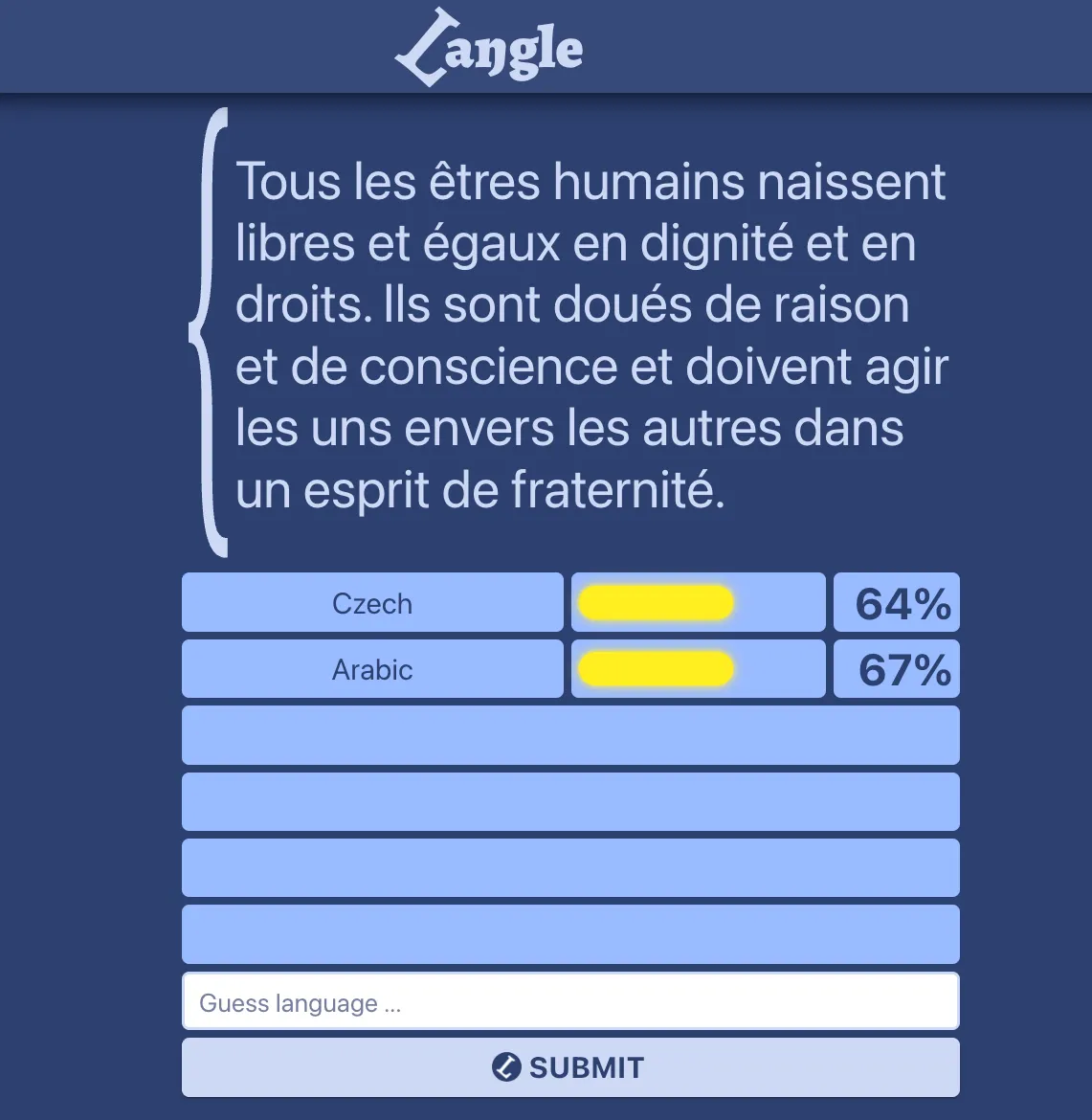
You’re shown several example sentences written entirely in the mystery language—no translations, no hints at first. Your job is to name the precise language.
- You have exactly five guesses to lock in the correct language.
- After every wrong guess, the game instantly reveals a closeness percentage (higher = closer) based on linguistic relatedness and geographic proximity.
- Wrong answers are LOCKED IN—you can’t reuse them, and each one narrows the field dramatically.
- Miss all five? You still get one final linguistic relatedness hint to learn what you almost caught.
- Three separate daily puzzles, increasing in difficulty: Level 1 (common languages), Level 2 (trickier), Level 3 (rare and minority languages that will humble even experts).
The catch? Languages that look similar on paper can be continents apart in the scoring system. One wrong guess can send you spiraling into entirely different language families—pure strategic chaos.
How To Play langle?
Step 1: Read the sentences
The screen shows 3–4 example sentences in the mystery language. Scan for script, word patterns, or familiar roots.
What you learn: First clues about possible regions or families (e.g., Latin-based words or Cyrillic script).
Step 2: Enter your first guess
Type any real language name (e.g., “Italian”).
Game response: If wrong → “68% closeness” plus the sentences remain visible.
What this means: Your guess is in the ballpark—maybe another Romance language is lurking nearby.
Step 3: Use the closeness score
Refine with the percentage. A 92% guess tells you you’re extremely warm; 12% means you’re in the wrong hemisphere.
Next constraint: Eliminate entire language branches and try something closer (e.g., switch from “Italian” → “Spanish” or even “Portuguese”).
Step 4: Lock in later guesses
Repeat with smarter picks. Each new percentage tightens the noose around the target.
Game response: Green success screen on the exact match—or the final relatedness hint if you run out of guesses.
Step 5: Celebrate or rage-quit
Share your score streak and move to the next daily level. Three puzzles, one sitting—easy to get hooked.
Strategy & Tips
- Start broad on Level 1 (major world languages) and get more surgical as difficulty ramps up.
- Pay attention to script and grammar in the sample text—it often screams “this is from the Indo-European family” or “definitely East Asian.”
- Treat the closeness % like a heat map: 80%+ means stay in the same family or region; below 30% means swing to a completely different continent.
- Save your best linguistic instincts for Level 3—those minority languages are the real bosses.