The NPR Daily Games List: How MapTap and TimeGuessr Made Linda Holmes' Playlist
Explore NPR's daily game picks from Linda Holmes, including MapTap and TimeGuessr, with rules, tips, difficulty, and which game to play first.
Quick Answer
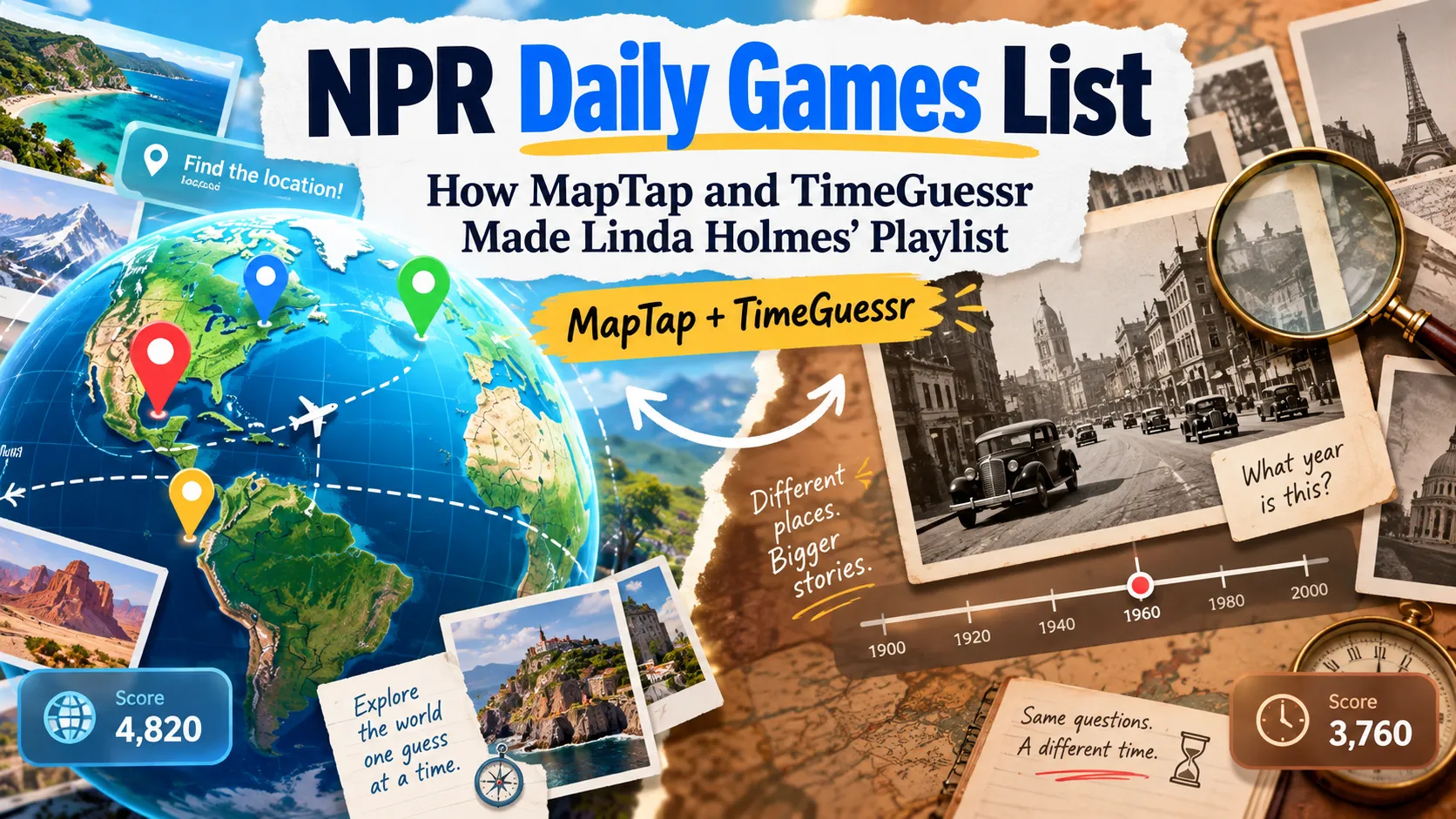
NPR pop culture correspondent Linda Holmes highlighted MapTap and TimeGuessr in a September 2026 roundup of five daily browser games worth adding to a puzzle routine. The complete list was MapTap, TimeGuessr, The Loop, Clues by Sam, and Catfishing.
MapTap and TimeGuessr are especially easy recommendations for players who like geography games because neither depends on memorizing trivia answers. MapTap tests where places are; TimeGuessr tests where and when photographs were taken. Both turn incomplete information into a short deduction challenge, and both can teach you something while you play.
If you only want to try one first, choose MapTap for fast spatial geography and TimeGuessr for deeper visual detective work.
What Is the NPR Daily Games List?
Linda Holmes' NPR roundup was aimed at daily-puzzle players looking beyond the familiar Wordle-and-crossword routine. Rather than sticking to one genre, the five selections cover geography, visual history, association puzzles, formal logic, and obscure knowledge.
The five featured games are:
- MapTap — locate a named place on an unlabeled 3D globe.
- TimeGuessr — estimate both the location and year of a historical or everyday photograph.
- The Loop — arrange 12 images in a circle so neighboring pictures have valid connections.
- Clues by Sam — solve a grid of suspects using only deductions that are already logically proven.
- Catfishing — identify a Wikipedia article from the categories attached to it.
That variety is important. This is less a ranking of the biggest puzzle sites than a collection of games with simple rules, short sessions, and a strong daily-play hook.
MapTap: What Is It?
MapTap is a daily geography game built around an unusually simple question: Can you point to a location without political borders helping you?
A location such as a city is named, and you rotate a 3D globe before tapping where you believe it is. The game then reveals the actual position and measures how close your guess was. A standard daily round contains five locations.
That missing-border design is what makes MapTap harder than it first appears. Knowing that Regina is in Saskatchewan, for example, does not automatically mean you can accurately place Regina on a satellite-style view of North America.
MapTap has also expanded beyond its basic daily puzzle with practice options involving countries, capitals, flags, cities, borders, landmarks, and other geography categories.
How to Play MapTap
- Read the target location carefully. Make sure you know whether you are looking for a city, region, landmark, or other place.
- Start with the continent. Get the largest geographic decision right before worrying about precision.
- Rotate the globe to a familiar orientation. Coastlines are much easier to recognize when north and south feel natural.
- Use physical geography as your reference system. Look for coastlines, peninsulas, islands, mountain ranges, lakes, and other shapes.
- Tap your best estimate. Your result is based on how close you were to the actual location.
- Study the reveal. The correction is part of the game. Remembering where you missed is how MapTap becomes easier over time.
Useful MapTap Tips
Use Coastlines Before Imaginary Borders
Political maps train players to recognize countries by outlines. MapTap removes that shortcut. Instead, build your guess around visible structures such as the Mediterranean, Great Lakes, Korean Peninsula, Persian Gulf, or major island chains.
Estimate Latitude First
Players often make larger north-south mistakes than they realize. Before choosing an exact longitude, ask whether the destination should sit roughly alongside another city whose latitude you already know.
For example, knowing that much of Western Europe sits farther north than many players intuitively expect can prevent large misses.
Learn Anchor Cities
You do not need to memorize every city. A network of anchors is more useful:
- London
- New York
- Mexico City
- São Paulo
- Cairo
- Cape Town
- Dubai
- Delhi
- Singapore
- Tokyo
- Sydney
Once those are mentally fixed, unfamiliar destinations can be estimated relative to them.
Review Bad Guesses Instead of Ignoring Them
A miss of hundreds or thousands of kilometers is more educational than a lucky near-perfect tap. Look at whether the mistake came from latitude, longitude, continental scale, or confusion between similar coastlines.
TimeGuessr: What Is It?
TimeGuessr adds another dimension to geography guessing: time.
Each puzzle begins with a photograph. You must decide where the picture was taken and estimate its year. Daily challenges contain five rounds, with separate location and year scoring contributing to the final result.
Photos can depict famous historical moments, but they can also show ordinary streets or everyday life. That means recognition helps, but it is not required. The core skill is extracting evidence from the photograph.
How to Play TimeGuessr
For every image, solve two connected problems.
1. Estimate the Location
Look for:
- Written language
- Storefront signs
- Road markings
- License plates
- Traffic direction
- Architecture
- Public transport
- Landscape and vegetation
- Utility poles and street furniture
Do not immediately jump from one clue to an exact city. First determine a likely region, then country, then city if enough evidence exists.
2. Estimate the Year
Use clues such as:
- Cars and buses
- Clothing
- Hairstyles
- Advertising design
- Camera and film characteristics
- Building condition
- Technology visible in the scene
- Political signs or public figures
- Infrastructure
Then place your estimate on the timeline and submit the round.
Useful TimeGuessr Tips
Separate Location Clues From Date Clues
A 1970s-looking photograph does not tell you where it was taken. Spanish text does not tell you when it was taken. Treat geography and chronology as two independent investigations before combining them.
Cars Are Excellent Chronological Anchors
Vehicles often narrow a photograph to a useful time window. Even if you cannot identify an exact model, the overall proportions, headlights, body styling, and prevalence of certain vehicle types can distinguish the 1950s from the 1970s or the 1990s from the 2010s.
Watch for Misleading Historical Context
An old building does not necessarily mean an old photograph. Likewise, traditional clothing can survive for decades. Prefer clues that change relatively quickly, such as cars, advertisements, electronics, road design, or contemporary hairstyles.
Read Every Visible Word
A tiny sign may be more valuable than the dominant landmark. Language identifies regions, domain names can indicate countries, phone-number formats may narrow locations, and business names can reveal cities.
Use Ranges Before Exact Years
Instead of immediately thinking "1962," start with something like late 1950s to mid-1960s. Then use secondary details to narrow the window.
This prevents one dramatic but ambiguous clue from dominating your entire estimate.
MapTap vs. TimeGuessr
| Feature | MapTap | TimeGuessr |
|---|---|---|
| Main skill | Spatial geography | Visual deduction |
| Geography required | High | Medium to high |
| History knowledge | Low | Helpful |
| Main input | 3D globe | Photograph, map and timeline |
| Daily format | 5 locations | 5 photographs |
| Typical thought process | "Where is this place?" | "Where and when was this?" |
| Best clues | Coastlines and relative position | Text, cars, clothing, architecture |
| Learning value | Builds mental maps | Builds historical and geographic awareness |
| Better for quick play | MapTap | — |
| Better for detective-style puzzles | — | TimeGuessr |
The important distinction is that MapTap tests geographic recall directly, while TimeGuessr lets you reconstruct an answer from evidence.
A player can therefore be weak at memorized geography and still become very good at TimeGuessr through observation.
Why Did These Two Games Fit Linda Holmes' List?
The common thread is not simply that the games are difficult. Both create the feeling that repeated play can improve your understanding of the world. MapTap exposes gaps in familiar geography, while TimeGuessr turns signs, clothing, vehicles, hairstyles, architecture, and other details into evidence.
That gives both games several qualities that work particularly well in a daily-game routine:
- The rules can be understood immediately.
- A round does not require a major time commitment.
- Every puzzle contains uncertainty.
- Scores make improvement visible.
- Players learn from the answer reveal.
- Success depends on reasoning rather than random guessing alone.
They also complement each other unusually well. MapTap builds the geographic framework that can later make TimeGuessr location guesses more accurate, while TimeGuessr teaches players to notice cultural and historical details that a conventional map quiz ignores.
Who Should Play MapTap?
MapTap is the stronger choice if you:
- Like GeoGuessr-style geography but want much shorter sessions.
- Want to improve your mental map of the world.
- Enjoy score chasing and incremental improvement.
- Prefer puzzles with very little reading.
- Want something that works well as a quick daily routine.
- Know countries and capitals but are unsure where they actually sit geographically.
It can be frustrating for absolute geography beginners, but that difficulty is also the point: incorrect guesses quickly reveal where your mental map needs work.
Who Should Play TimeGuessr?
TimeGuessr is better if you:
- Enjoy historical photographs.
- Like visual detective games.
- Notice small environmental details.
- Enjoy GeoGuessr but want more than geographic clues.
- Like history without wanting a conventional trivia quiz.
- Prefer puzzles where several weak clues combine into one strong answer.
It is especially satisfying for players who like explaining why an answer is plausible rather than simply knowing it.
What About the Other NPR Picks?
The rest of the list covers very different puzzle styles.
The Loop is the most approachable association puzzle. You arrange 12 illustrations so that every neighboring pair shares some connection. A picture can connect through words, meaning, appearance, or another association.
Clues by Sam is for stricter logic players. Its key twist is that being correct is not enough: the game expects each decision to be justified by the clues currently available.
Catfishing is the hardest recommendation in the group. It asks you to identify a Wikipedia page from its category labels, turning broad cultural knowledge and obscure associations into a deduction game.
Taken together, the five games make a useful mini-playlist: geography with MapTap, history and observation with TimeGuessr, associations with The Loop, deduction with Clues by Sam, and deep knowledge with Catfishing.
Final Take
The NPR list is worth exploring because it points toward a broader generation of daily games that do more than imitate Wordle.
Start with MapTap if you want the simplest rules and the fastest feedback loop. Five locations are enough to expose surprising gaps in your world geography, and repeated play can noticeably improve spatial knowledge.
Start with TimeGuessr if you want the richer puzzle. Every photograph can become a miniature investigation involving language, architecture, transportation, fashion, politics, technology, and history.
For players building a daily-game rotation, the strongest combination is actually to play both: MapTap trains where things are; TimeGuessr trains you to recognize what a place and period look like.