One-Word Movie Clues vs Poster Spoilers: Why Text-Only Daily Film Quizzes Are Rising
Learn how text-only daily movie quizzes work, why one-word clues change the challenge, and how to solve films without poster or screenshot spoilers.
Quick Answer
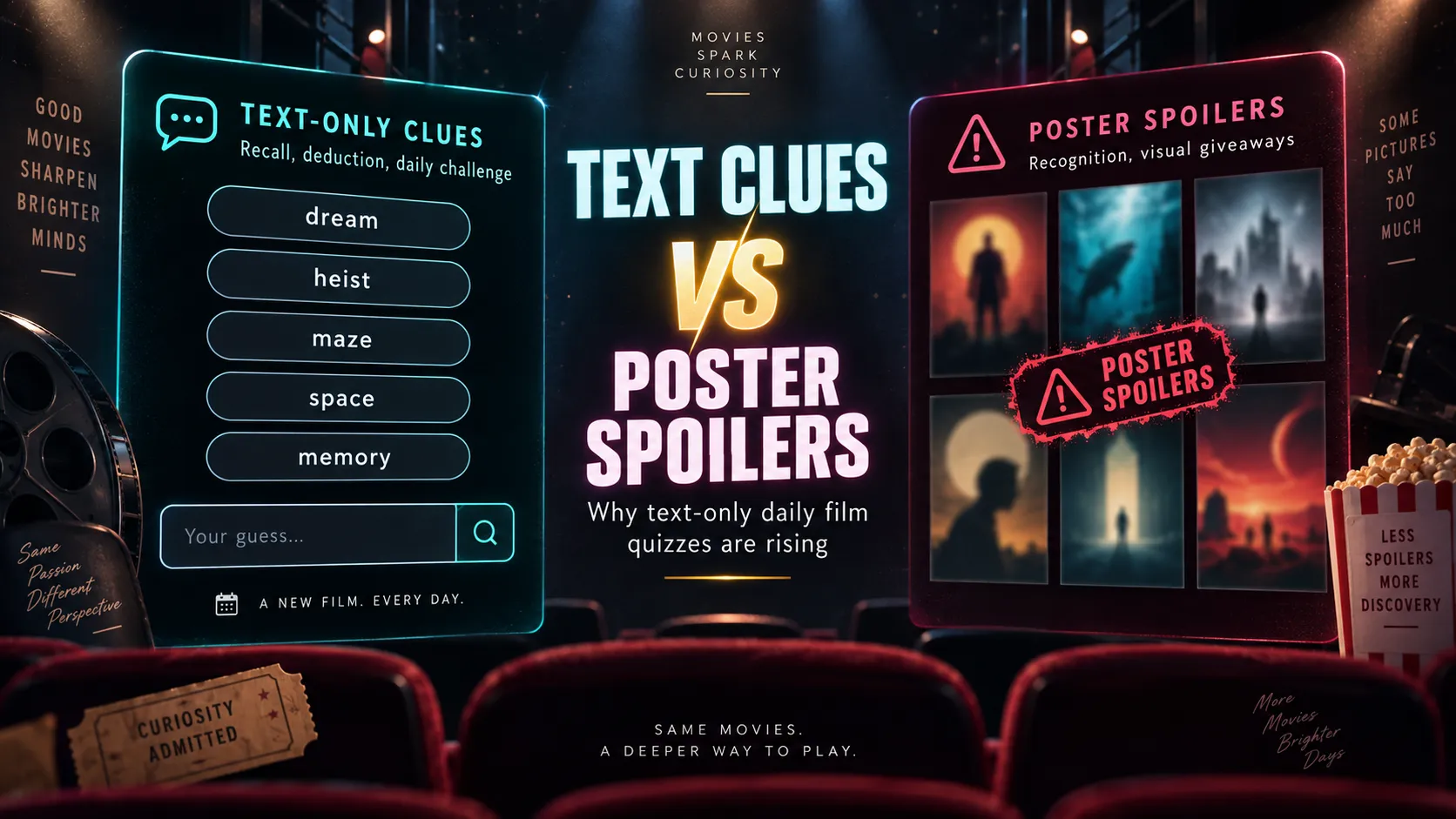
Text-only daily movie quizzes ask you to identify a film from words, facts, quotes, cast clues, themes, or progressively revealed hints instead of immediately showing a poster or screenshot.
The appeal is simple: text clues make you recall a movie rather than merely recognize its artwork.
A poster can accidentally reveal an actor, costume, logo, color scheme, setting, or franchise before you have done much deduction. A clue such as dream, heist, or gravity, however, gives you information without handing you the visual identity of the movie.
That creates a different kind of game. You start with a wide field of possibilities, interpret deliberately ambiguous clues, make a guess, and use later clues to narrow the answer.
For players who enjoy film knowledge, deduction, and short daily puzzles, the text-first format can feel more satisfying than simply recognizing a familiar image.
What Is a Text-Only Daily Movie Quiz?
A text-only movie quiz hides the day's film behind written information rather than key art or footage.
Depending on the game, you might receive:
- One-word clues
- Plot concepts
- Genres
- Release-year information
- Director clues
- Cast names
- Character names
- Quotes
- Country or language
- Title length
- Box-office information
- Progressively revealed synopsis words
The puzzle usually starts vague and becomes easier after each incorrect guess or manual clue reveal.
For example, a fictional puzzle could unfold like this:
Clue 1: dream
That could describe dozens of films.
Then:
Clue 2: heist
Now the answer space becomes much smaller.
Then:
Clue 3: Nolan
At this point, Inception becomes the obvious candidate.
The challenge is deciding how early you are confident enough to submit.
Why One-Word Clues Work So Well
A good one-word clue is informative without being definitive.
Consider:
island
Possible answers might include Shutter Island, Cast Away, Jurassic Park, The Menu, or dozens of other films depending on context.
Now add:
dinosaur
The possible field collapses dramatically.
One-word clues work because each word creates a conceptual filter rather than a direct description.
You are repeatedly asking:
Which movies fit all of the clues at the same time?
That intersection is the puzzle.
Recognition vs Recall
Poster-based and text-based movie games test overlapping but different abilities.
A poster quiz often tests recognition.
You see an image and think:
I have seen that face, costume, typography, or composition before.
A text-only quiz relies more heavily on recall.
You see:
space
cornfield
time
and must retrieve Interstellar from your memory without its famous imagery being placed directly in front of you.
Neither format is inherently better. They simply reward different kinds of film knowledge.
Why Posters Can Become Accidental Spoilers
Movie posters contain far more information than they initially seem to.
Even when a game blurs or crops the image, players can use:
- Actor silhouettes
- Costume colors
- Franchise branding
- Typography
- Famous props
- Character positioning
- Background locations
- Studio visual language
- Dominant color palettes
Imagine a superhero poster containing a partially visible red-and-blue suit.
The intended clue might be the overall composition, but the costume alone can reduce the answer space to a handful of films.
Or imagine seeing a fedora, whip, desert background, and 1980s poster typography. Even aggressive cropping may leave enough visual information for an experienced player to identify Indiana Jones immediately.
Text clues give puzzle creators more control over exactly how much information is revealed at each stage.
Text Clues Create a Cleaner Difficulty Curve
Progressive movie quizzes work best when every clue noticeably changes the puzzle.
A well-designed sequence might look like:
Clue 1: memory
Clue 2: tattoo
Clue 3: reverse
Clue 4: Nolan
The early clues reward film knowledge and lateral thinking. Later clues provide a safety net for casual players.
With images, controlling difficulty can be harder. One supposedly difficult crop may immediately reveal the movie to someone who remembers a distinctive costume or actor.
Text allows the designer to reveal information deliberately:
theme → plot element → character → actor → director → year
That produces a predictable progression from hard to easy.
How to Play One-Word Movie Clue Games
The exact rules differ between games, but the optimal thought process is similar.
Step 1: Treat the First Clue as a Category, Not an Answer
Suppose the first clue is:
ocean
Do not immediately guess Jaws just because it is the first famous ocean movie that comes to mind.
Create a small mental shortlist instead:
- Jaws
- Finding Nemo
- Titanic
- Cast Away
- The Abyss
- Moana
- Life of Pi
The first clue usually establishes a broad semantic area.
Step 2: Intersect the Next Clue
Now imagine the second clue is:
shark
Your original shortlist changes dramatically.
Jaws becomes strong, but you might still consider The Meg, Deep Blue Sea, or another shark film.
Do not ask whether each clue individually fits your guess.
Ask whether your candidate explains all clues better than its alternatives.
Step 3: Look for the Most Discriminating Clue
Not every clue has equal value.
Consider:
space
father
corn
The first two describe many movies. corn is much more unusual and therefore carries more information.
Rare clues should receive greater weight than generic ones.
Step 4: Decide Whether an Early Guess Is Worth the Risk
Many daily games reward solving with fewer clues.
That creates a risk decision.
If your current candidates are:
- Inception: 70%
- Paprika: 15%
- The Matrix: 10%
- Other: 5%
an aggressive player might guess immediately.
If your confidence is only 30%, taking another clue is usually smarter unless wrong guesses carry little penalty.
A Practical Example
Imagine today's clues appear one by one.
Clue 1
hotel
Possible movies include:
- The Shining
- Psycho
- Lost in Translation
- The Grand Budapest Hotel
- Home Alone 2
No strong guess yet.
Clue 2
writer
Now The Shining becomes more interesting because Jack Torrance is a writer.
But it is still not certain.
Clue 3
maze
That is much more discriminating.
The combination becomes:
hotel + writer + maze
At this stage, The Shining is a high-confidence answer.
Notice that none of the clues alone gives away the movie. Their intersection does.
That is what makes the format satisfying.
The Best Way to Think About Clues
Instead of brainstorming random movie titles, classify each clue.
A clue usually belongs to one of several types.
Setting
Examples:
desert
space
school
island
hotel
Setting clues are useful for establishing a broad category but are rarely enough by themselves.
Object
Examples:
ring
whip
mask
phone
car
Objects can be extremely valuable if they are strongly associated with one film.
Theme
Examples:
revenge
memory
identity
family
grief
Themes are deliberately broad. Use them to support another clue rather than as your primary evidence.
Plot Action
Examples:
heist
escape
rescue
survive
investigate
These often reduce the answer space faster than abstract themes.
Character or Role
Examples:
detective
astronaut
teacher
boxer
assassin
Roles become particularly powerful when combined with a setting or object.
Production Clue
Examples might identify a director, actor, release decade, country, studio, or award.
These clues are normally much stronger because they describe metadata rather than interpretation.
If a director appears, strongly prioritize films that also explain all earlier narrative clues.
Use Information Value, Not Clue Order
Players often assume that later clues are automatically more important.
That is usually true in progressive games, but not always.
Suppose you have:
crime
Los Angeles
1994
briefcase
The word briefcase may be more useful than crime, even if both appeared early.
A useful question is:
How many movies would still fit if this were the only clue I had?
The fewer possible answers, the more valuable the clue.
Build a Shortlist Instead of Guessing Randomly
One of the biggest differences between strong and weak players is shortlist management.
After two or three clues, aim to hold only a few candidates in mind.
For example:
robot
future
police
Possible shortlist:
- RoboCop
- Terminator 2
- Blade Runner
Now test each new clue against those candidates.
If the next clue is:
Detroit
RoboCop becomes overwhelmingly stronger.
This is much more efficient than producing a completely new movie after every clue.
Do Not Overfit a Single Clever Connection
Movie fans are very good at finding explanations after they have committed to an answer.
Suppose the clues are:
water
family
blue
You think of Avatar: The Way of Water and suddenly every clue seems perfect.
But water, family, and blue are all broad concepts.
A better strategy is to ask:
Could five other famous movies also fit these clues?
If the answer is yes, your confidence should remain low.
Wait for something more discriminating.
Proper Nouns Are Usually Powerful Clues
A clue such as:
Paris
can be broad.
But:
Gotham
immediately narrows the field to Batman-related movies.
Likewise, named characters, fictional locations, historical events, or uncommon professions can dramatically reduce uncertainty.
When a clue feels unusually specific, use it as an anchor and reinterpret the earlier broad clues around it.
Think in Movie Families
If you cannot identify the exact title, try identifying the family first.
For example:
wizard
school
scar
You may immediately know the answer belongs to the Harry Potter series even if you cannot yet determine the installment.
Now your task is no longer:
Which of thousands of movies is this?
It becomes:
Which Harry Potter movie best fits the remaining clues?
The same strategy works for:
- Marvel
- Star Wars
- James Bond
- Mission: Impossible
- Fast & Furious
- Pixar
- Disney animation
- Batman
- Spider-Man
- Jurassic Park
Reducing the problem to a franchise is already major progress.
Watch for Sequel Traps
Franchise recognition creates another common failure mode.
Clues such as:
dinosaurs
island
escape
might identify the Jurassic franchise without telling you whether the answer is Jurassic Park, The Lost World, Jurassic World, or another entry.
Do not submit the franchise's most famous title automatically.
Look for sequel-specific information such as:
- New locations
- New characters
- Specific villains
- Release year
- Director
- Distinct plot events
Daily movie quizzes frequently become difficult precisely because several films share the same universe and imagery.
Why Text-Only Quizzes Feel More Spoiler-Safe
There are two different meanings of spoiler here.
The first is puzzle spoilers. A recognizable poster may reveal the answer too quickly.
The second is movie spoilers. A carefully chosen one-word clue can reference a film without displaying a major scene, character reveal, death, monster, or late-story visual.
This makes text particularly useful for players who enjoy movie trivia but have not necessarily watched every film represented in the game.
Of course, badly written clues can still reveal plot information. Good daily games therefore tend to begin with broad concepts and reserve specific details for later hints.
Why Text-First Movie Games Work Well on Mobile
Daily puzzles compete for a very small amount of attention.
Text-first interfaces can be extremely lightweight:
clue → guess box → next clue → result
There is no need to wait for a video clip, inspect a tiny poster crop, or distinguish subtle visual details on a phone screen.
That makes the format comfortable for quick sessions during a commute, lunch break, or daily puzzle routine.
It also makes the puzzle easier to replay mentally. Players can discuss clues such as dream, heist, and snow without needing to send screenshots of the original image.
Why Daily Film Quizzes Are Moving Beyond Posters
Visual identification remains one of the most intuitive movie-game formats, but the broader daily-game ecosystem increasingly supports many different clue systems.
Modern movie puzzles may use:
- Progressive written clues
- Quotes
- Cast connections
- Release-year comparisons
- Genre feedback
- Semantic word matching
- Hidden synopsis words
- Title-length patterns
- Actor chains
- Director relationships
The reason is replayability.
There are only so many ways to blur a movie poster. Textual and metadata-driven mechanics create much more room for different styles of deduction.
They can test whether you know what happens in a movie, who made it, who appears in it, or what concepts define it, rather than simply whether you remember its artwork.
Useful Tips for Better Scores
Delay Your First Guess When the Clue Is Generic
Words such as love, family, war, city, or death describe enormous numbers of films.
Unless incorrect guesses are free, wait for another clue.
Guess Earlier on Rare Combinations
dream + heist
is much stronger than:
dream + love
The rarer the combination, the safer an early guess becomes.
Separate Certainty From Familiarity
The first movie you remember is not necessarily the most likely answer.
Famous titles come to mind more easily, creating a bias toward blockbusters.
Always test your candidate against every clue.
Use Release Information Aggressively
If a game provides year, decade, genre, director, or country feedback, treat it as hard evidence.
A thematic clue may be debatable. A release year is not.
Save Strong Hints When Scoring Rewards Early Solves
If revealing another clue lowers your score, do not automatically click through every available hint.
Spend a few seconds building candidates first.
The enjoyable tension comes from deciding when your current evidence is sufficient.
Learn From the Reveal
When you fail a puzzle, do not immediately close the page.
Review the clue sequence and ask when the answer should realistically have become identifiable.
This helps you learn how that particular game's clue writer thinks, which can improve future results.
Poster Quizzes Are Still Better for Some Players
Text-only does not replace visual movie games.
Poster and screenshot quizzes are better if you enjoy:
- Cinematography
- Production design
- Costume recognition
- Actor recognition
- Visual memory
- Movie marketing artwork
They can also be much faster. A familiar frame may trigger an answer instantly without requiring deliberate reasoning.
Text-first games trade that immediate recognition for a slower deduction process.
The best format depends on what part of film knowledge you enjoy testing.
Who Should Play Text-Only Movie Quizzes?
These games are a strong fit if you enjoy:
- Movie trivia
- Daily guessing games
- Word association
- Deduction puzzles
- Film knowledge beyond posters
- Progressive clue systems
- Competing for low clue counts
- Short browser games
They are particularly satisfying for players who know films through plots, directors, actors, themes, and memorable details rather than through poster artwork.
Casual movie fans can still enjoy them because progressive clues usually make the puzzle easier over time.
Hardcore cinephiles can challenge themselves to solve from the earliest and most ambiguous clues.
Final Take
One-word movie clues create a different kind of film quiz from poster guessing.
A poster asks:
Do you recognize this movie?
A good text-only puzzle asks:
Can you reconstruct the movie from incomplete information?
That distinction is why the format works so well as a daily game.
The strongest strategy is to avoid chasing the first title that comes to mind. Build a shortlist, identify the most informative clue, intersect every clue, and guess only when one candidate explains the evidence substantially better than the rest.
Poster quizzes will remain fun because visual recognition is deeply connected to cinema. But clue-first games offer something posters often cannot: tightly controlled difficulty, fewer accidental giveaways, and a satisfying moment when several vague words suddenly point to exactly one movie.