The Mechanics of 'Rare Beats Obvious': How Games Like Krillion and Seldom Rewrite Trivia Rules
Learn how Krillion and Seldom reward rare correct answers, how rarity scoring changes trivia strategy, and how to consistently beat obvious guesses.
Quick Answer
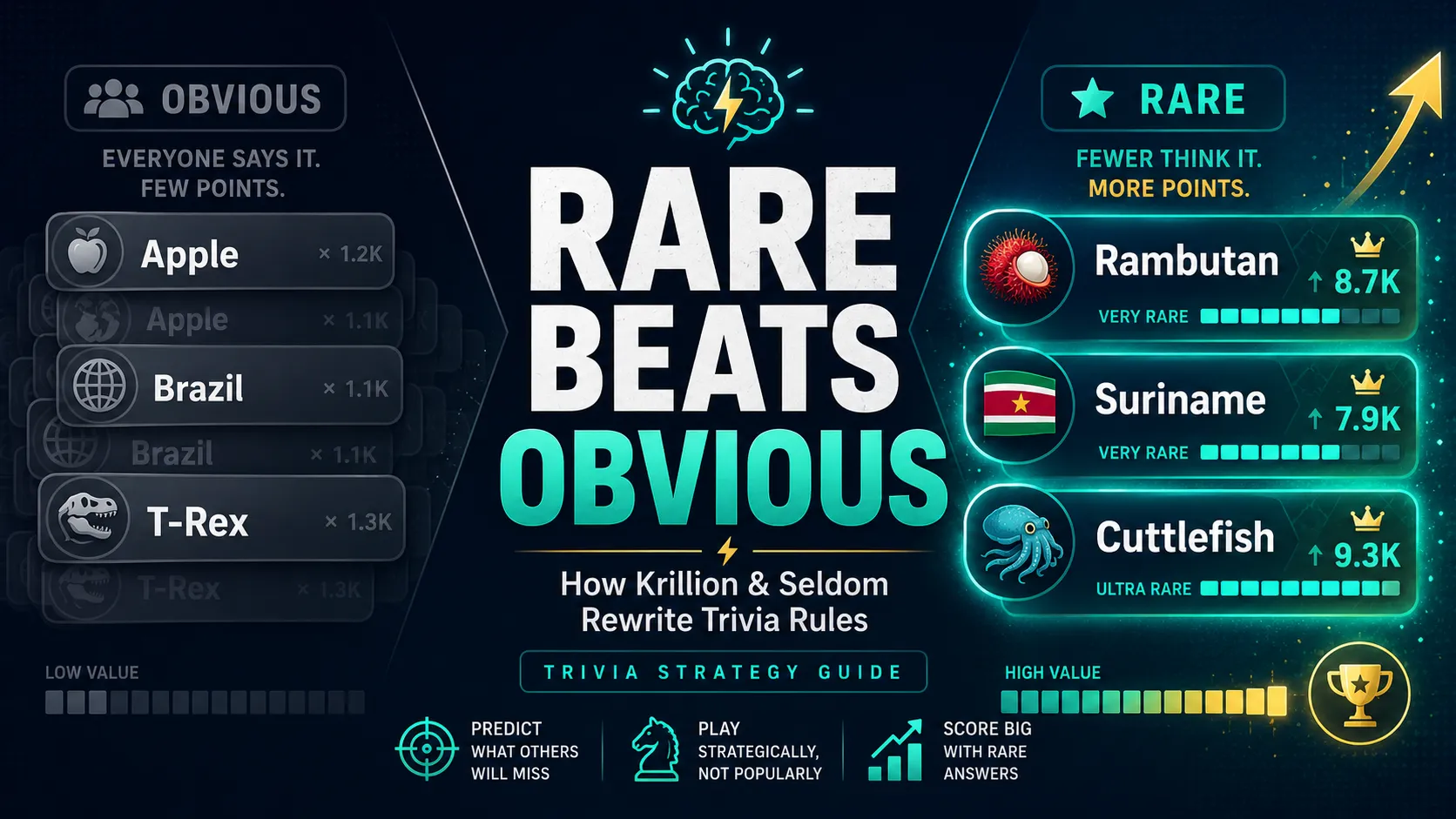
“Rare beats obvious” trivia changes the objective from finding a correct answer to finding a correct answer that other players are unlikely to choose.
Krillion and Seldom both use this inversion, but in different ways. Krillion gives you a series of timed prompts and rewards uncommon valid answers with more points and greater dive depth. Seldom gives you multiple attempts at a daily prompt and scores answers by how common they are expected to be; lower is better, and the rarest possible result is a “Seldom.”
The important skill is therefore not obscure knowledge by itself. It is second-order recall: know several valid answers, predict which one everyone else will think of first, then deliberately move one or two steps beyond it.
What Is “Rare Beats Obvious” Trivia?
Traditional trivia normally rewards convergence. There is one answer the designer wants, and everyone tries to reach it.
Rarity trivia rewards divergence.
A prompt such as “Name a fruit” might accept hundreds of answers. Apple is perfectly correct, but it is strategically weak because it is one of the first fruits most people recall. Kiwi may be less common, Lychee rarer still, while something like Rambutan has a better chance of standing out.
That produces a different mental question:
Normal trivia: “What is a correct answer?”
Rare-answer trivia: “What is a correct answer that the crowd will overlook?”
This small change turns a knowledge test into a mixture of trivia, association, risk management, and prediction.
How Krillion Uses the Mechanic
Krillion presents a sequence of prompts where players need to quickly name something that fits each category. Valid but obvious answers tend to score less, while rarer answers earn stronger results.
The timer is important. Without it, you could slowly search your memory for the most obscure technically valid example. Under time pressure, the game tests how quickly you can escape your first association.
Imagine the prompt were:
Name a bird.
Your mental sequence might be:
Eagle → Penguin → Heron → Cassowary
Submitting Eagle is safe but predictable. Cassowary is much less predictable, but only useful if you are confident it qualifies and can enter it correctly before time expires.
That creates Krillion's central tension: rarity versus certainty.
How Seldom Changes the Formula
Seldom slows the same idea down and lets you explore it more deliberately.
Each daily puzzle gives you several guesses for one prompt. Your result reflects how commonly that answer is expected to be given. A very common response performs poorly, while an answer almost nobody thinks of can produce the game's namesake result, a Seldom.
Because you have several attempts, Seldom feels less like one high-pressure commitment and more like a search down a rarity ladder.
Suppose the prompt is:
Name something you would put on top of ice cream.
Your first layer might contain:
- Chocolate sauce
- Sprinkles
- Whipped cream
Those are valid, but thousands of players can reach them instantly.
The stronger question is: What still makes obvious semantic sense, but sits farther from the center of the category?
That might push you toward a regional topping, a particular fruit, an uncommon confection, or another defensible choice that most players do not retrieve immediately.
The Real Mechanic: Second-Order Thinking
These games are often described as tests of obscure knowledge, but that misses their most interesting mechanic.
You are predicting other people's memories.
Consider:
Name a country in South America.
Brazil may be the first answer you know. But it is also probably the first answer thousands of other players know.
Your internal process should become:
- Identify several unquestionably valid answers.
- Remove the answer with the strongest cultural visibility.
- Consider what other trivia-minded players will also identify as the “clever” alternative.
- Pick something slightly beyond that crowd without becoming questionable.
That fourth step matters because rarity games develop their own meta. Once everyone learns not to answer Brazil, a supposedly clever alternative can itself become crowded.
An answer can feel clever precisely because many players independently make the same jump.
The Three Zones of an Answer
A practical way to play is to mentally divide answers into three zones.
Zone 1: Obvious
These arrive instantly.
For “Name a fruit,” think Apple, Banana, Orange.
They are useful emergency answers, but rarely optimal.
Zone 2: Uncommon but Safe
These require one more retrieval step while remaining unquestionably valid.
Think Persimmon, Guava, or Passion Fruit.
This is usually the best zone for consistent play. You sacrifice the tiny chance of an extraordinary rarity result in exchange for much lower risk of rejection or timeout.
Zone 3: Deep Cut
These are answers you suspect few players will produce at all.
They can deliver exceptional scores, but problems appear quickly: spelling becomes harder, category boundaries become debatable, and you may waste the entire timer searching for something unnecessarily exotic.
Strong players do not automatically choose Zone 3. They choose the rarest answer they can confidently defend.
A Better Way to Think Under the Timer
In Krillion, do not spend most of the timer trying to discover a perfect answer.
Use a short mental ladder instead.
When the prompt appears, generate approximately three candidates:
obvious → less obvious → rare but certain
Then submit the deepest candidate you trust.
For example:
Name a sea creature
Shark → Octopus → Cuttlefish
If Cuttlefish comes to mind immediately and clearly fits, take it. Do not keep digging for an obscure taxonomic term merely because it might score better.
The opportunity cost of searching matters: a mediocre accepted answer beats an amazing answer you never submit.
Useful Tips
Kill Your First Answer
Your first association is valuable because it tells you what the crowd is likely thinking.
Do not necessarily submit it. Treat it as information about your opponents.
Generate Before Evaluating
Quickly produce two or three valid possibilities before deciding which is rarest. Evaluating every idea immediately slows recall.
Prefer Specific Answers
Specific species, titles, places, people, objects, or terms often outperform broad category staples because fewer players retrieve them automatically.
Specific does not mean absurd. It still needs to fit cleanly.
Learn Cultural Defaults
Some answers dominate because of movies, school curricula, advertising, sports coverage, or geography.
Knowing those defaults helps you avoid them.
If a question asks for a dinosaur, Tyrannosaurus rex is not merely common knowledge; it is a cultural default. Your advantage comes from recognizing that before submitting it.
Watch for the “Clever Answer” Trap
Trivia players often make similar second choices.
If everyone thinks, “Obviously not the obvious answer,” the popular alternative can become almost as crowded as the original.
The strongest answers are frequently one association beyond the fashionable clever answer.
Do Not Chase Rarity at the Expense of Validity
The scoring system only matters after your answer qualifies.
A safe uncommon answer is usually superior to something technically arguable that risks being rejected.
Build Category Depth Outside the Game
You can improve surprisingly quickly by practicing categories rather than memorizing individual trivia facts.
Try producing ten examples for common prompt families:
- Countries
- Animals
- Foods
- Movies
- TV shows
- Sportspeople
- Historical figures
- Musical artists
- Brands
- Geographic features
The goal is to make your fourth or fifth association accessible as quickly as your first.
Why These Games Feel Different From Normal Trivia
Rarity scoring removes one of traditional trivia's biggest limitations: two knowledgeable players answering the same factual question are normally indistinguishable once both get it right.
Here, which correct answer you choose matters.
One player may know five valid countries but choose the most obvious. Another may know exactly the same five countries yet recognize which one the crowd will overlook. The second player performs better without necessarily possessing more factual knowledge.
That makes the game partly about knowledge organization rather than knowledge quantity.
It also creates better post-game discussion. Instead of simply saying “I knew it” or “I didn't,” players compare choices:
- “Why did everyone think of that?”
- “How did nobody choose mine?”
- “I thought that answer would be rare.”
The score becomes feedback about collective memory.
Krillion vs. Seldom
The games share the same philosophical rule but produce different experiences.
| Mechanic | Krillion | Seldom |
|---|---|---|
| Core objective | Give rare valid answers | Find the least commonly given valid answer |
| Daily structure | Multiple timed prompts | One main daily prompt |
| Attempts | Limited by each prompt | Multiple guesses |
| Pressure | High | More exploratory |
| Score direction | Rarer answers perform better | Lower rarity scores are better |
| Ideal skill | Fast uncommon recall | Systematic rarity hunting |
Krillion is better at testing whether you can escape the obvious answer immediately. Seldom gives you more room to investigate the category and repeatedly move farther from consensus.
Who Will Enjoy This Style of Trivia?
These games are especially good for players who enjoy trivia but are tired of binary right-or-wrong quizzes.
They suit you if you like:
- Open-ended questions rather than multiple choice
- Comparing results with friends
- Word association
- Category knowledge
- Strategic risk taking
- Predicting what other players will do
- Daily games that take only a few minutes
They may be less satisfying if you strongly prefer questions with one objectively canonical answer. Rarity scoring deliberately introduces a social layer: being correct is only the entry requirement.
Final Take
“Rare beats obvious” is a meaningful redesign of trivia rather than a cosmetic scoring gimmick.
Traditional trivia asks whether information exists in your memory. Krillion and Seldom ask something harder: how quickly can you navigate that memory while accounting for everyone else's?
The most effective strategy is not to become maximally obscure. Build a habit of moving past your first association, identifying two or three safe alternatives, and choosing the rarest one you trust.
Once that habit forms, ordinary answers start looking different. Apple is no longer merely a fruit. It is the answer you know everyone else is about to type—and that is precisely why you should keep thinking.