Wordspine Explained: Sprint, Pro, and How the Letter Spine Works
Learn how Wordspine works, the difference between Sprint and Pro, how letter spines restrict answers, and practical strategies for finding words.
Quick Answer
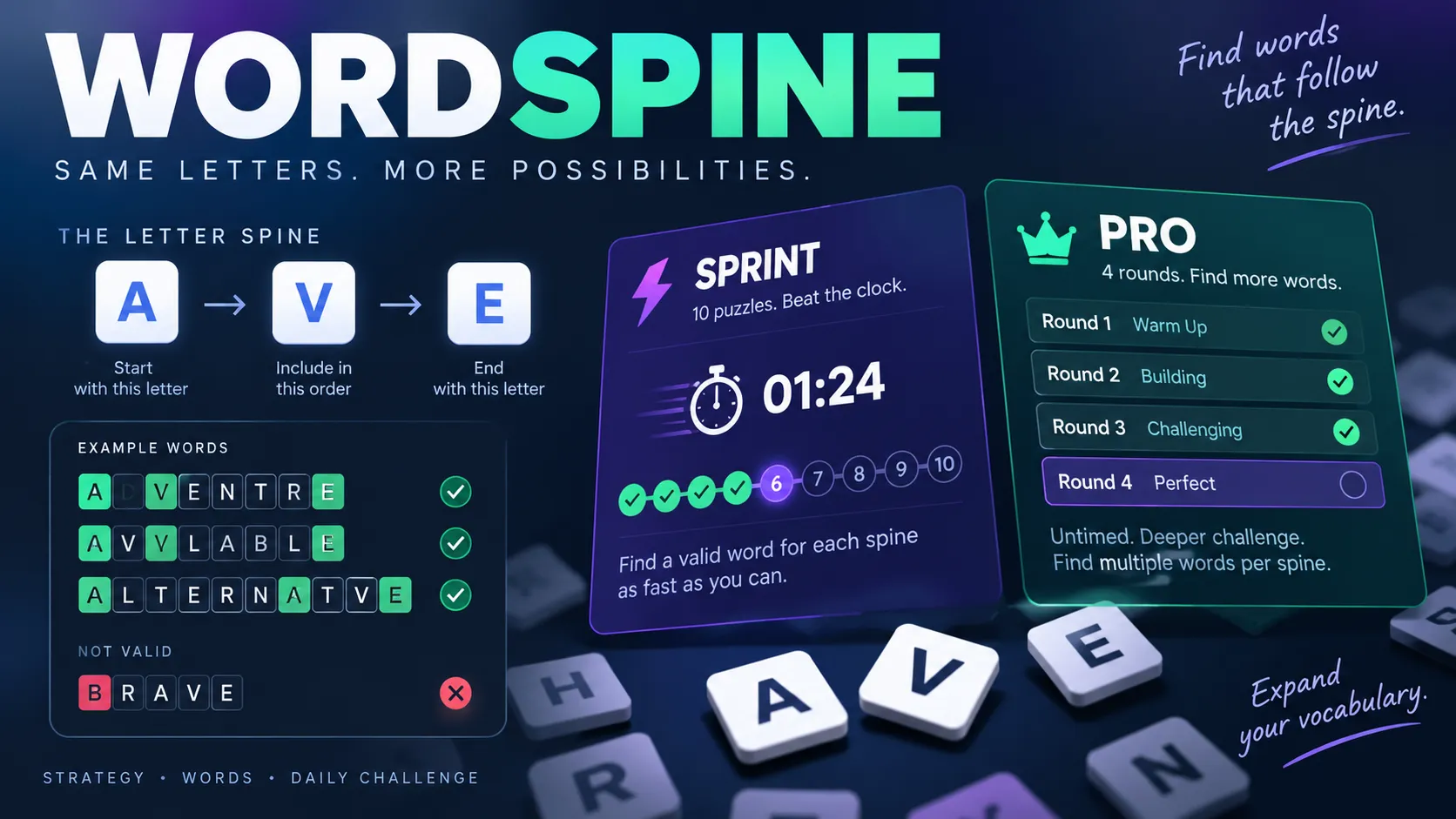
Wordspine is a daily word game where you receive a sequence of letters and must find valid words that contain those letters in a strict order. The first spine letter must be the first letter of your word, the final spine letter must be the last letter, and every letter between them must appear somewhere in the middle in the same order.
For example, with the spine A → V → E, adventure works because it starts with A, contains V after the A, and ends with E. You are allowed to insert as many extra letters as needed between the required letters.
Wordspine has two main modes. Sprint gives you 10 puzzles and measures how quickly you solve them. Pro is untimed and consists of four increasingly difficult rounds in which you try to find multiple words for each spine.
What Is Wordspine?
Wordspine is built around a simple constraint: instead of guessing one hidden answer, you construct your own valid answer around a fixed sequence of letters.
That sequence is the letter spine.
If the puzzle gives you:
C → D → M
then your answer must:
- Start with C.
- Contain D somewhere after the C.
- End with M.
A word such as condominium satisfies those conditions.
The letters do not have to be adjacent. That is the key to the game.
You are effectively searching your vocabulary for a word that can wrap additional letters around and between the fixed spine.
How the Letter Spine Works
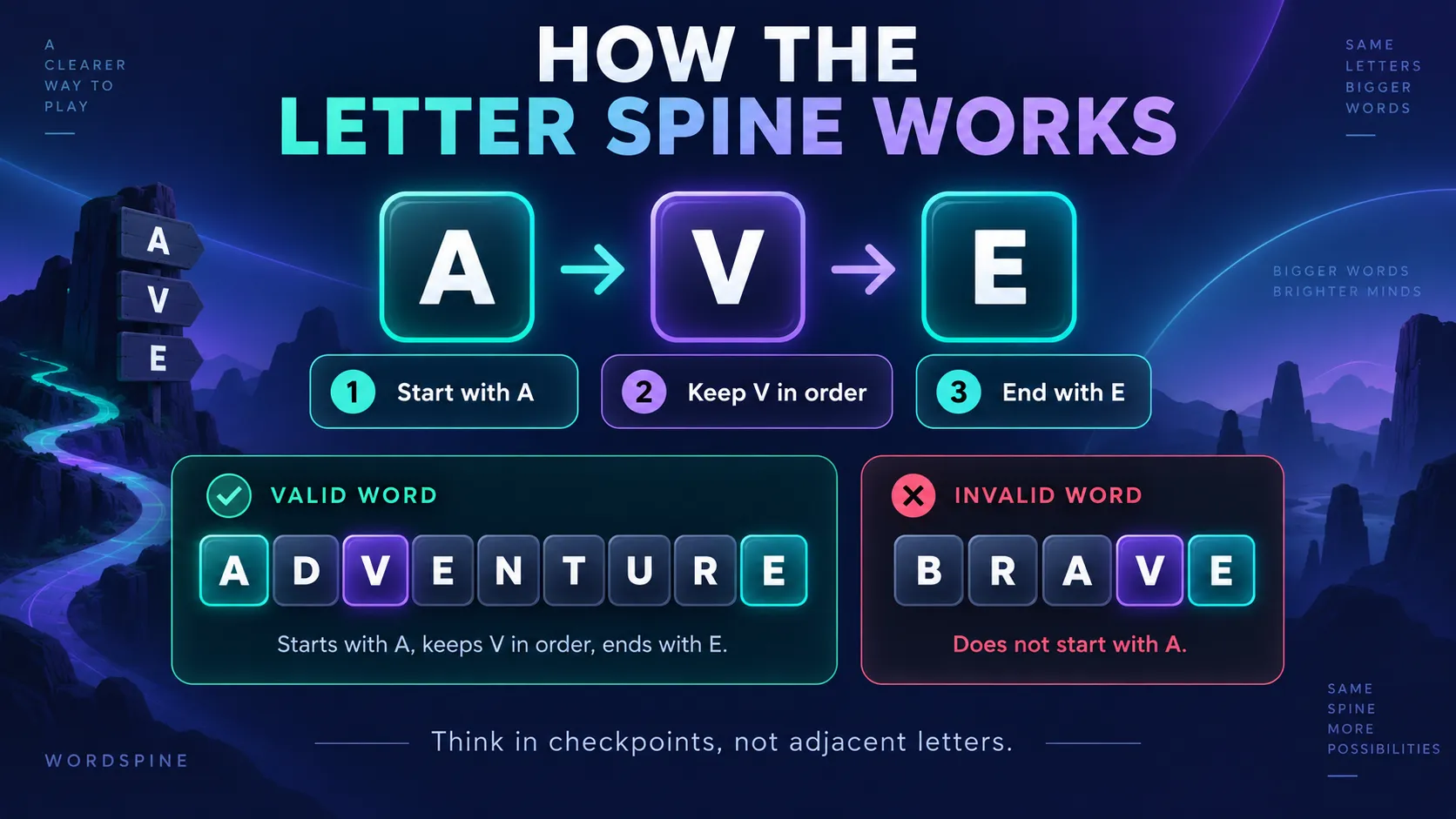
The easiest way to understand Wordspine is to separate the spine into three roles.
The First Letter Is Locked to the Start
If the spine begins with A, your answer must begin with A.
You cannot use a word that merely contains A later in the word.
For:
A → V → E
adventure can work, while a word beginning with another letter cannot.
The Last Letter Is Locked to the End
The final spine letter must also be the final letter of your answer.
This often eliminates words that initially look perfect.
For example, if the spine ends with E, a word that contains the required sequence but ends in S is invalid.
This start-and-end restriction is one of the most important things to check before submitting an answer.
Middle Letters Must Stay in Order
Any letters between the first and last spine letters must occur in the same order shown.
Suppose the spine is:
A → V → T → E
You need an A-starting, E-ending word in which V appears before T.
The V and T do not need to touch each other. Other letters may appear before, after, or between them.
Think of the required letters as fixed checkpoints rather than a continuous string.
Extra Letters Are Allowed
Wordspine would be extremely restrictive if every answer had to use only the displayed letters. Instead, you can insert additional letters freely.
A spine such as:
C → D → M
is therefore not asking you to rearrange C, D, and M into a three-letter word.
It is asking:
What real word starts with C, eventually reaches D, and finally ends with M?
This is why longer words are often easier to discover than players initially expect. More word length gives you more opportunities to fit the required sequence.
Letter Order Matters More Than Distance
Suppose the spine is:
S → T → N
An answer is valid if it starts with S, ends with N, and contains T somewhere between them.
It does not matter whether T is the second letter or much later in the word.
What matters is the order:
S ... T ... N
This is a useful mental shorthand for every Wordspine puzzle.
With a longer spine such as:
C → O → M → I → T
think:
C ... O ... M ... I ... T
Every required letter needs to appear from left to right in that sequence.
Wordspine Sprint Explained
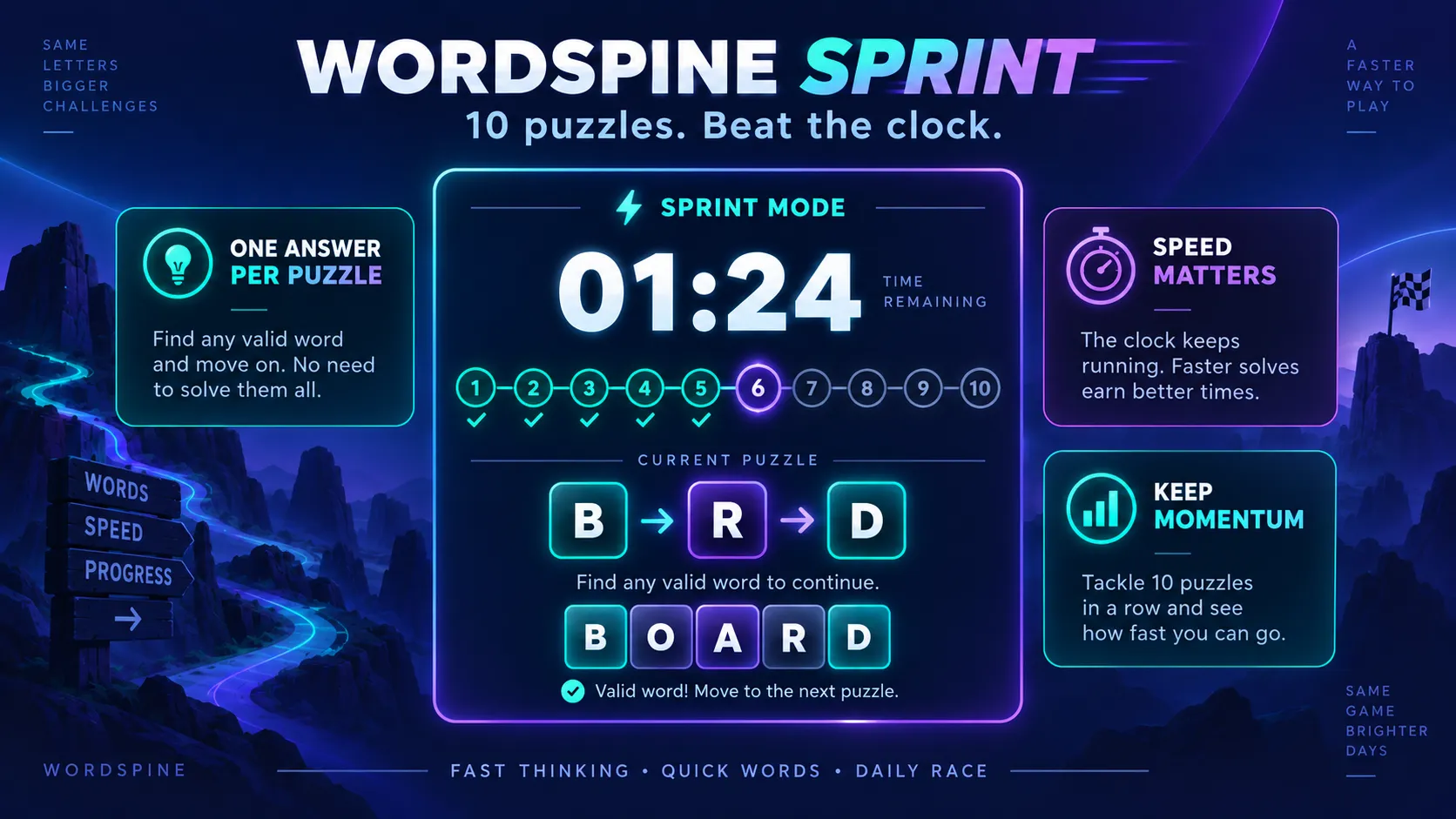
Sprint is the faster and more accessible Wordspine mode.
You receive 10 letter-spine puzzles, one after another, and the timer tracks how long you take to complete the set.
For each puzzle, you only need to find a valid answer and move on.
The main objective is therefore straightforward:
Solve all 10 as quickly as possible.
This changes how you should think about answers. Sprint is not the place to spend 30 seconds looking for an impressive 12-letter word when a simple valid answer is already available.
A Good Sprint Mindset
Imagine your spine is:
B → R → D
You might be able to think of several elaborate possibilities, but the best Sprint answer is usually the first common valid word you recognize.
Speed matters more than elegance.
Submit a safe answer, move to the next spine, and keep momentum.
What Sprint Tests
Sprint rewards:
- Fast vocabulary recall
- Pattern recognition
- Familiarity with prefixes and suffixes
- Quick validation of letter order
- The ability to abandon an unproductive idea
The timer adds pressure, but the underlying puzzle remains vocabulary-based rather than reflex-based.
Wordspine Pro Explained
Pro uses the same letter-spine rule but turns it into a deeper vocabulary challenge.
Instead of racing through 10 single-answer puzzles, Pro consists of four rounds with 10 answer slots in each round. The rounds become progressively harder, moving from easier spines toward the most restrictive challenges.
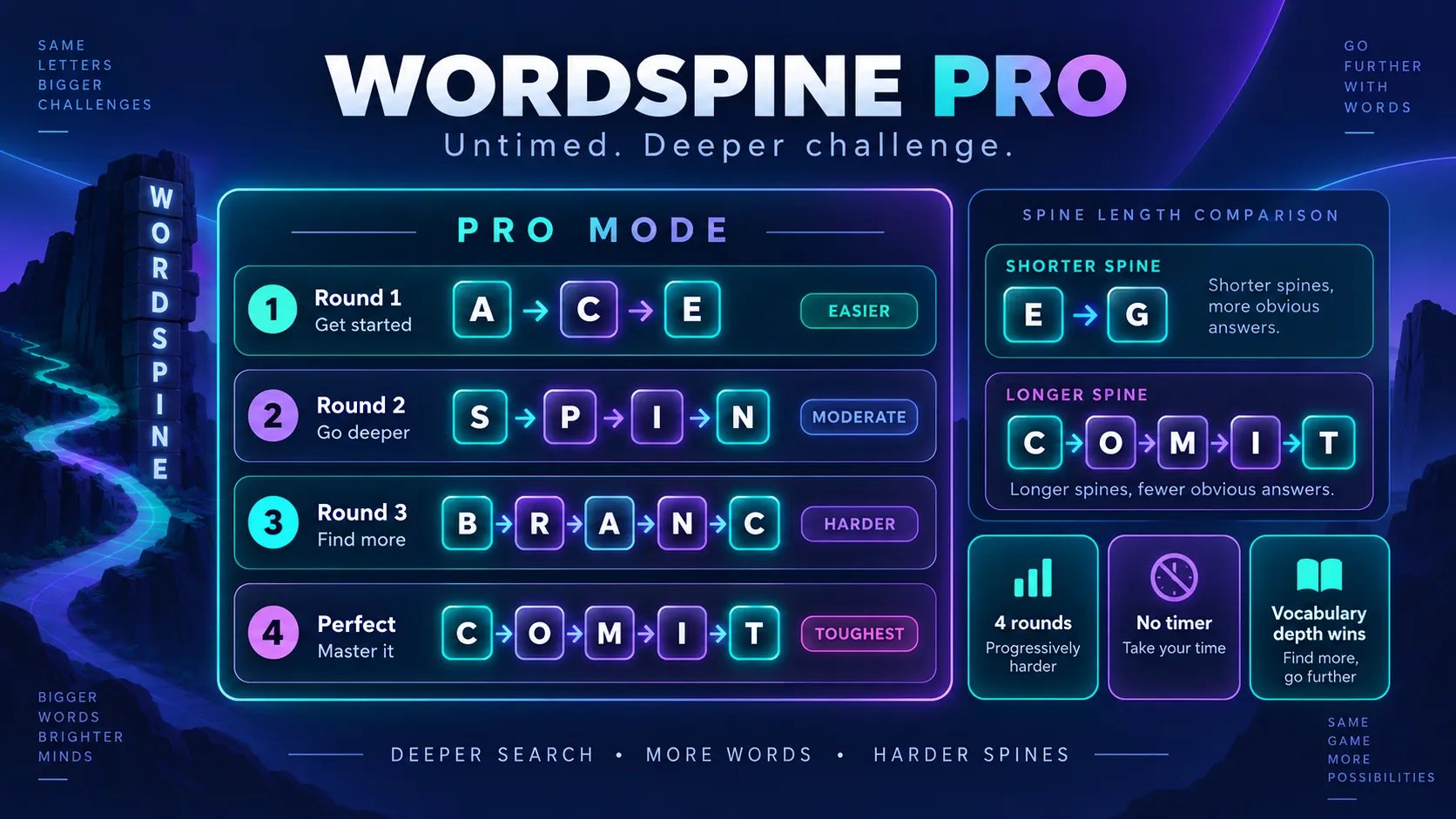
Pro is not timed, so the emphasis shifts from speed toward finding enough valid words to build the strongest result you can.
The game progresses from easier difficulty toward a highest tier labeled Perfect.
The spine itself also becomes more restrictive as additional required letters are introduced. Wordspine uses spines ranging from short two-letter patterns through longer sequences of up to five required letters.
Why Pro Gets Hard Quickly
Consider the difference between:
E → G
and:
C → O → M → I → T
The first pattern leaves enormous freedom. You simply need a word beginning with E and ending with G.
The second pattern locks five checkpoints into a precise order. Even a large vocabulary produces far fewer obvious candidates.
That is the central difficulty curve in Pro: every additional spine letter sharply reduces the available search space.
Sprint vs. Pro
| Mode | Structure | Timer | Main Challenge |
|---|---|---|---|
| Sprint | 10 sequential spine puzzles | Yes | Find one valid word quickly |
| Pro | 4 rounds, up to 10 words per round | No | Find many words from increasingly restrictive spines |
If you want a short daily challenge, start with Sprint.
If you enjoy digging through vocabulary and discovering less obvious answers, Pro is the more interesting mode.
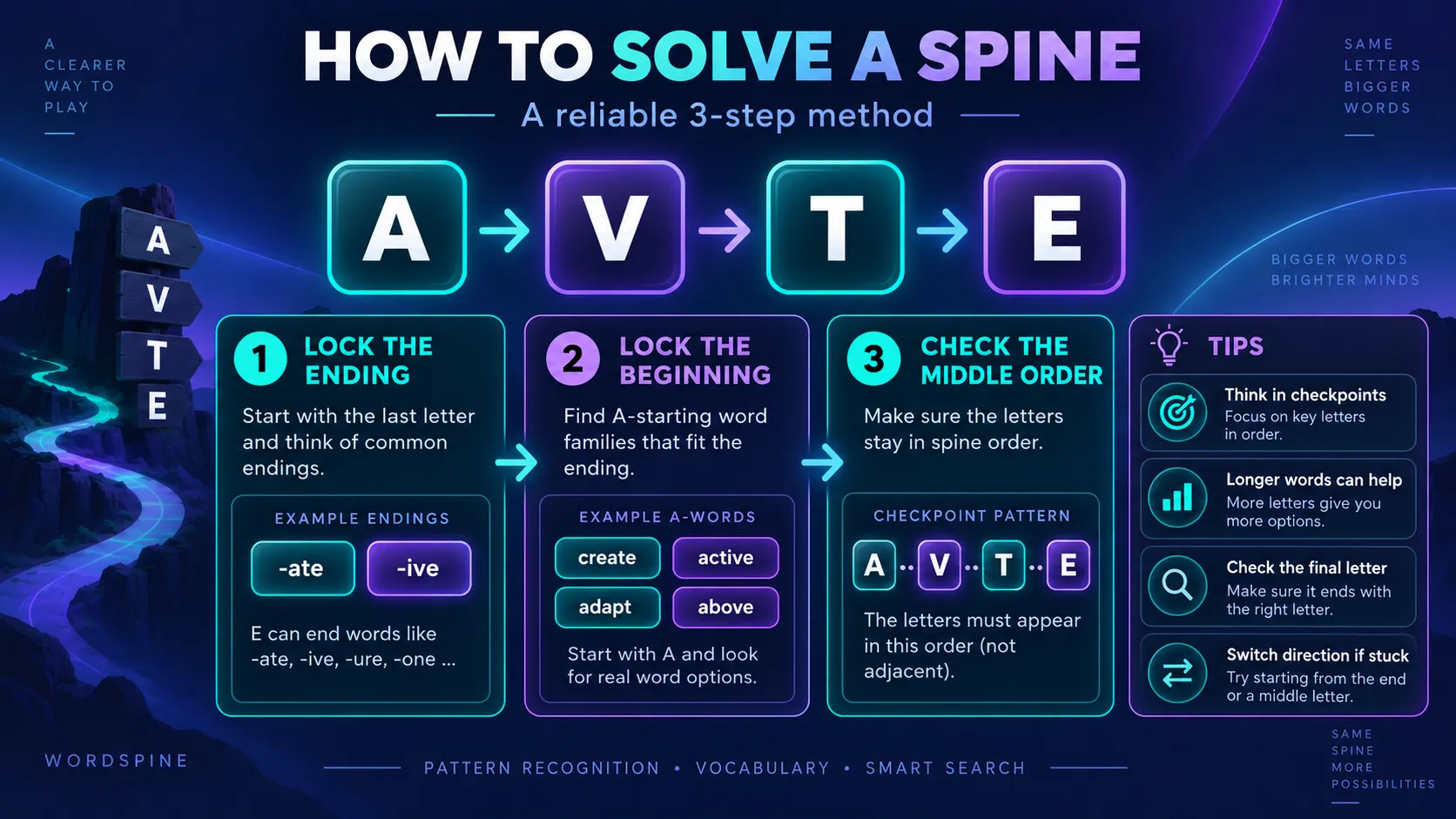
A Reliable Way to Solve Any Spine
When you get stuck, do not search randomly through your entire vocabulary. Break the puzzle into smaller constraints.
Suppose you receive:
A → V → T → E
Step 1: Lock the Ending
You already know the answer must end in E.
Think about familiar E-ending structures such as:
-ate-ive-able-ance
Not every suffix will work, but thinking from the ending can dramatically reduce the search space.
Step 2: Lock the Beginning
Now restrict yourself to words starting with A.
Instead of searching every E-ending word you know, you are searching only A-starting words with an appropriate ending.
Step 3: Insert the Middle Spine
Finally check whether V occurs before T.
The mental structure becomes:
A ... V ... T ... E
This is much easier to reason about than staring at four isolated letters.
Useful Wordspine Strategies
Start With Common Word Families
Prefixes and suffixes are extremely useful because the first and last letters are fixed.
If you need a word beginning with C, mentally cycle through familiar beginnings such as:
co-, con-, com-, counter-, cross-
Then see whether one naturally accommodates the middle spine and required ending.
You can use the same approach backward from the final letter.
Say the Spine Out Loud
A sequence such as:
C → D → N → M
can sometimes trigger a word more easily when spoken as sounds rather than examined visually.
Your vocabulary is partly phonetic. Saying the sequence slowly may activate familiar word patterns that do not immediately appear when reading isolated letters.
Think Longer, Not Shorter
Players often search for the shortest possible answer first.
That can make a difficult spine harder.
Longer words contain more internal positions where required letters can appear. When a four- or five-letter spine feels impossible, deliberately think about longer nouns, adjectives, and verb forms.
Check the Ending Before Submitting
A frequent near-miss occurs when a player finds a word containing the entire spine but forgets that the final required letter must actually finish the word.
If the spine is:
A → V → E
an answer ending in -ed, -er, or -es fails even if A, V, and E otherwise appear correctly.
Always perform a quick three-part check:
correct start → correct middle order → correct final letter
Do Not Assume Required Letters Are Adjacent
If you see:
P → L → T
do not search only for strings resembling PLT.
Instead search for:
P ... L ... T
The gaps are where most valid answers come from.
Use Morphology in Pro
When Pro asks for several answers from the same spine, finding one word can lead to others.
Think about related forms, prefixes, suffixes, and longer derivatives, provided each submitted item is accepted as a valid word and still obeys the spine.
One discovery can therefore unlock an entire family of candidates.
Change Direction When Stuck
If searching from the first letter stops producing ideas, work backward from the ending.
For a word that must end in M, think about common M-ending words or endings first, then test which ones begin with the required starting letter and contain the middle sequence.
Switching search direction is often enough to break a mental block.
Common Wordspine Mistakes
Rearranging the Spine
The letters cannot appear in any convenient order.
If the spine is:
C → D → N → M
the D must occur before the N.
A word containing all four letters but placing N before D does not qualify.
Ignoring the Start or End Rule
The first and final spine letters are stricter than the middle letters.
They must occupy the actual first and last positions of the submitted word.
Searching Only for Exact Letter Strings
The spine is a subsequence, not necessarily a substring.
The required letters can be separated by several other letters.
Recognizing this distinction opens far more possibilities.
Spending Too Long on Sprint
If your goal is a fast Sprint time, perfectionism is costly.
Once you have a clearly valid common word, submit it instead of continuing to hunt for something longer or more interesting.
Giving Up Too Early in Pro
Pro can produce letter sequences that initially look nearly impossible. Because extra letters can appear anywhere between the spine letters, however, there may be valid long words that are not obvious from the short pattern itself.
Try prefixes, endings, compound-like structures, and longer vocabulary before abandoning the round.
Which Mode Should You Play?
Choose Sprint if you enjoy Wordle-style daily routines, short sessions, beating personal times, or competing with friends over a simple result.
A complete Sprint can fit into a few minutes once you understand the rules.
Choose Pro if the interesting part for you is vocabulary exploration rather than speed. Finding several different words that satisfy one increasingly restrictive pattern turns the mechanic into a much deeper search problem.
Many players will enjoy both because they exercise different skills despite using exactly the same core rule.
Who Is Wordspine Best For?
Wordspine is a particularly good fit for players who enjoy:
- Daily word games
- Wordle alternatives
- Spelling and vocabulary challenges
- Pattern recognition
- Anagrams and letter puzzles
- Finding unusual or long words
- Competing on completion time
- Games that take only a few minutes to understand
It can be harder for players learning English because success depends heavily on having a broad working vocabulary. However, the simple rules make it approachable even when individual puzzles are difficult.
Unlike Wordle, Wordspine does not require you to infer one secret word from colored feedback. There can be many correct answers. The challenge is finding a word that satisfies the structure, not discovering the designer's single intended solution.
That makes the game feel closer to an open-ended vocabulary puzzle than a conventional guessing game.
Final Take
Wordspine gets a lot of mileage from one unusually clean rule: preserve the displayed letters as the spine of a larger word.
Sprint turns that mechanic into a quick daily race. Pro reveals its deeper side by asking you to repeatedly search the vocabulary space around increasingly restrictive letter sequences.
The most important lesson for new players is simple: do not treat the spine as a group of adjacent letters. Read it as a sequence of checkpoints.
START ... MIDDLE ... MIDDLE ... END
Once that idea clicks, Wordspine becomes much easier to solve—and considerably more strategic when the spines get longer.