What Is Bloom?
Bloom is a free daily logic puzzle created by Stoop Games. It takes the familiar flood-fill mechanic and turns it into a colorful challenge of planning, spatial reasoning, and move optimization.
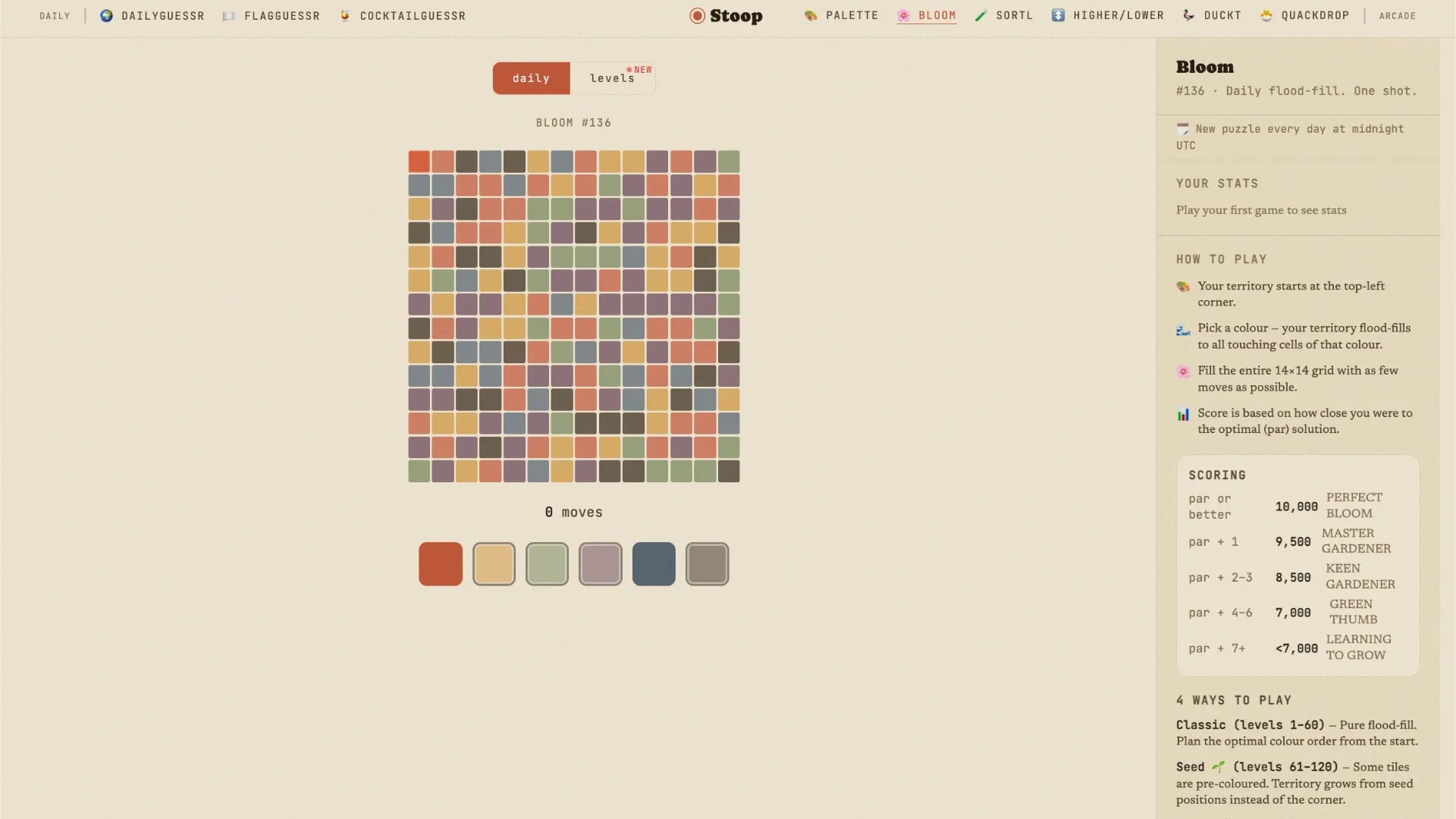
Every day, players receive the same 14×14 grid containing six different colors. Your territory begins in the top-left corner. By selecting colors, you expand your connected territory until every cell on the board has been absorbed.
The goal sounds simple: fill the entire board in as few moves as possible. However, choosing the color that immediately captures the most cells is not always the smartest decision. A smaller expansion might connect you to several large regions on your next turn.
Bloom features one daily attempt, a par-based scoring system, and an additional Levels mode containing 240 puzzles. It is completely free, runs directly in a web browser, and requires no account or download.
Bloom Game Rules
Bloom follows a straightforward set of rules:
- 14×14 grid: The daily puzzle contains 196 colored cells.
- Six colors: Every grid uses Terracotta, Ochre, Sage, Plum, Slate, and Ink.
- Starting territory: Your connected territory begins at the top-left corner.
- Choose a color: Select one of the six color buttons to recolor your territory.
- Flood-fill expansion: Your territory automatically absorbs adjacent, connected cells matching your selected color.
- Plan your moves: Every color selection contributes to your move count.
- Complete the board: Continue until all 196 cells belong to one connected territory.
- Beat par: Your performance is measured against a target move count called par.
The daily puzzle allows just one attempt. All players receive the same grid, and a new challenge becomes available at midnight UTC.
How to Play Bloom
- Open Bloom: Visit bloom.stoop.games and select the Daily game. Examine the 14×14 board before making your first move.
- Inspect neighboring colors: Look at the color groups touching your starting territory. Consider which selection will expand your territory and expose useful neighboring regions.
- Choose your first color: Click one of the six color buttons beneath the board. Your territory changes color and absorbs all connected cells of that color along its boundary.
- Expand strategically: Keep selecting colors, planning several moves ahead. Watch your move counter and compare your progress with the displayed par.
- Finish and check your score: Once the entire board has become one connected color, Bloom calculates your score. Return tomorrow for the next daily puzzle or select Levels for more challenges.
Example: How Flood-Fill Works
Imagine a small section of your board looks like this:
S S O P
S O O P
T T O I
T P I I
Color key:
- S = Sage
- O = Ochre
- P = Plum
- T = Terracotta
- I = Ink
Your starting territory is the connected Sage group in the upper-left corner.
Move 1: Choose Ochre.
Your Sage territory changes to Ochre. Because several Ochre cells touch the expanded region, they are absorbed as part of the same move.
Move 2: Consider Terracotta or Plum.
Now examine the new boundary. Terracotta might capture a connected region toward the bottom-left, while Plum could open a different route across the board.
Move 3: Plan the next connection.
Rather than choosing based only on the number of immediately captured cells, consider which color creates access to the largest connected regions on subsequent turns.
This simplified example illustrates the central challenge. In the actual daily game, your decisions affect a 14×14 grid, making long-term planning considerably more important.
Bloom Scoring: How to Beat Par
Bloom evaluates your performance by comparing the number of moves used with par, the game's target solution length.
| Performance | Score | Rating |
|---|---|---|
| Par or better | 10,000 | Perfect Bloom |
| Par + 1 move | 9,500 | Master Gardener |
| Par + 2–3 moves | 8,500 | Keen Gardener |
| Par + 4–6 moves | 7,000 | Green Thumb |
| Par + 7 or more | Below 7,000 | Learning to Grow |
Par is calculated using a greedy approximation rather than an exhaustive proof of the mathematical optimum. This means particularly clever solutions can sometimes outperform the displayed target.
A Perfect Bloom earns the maximum score of 10,000 points.
Four Bloom Game Modes
Beyond the daily challenge, Bloom includes 240 levels divided into four modes. Each introduces a different strategic challenge.
Classic Mode — Levels 1–60
Classic is the original flood-fill experience. Your territory starts in the corner, and you must find an efficient sequence of color selections to fill the grid.
The primary challenge is identifying the best expansion order without special mechanics or restrictions.
Seed Mode — Levels 61–120
Seed changes where your territory begins. Instead of expanding exclusively from the corner, your starting territory grows from designated seed positions.
This creates a different opening challenge: connect separated regions and use multiple starting positions to expand efficiently.
Virus Mode — Levels 121–180
Virus introduces a spreading fuchsia color that expands by one tile after each move.
Players must decide when to absorb the spreading virus. Capturing it early can reduce its influence, while waiting may allow a larger region to become available in a single move.
Token Mode — Levels 181–240
Token adds limits to how often each color can be selected.
If you exhaust a color's available uses while cells of that color remain on the board, you lose the level.
This mode rewards resource planning as much as spatial reasoning.
Bloom Strategy and Tips
1. Think About Territory Boundaries
A good move does more than absorb cells. It creates a larger boundary from which your territory can reach additional color groups.
Look for selections that expose multiple useful regions instead of focusing entirely on immediate growth.
2. Plan Two or Three Moves Ahead
Before choosing a color, consider what happens afterward.
For example, capturing an Ochre region may position your territory next to a large Plum cluster. Selecting Ochre first could make the following Plum move significantly more productive.
3. Avoid Repeatedly Switching Between Colors
Constantly alternating between colors without meaningfully expanding your territory can inflate your move count.
Try to identify a useful sequence of connected regions before committing to a selection.
4. Use Levels Mode for Practice
The daily puzzle has only one attempt, but Levels mode provides 240 additional challenges. Practice evaluating territory boundaries, comparing possible color orders, and discovering efficient solutions without risking your daily result.
5. Adapt Your Strategy to Each Mode
Classic rewards efficient flood-fill planning. Seed emphasizes connecting starting regions. Virus requires anticipating a spreading color. Token demands careful management of limited color selections.
A strategy that works well in Classic might be ineffective in Token or Virus.
Is Bloom Free to Play?
Yes. Bloom is completely free to play in a browser. There are no required accounts, subscriptions, downloads, or advertisements.
The daily puzzle refreshes at midnight UTC, and the 240 additional levels provide more opportunities to practice between daily challenges.
Frequently Asked Questions
Is Bloom a daily game?
Yes. Bloom provides one new 14×14 daily puzzle at midnight UTC. Everyone receives the same grid.
Can you replay the daily Bloom puzzle?
No. The daily challenge provides one attempt. However, Levels mode offers 240 additional puzzles that can be replayed.
How many colors are in Bloom?
The standard grid uses six colors: Terracotta, Ochre, Sage, Plum, Slate, and Ink. Virus mode adds a spreading fuchsia mechanic.
What does par mean in Bloom?
Par is the target number of moves for solving the grid. It is estimated using a greedy algorithm, so it is not necessarily a proven global minimum.
How do you get a perfect score in Bloom?
Complete the entire board in par or fewer moves. This awards 10,000 points and the Perfect Bloom rating.
Does Bloom have unlimited puzzles?
The daily challenge is limited to one attempt, but Levels mode offers 240 replayable levels across Classic, Seed, Virus, and Token modes.
Is Bloom similar to Wordle?
Both provide daily challenges shared among players, but the gameplay is very different. Wordle involves guessing a hidden word, while Bloom is a visual optimization puzzle where players strategically expand territory using colors.
Why Play Bloom?
Bloom is especially appealing to players who enjoy compact logic games, optimization puzzles, and challenges that reward thinking several moves ahead.
Unlike guessing games, the entire board is visible from the beginning. The difficulty comes from deciding which sequence of actions produces the most efficient solution.
Its combination of a shared daily puzzle, performance ratings, and 240 additional levels makes Bloom suitable for both quick daily sessions and longer strategic play.
Ready to grow your territory? Play Bloom for free and see whether you can earn a Perfect Bloom.