
What Is Chain?
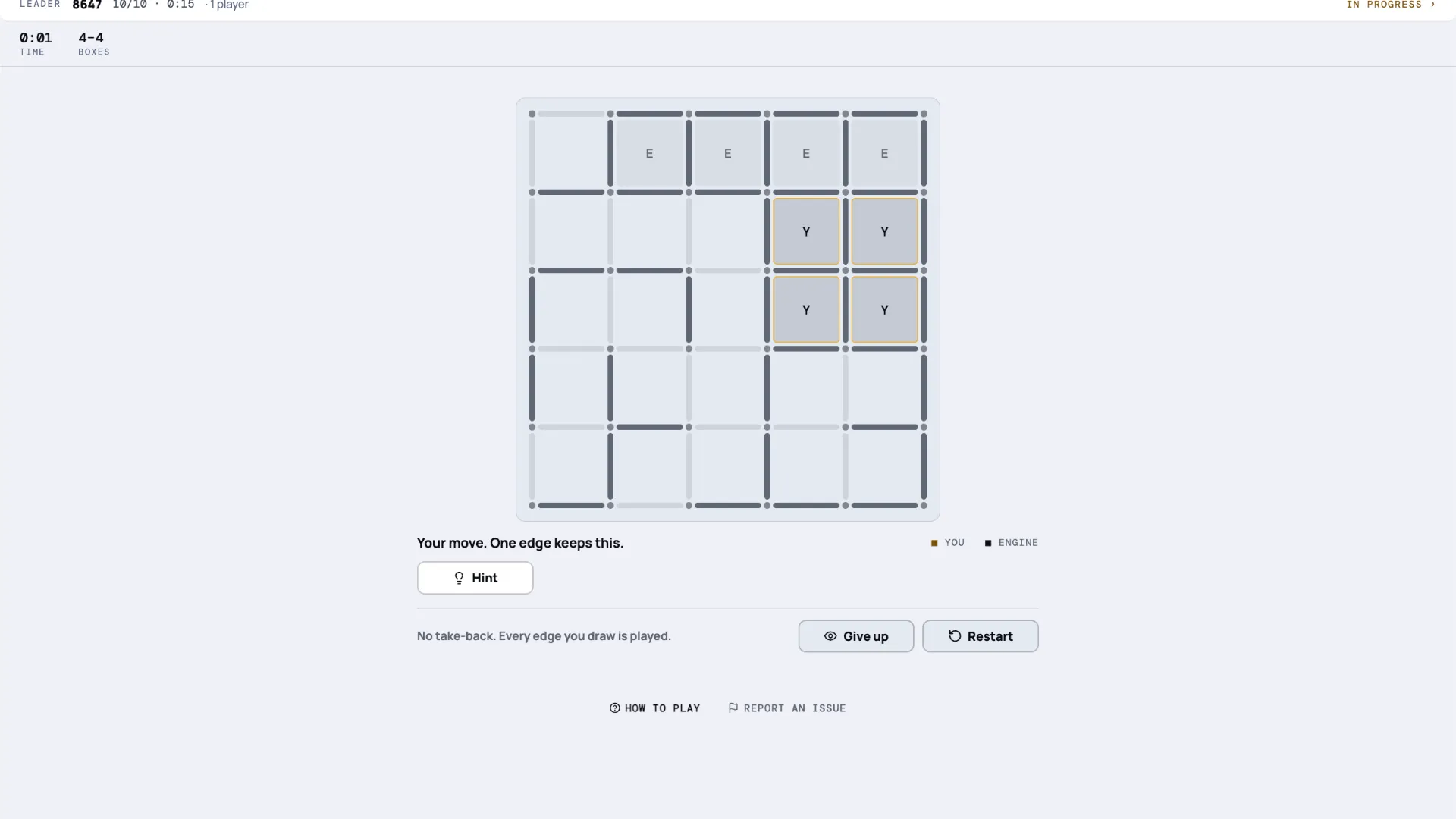
Chain is a daily puzzle based on the endgame of Dots and Boxes, the classic strategy game where players connect neighboring dots with lines and claim a box by completing its fourth side.
Instead of starting with an empty grid, Chain drops you directly into a late-game position. Most of the edges have already been drawn, the score is already developing, and only a small number of moves remain.
The challenge is to find the move that keeps the position winning against an opponent that plays optimally.
The Core Twist
Chain focuses on one of the most interesting parts of Dots and Boxes: controlling chains of boxes.
Completing a box normally feels like a good move because you score a point and immediately get another turn. Near the end of a Dots and Boxes game, however, taking every available box can be a mistake.
Opening a long chain may allow the other player to collect several boxes in succession. Sometimes the best move is even to leave boxes for your opponent so that they are forced to open the next, larger chain.
A simplified situation could look like this:
`text Chain A: 4 boxes Chain B: 7 boxes
Take every box in Chain A → You may be forced to open Chain B.
Give away the final boxes in Chain A → Your opponent may be forced to open Chain B instead. `
This makes Chain a game about control and timing rather than simply grabbing every available point.
How to Play Chain
- Study the board. Look at the remaining empty edges, completed boxes, current score, and connected groups of unfinished squares.
- Identify the chains. Work out which groups of boxes could be collected consecutively once somebody opens them.
- Choose an edge. Draw a line between two neighboring dots. Completing a box gives you another move, just like standard Dots and Boxes.
- Manage control. Decide whether taking available boxes helps you or leaves you responsible for opening a larger chain afterward.
- Finish the position. Continue playing against the computer and see whether your choices preserve the winning endgame.
Example of Chain Control
Imagine there are two remaining groups of boxes.
The first contains three boxes and the second contains eight. You are currently able to collect the smaller chain.
The obvious move is to take all three boxes. But doing so might leave you with the next turn after that chain is exhausted, forcing you to open the eight-box chain for your opponent.
A stronger move in some positions is to sacrifice part of the smaller chain. Your opponent takes a couple of boxes, but they remain responsible for making the move that opens the larger group.
Chain builds its puzzles around recognizing situations like this.
Why Chains Matter
A chain is a connected sequence of boxes that becomes difficult to stop once one end is opened.
Because completing a box gives the same player another move, a player can often collect an entire chain in one sequence.
That means the important question is not only:
How many boxes can I take now?
It is also:
Who will be forced to open the next chain?
Understanding that difference is the key to solving Chain consistently.
Strategy Tips
- Do not automatically take every available box. An immediate point can sometimes cost you control of the board.
- Count complete chains. Think about the total number of boxes that become available after an edge is opened.
- Look one sequence ahead. Consider whose turn will effectively remain after the current chain has been resolved.
- Watch for sacrifices. Giving your opponent a small number of boxes can occasionally force them to open a much larger chain.
- Use the score. A sacrifice is only useful if the final distribution of boxes still works in your favor.
- Treat every remaining edge as important. Late-game Dots and Boxes positions can change dramatically because of a single line.
Who Will Enjoy Chain?
Chain is a good fit for players who enjoy short daily logic challenges but want something different from word guessing or trivia.
It is especially interesting if you like abstract strategy, mathematical puzzles, or classic games where a simple set of rules creates surprisingly deep decisions.
You do not need to be an experienced Dots and Boxes player to start, but understanding chains and board control quickly becomes essential as you try to solve the daily position more efficiently.