What is Chemdle?
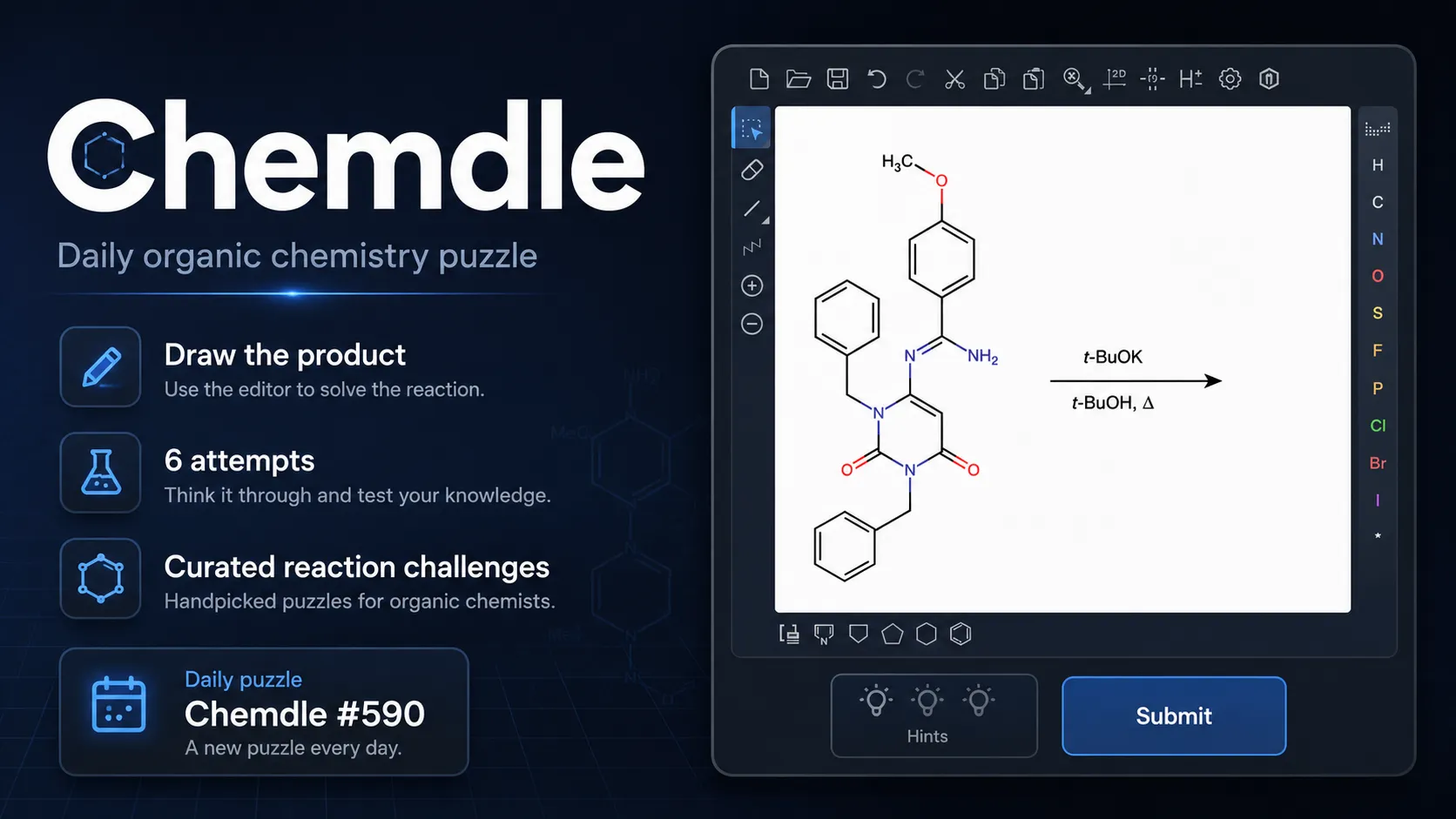
Chemdle replaces letters with atoms and turns the Wordle formula into a full organic chemistry showdown. Each puzzle presents starting material, reagents, reaction conditions, and one terrifying question mark. Your task is to draw the missing molecular product before six attempts evaporate.
This is not a periodic-table vocabulary quiz. Chemdle expects you to recognize transformations, track functional groups, consider stereochemistry, and sometimes survive several steps of a published synthesis. Wrong structures can still reveal matching fragments or valid intermediates, turning every failed experiment into evidence for the next one.
Chemdle Game Rules (The Catch / The Trap)
The reaction battle follows this cycle:
REACTION SCHEME → DRAW A STRUCTURE → SUBMIT → STUDY MATCHES → REVISE
- One curated chemistry problem: Study the supplied substrates, reagents, conditions, and unknown product.
- Draw your answer: Use the built-in molecular structure editor rather than typing a compound name.
- Six attempts: You MUST draw the accepted final product before your sixth submission is spent.
- Matching substructures are highlighted: Correct portions of your molecule show that part of your reasoning is on target.
- Bond details matter: A bond may be positioned correctly but separately marked when its order is wrong.
- Intermediates can be recognized: A valid intermediate may show that you are following the right pathway, but it does not complete the puzzle.
- Hints vary by puzzle: Some challenges offer progressive hints when the reaction refuses to surrender.
- Exact structure wins: Connectivity, bond order, functional groups, and relevant stereochemistry can all matter.
The trap is that a molecule can look almost perfect while still being chemically wrong. One missing carbonyl, reversed stereocenter, misplaced double bond, or forgotten protecting group can keep the final answer locked.
Correct skeleton ≠ Correct product
Correct product + wrong stereochemistry ≠ Guaranteed win
How To Play Chemdle?
Step 1: Read the reaction scheme
Example problem:
Cyclohexanone — NaBH₄, MeOH → ?
Player notices: Sodium borohydride commonly reduces ketones to secondary alcohols.
Step 2: Draw an opening guess
Player Draws: Cyclohexene
Game Response:
Ring framework: matched
Reaction center: incorrect
What This Means: The six-membered carbon skeleton survived, but replacing the carbonyl with an alkene does not fit the reagents.
Step 3: Repair the functional group
Next Draw: Cyclohexanol
The player replaces the carbonyl carbon's double-bonded oxygen with an alcohol group while preserving the ring.
C=O → C–OH
Step 4: Submit the completed product
Result: Correct product
The molecular structure is accepted, the remaining guesses are saved, and the full explanation can reveal why the transformation works. Harder Chemdle puzzles may require several such deductions before the final molecule emerges.
Chemdle Strategy & Tips
Begin with the reagents. Identify whether the reaction suggests oxidation, reduction, substitution, elimination, coupling, protection, deprotection, or rearrangement before touching the editor.
Preserve confirmed fragments. When part of a guess matches, modify the suspicious reaction center instead of redrawing the entire molecule from scratch.
Track atoms deliberately. Ask which atoms originate in the starting material, which enter from a reagent, and whether any group should leave during the transformation.
Check stereochemistry and bond order before submitting. A wedge, dash, alkene geometry, aromatic bond, or oxidation state can separate a winning product from an extremely convincing failure.
For multistep syntheses, think one transformation at a time. Drawing a recognized intermediate may confirm the route and make the final step much easier to predict.