What is Dartwords?
Dartwords drops you into a word hunt with almost nothing to hold onto. There is one secret word each day, 10 guesses, and absolutely no opening clue. Your first move can be virtually any word you think might expose something useful.
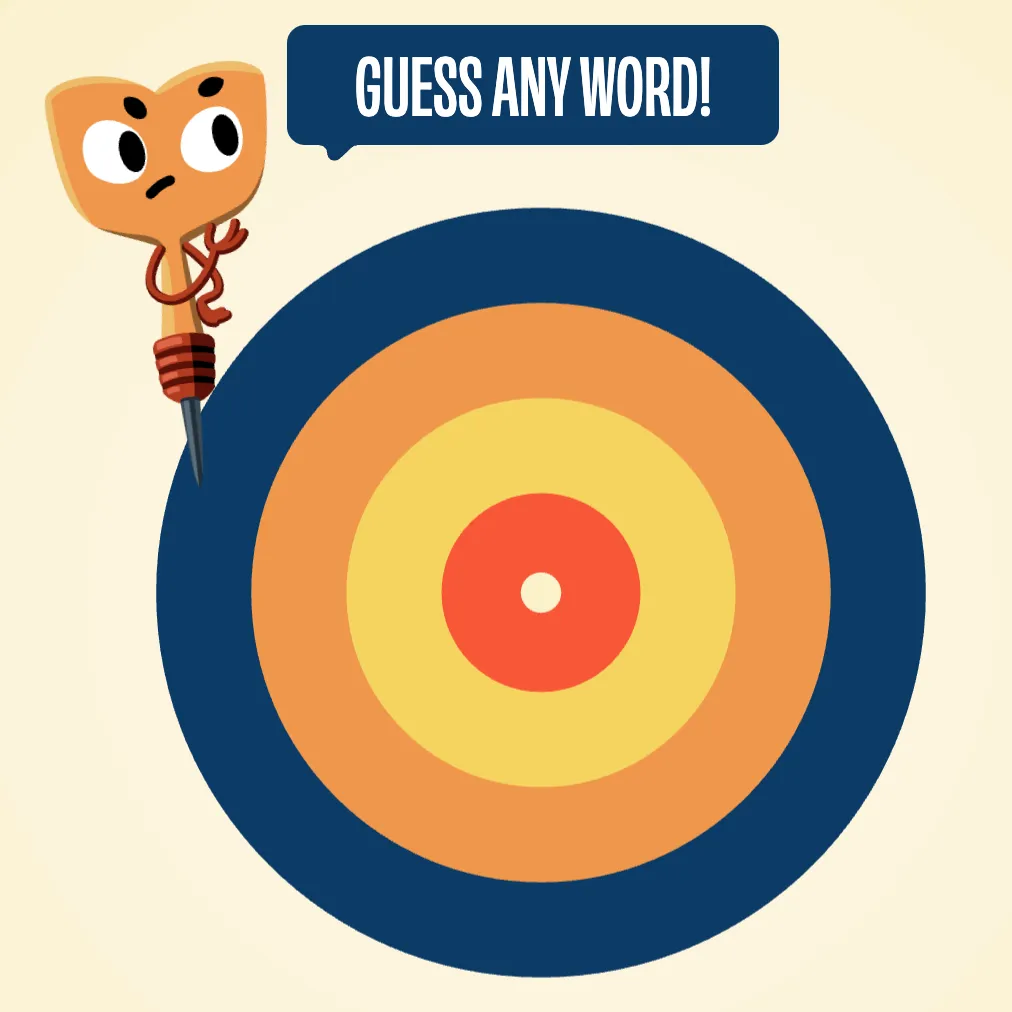
The twist is Darty, an expressive little dart that talks back. Instead of Wordle-style letter feedback, Darty gives conversational clues about how your guess relates to the answer. At the same time, your guess lands as a dart on a target: move closer to the correct idea and the dart moves closer to the bullseye. The result feels less like decoding letters and more like playing a strange game of 20 Questions against a tiny animated opponent.
Dartwords Game Rules (The Catch / The Trap)
🎯 One daily target: There is a secret word to discover each day.
🔟 Ten shots: You have up to 10 guesses to find it. Every word you submit spends another attempt.
❓ No starting clue: Dartwords does not give you a category, definition, first letter, or Wordle-style grid before your opening guess. You have to create your own starting point.
💬 Darty responds: After a guess, Darty gives you a contextual clue about how your word relates to the target. The clue may push you toward or away from a category, property, size, purpose, or other relationship.
🎯 Watch the dartboard: Each guess also lands on the target. A dart closer to the bullseye means your guess is getting closer to the secret word, giving you another signal beyond Darty's text clue.
The trap is simple: being close is not the same as knowing why you are close. A useful guess should reveal something about the target rather than simply throwing near-synonyms at the board.
How To Play Dartwords?
1. Fire a broad opening shot
Player Guesses: DOG
🎯 Dart: Lands well away from the bullseye.
💬 Darty: Gives you a clue suggesting the target belongs somewhere else conceptually.
What You Learn: Your first guess has eliminated a large branch of possibilities.
2. Test a new category
Player Guesses: CAR
🎯 Dart: Moves closer to the center.
💬 Darty: Gives another relationship-based clue about the target.
What You Learn: You may now be somewhere around manufactured objects, machines, transportation, or something associated with them.
3. Narrow the meaning, not the spelling
Player Guesses: BICYCLE
🎯 Dart: Lands even nearer the bullseye.
Next Constraint: The target probably has a stronger conceptual connection to BICYCLE than to CAR. Follow that relationship instead of hunting for words with similar letters.
4. Take the bullseye shot
Use Darty's accumulated hints plus the dart positions to make a precise final guess. Hit the secret word before your tenth attempt and the daily hunt is solved.
Dartwords Strategy & Tips
- Start broad. A category-testing word such as
animal,food,vehicle,music, orbuildingcan reveal more than an overly specific opening guess. - Treat each guess as a question. Ask yourself what you will learn if the dart moves closer—or farther away.
- Read both signals. Darty's response tells you how to think about the relationship, while the dartboard gives you a visual sense of proximity.
- Switch categories when necessary. The game's open-ended clues reward lateral thinking more than repeatedly guessing near-synonyms.
- Save precision for later. With only 10 attempts, use the early guesses to map the territory and the later guesses to attack the bullseye.
Dartwords was created by The Game Band, the studio behind Blaseball. Its conversational clue system gives the daily word-game formula a more playful, improvisational feel than traditional letter-by-letter guessing games.