
What Is Wordspine?
Wordspine is a free daily word game built around a simple twist: you're given a sequence of letters, and every answer must use those letters in order. It starts easy and grows trickier, with two modes—Sprint for a quick 10-word run, and Pro for a slower, deeper puzzle.
For example, suppose the spine is:
A → V → E
A valid answer is:
ADVENTURE
It begins with A, contains V later in the word, and ends with E. The required letters do not have to sit next to each other, so you can insert other letters between them.
Wordspine offers two main ways to play: Sprint, a timed set of 10 puzzles, and Pro, a longer untimed challenge with increasingly restrictive letter spines.
The Letter Spine Rule
The central mechanic is easier to understand if you treat the displayed letters as checkpoints.
For a spine such as:
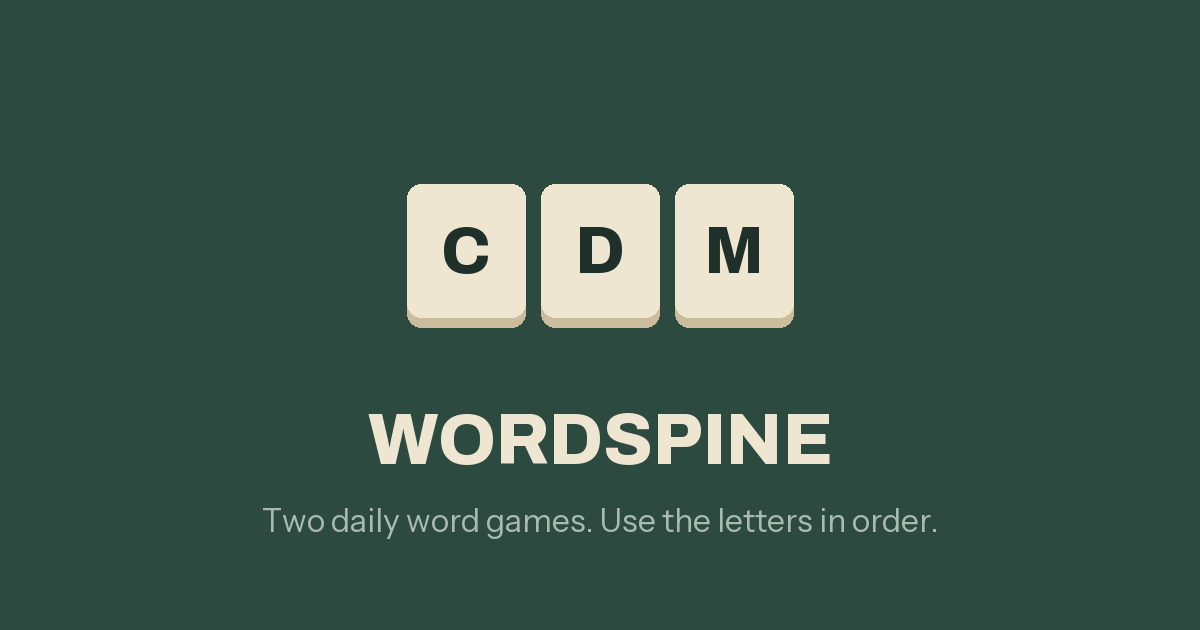
C → D → N → M
Your answer must:
- Start with C.
- Include D after that C.
- Include N somewhere after the D.
- End with M.
CONDOMINIUM works because those required letters appear in the correct order while extra letters fill the gaps.
The spine is therefore not a substring that must appear exactly as written. What matters is the order and position constraints.
A longer spine leaves fewer possible answers, which is what makes the harder puzzles challenging.
Sprint vs. Pro
Sprint
Sprint is the quick version of Wordspine. You work through 10 letter-spine puzzles while a timer tracks how long you take to complete them.
The goal is not to discover one predetermined secret word. You simply need to find a valid word satisfying each spine as quickly as possible.
Pro
Pro uses the same letter-order mechanic without the timer. It contains four rounds of 10 challenges, progressing from easier patterns toward more restrictive ones.
That makes Pro better suited to players who enjoy searching their vocabulary for less obvious possibilities rather than racing the clock.
How to Play Wordspine
- Read the spine. Suppose you receive
A → V → E. - Lock the endpoints. Your answer must begin with A and finish with E.
- Preserve the middle letters. Look for a word containing V somewhere between those endpoints.
ADVENTUREis one valid possibility. - Submit the word and continue. In Sprint, move through all 10 puzzles as quickly as possible. In Pro, continue through the progressively harder rounds without a timer.
The same idea extends to longer spines. With something like A → V → T → E, you need an A-starting, E-ending word where V occurs before T, even if several other letters appear between them.
Strategy Tips
Start by thinking about the required ending as well as the beginning. A word may contain all the right middle letters but still fail because its final letter does not match the spine.
For longer spines, avoid trying to read the required letters as one continuous chunk. Instead, mentally spread them across a word as checkpoints. A pattern such as C → D → N → M looks much less intimidating once you remember that many unrelated letters can appear between C, D, N, and M.
Common prefixes and suffixes can also help. Once the first and last letters narrow the shape of the answer, try familiar word families and then check whether the middle spine letters appear in the required order.
If you enjoy vocabulary puzzles but want something different from guessing a fixed five-letter answer, Wordspine's open-ended letter-order mechanic gives it a noticeably different feel.