
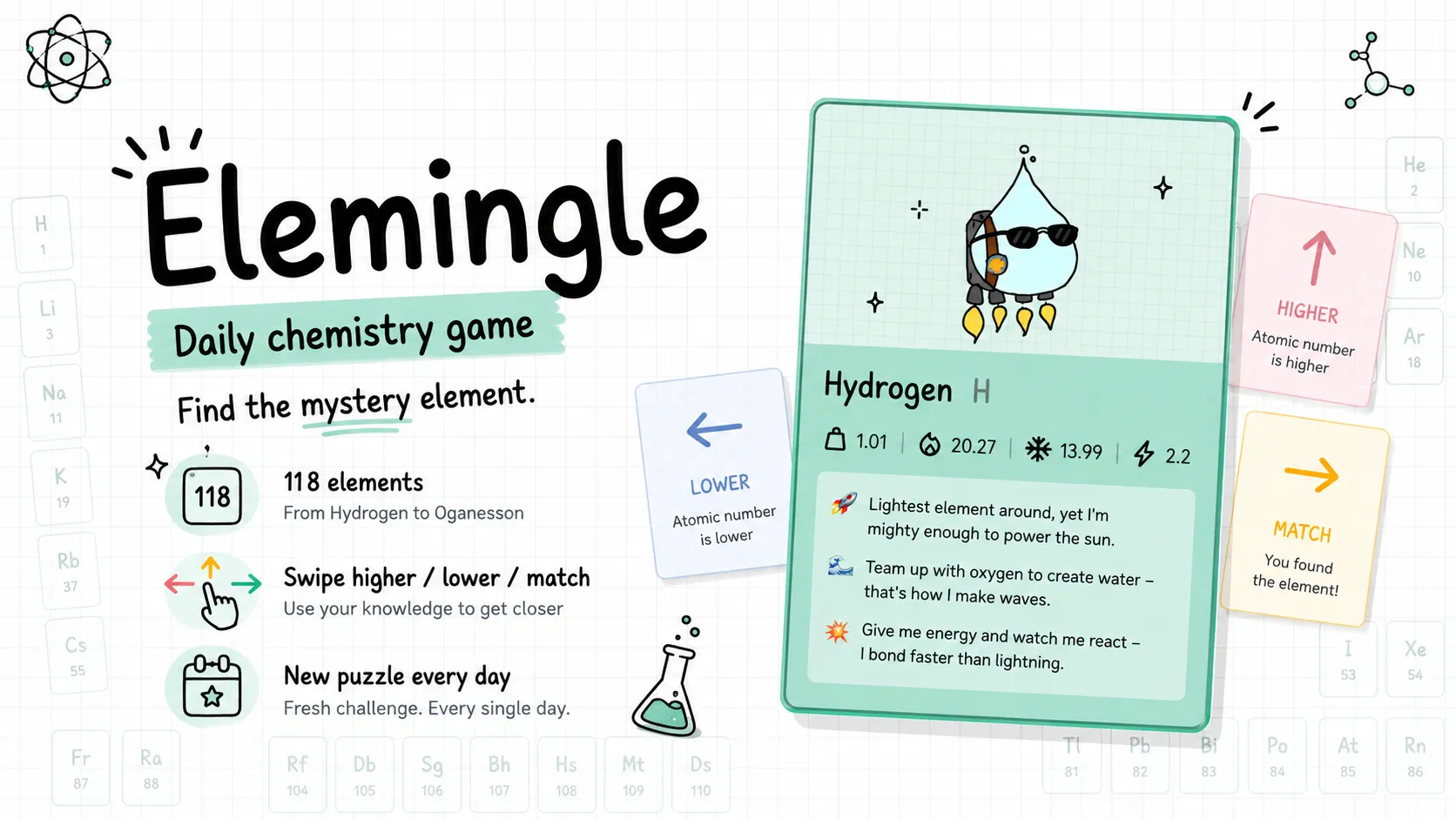
What is Elemingle?
Elemingle turns the periodic table into a deck of chemistry-powered dating cards. One element is secretly chosen as the Mystery Element, and every card you meet forces a decision: is this element lower, higher, or exactly equal to the hidden target in atomic number?
The atomic numbers themselves are concealed, so you must rely on memory, atomic weight, physical properties, category colors, playful trivia, deduction, and occasionally a brave dose of luck. Correct swipes squeeze the Mystery Element into an increasingly narrow section of the periodic table until you are ready to make the final match. A new target appears daily, while Practice Mode offers unlimited extra games.
Elemingle Game Rules (The Catch / The Trap)
Each game begins with a deck covering the 118 confirmed elements. Cards display an element's name, symbol, category, properties, and trivia—but NOT its atomic number.
ELEMENT CARD → COMPARE → SWIPE → UPDATE RANGE → REPEAT
- Swipe left — LOWER: Use
←when the element on the card has a lower atomic number than the Mystery Element. - Swipe right — HIGHER: Use
→when the card's element has a higher atomic number than the Mystery Element. - Swipe up — MATCH: Use
↑when you believe the displayed card is the Mystery Element. - Correct comparisons create bounds: The highest confirmed lower element becomes your lower boundary, while the lowest confirmed higher element becomes your upper boundary.
- Watch the periodic table: Colored borders mark the surviving range, and gray squares show elements that have been ruled out.
- Direct guesses are allowed: You can swipe up on the current card or use the answer form beneath the table.
- Wrong direct guesses are eliminated: An incorrect answer becomes gray but does not change the established range.
- Mistakes matter: The objective is not merely to finish—it is to uncover the element as cleanly as possible.
The trap is the swipe direction. You are judging the card relative to the Mystery Element, not telling the Mystery Element where to move.
Card atomic number is lower → ←
Card atomic number is higher → →
Card is the answer → ↑
A reversed comparison wastes a move and leaves the chemical suspect list dangerously wide.
How To Play Elemingle?
The atomic numbers below are shown for explanation; the real cards hide them.
Step 1: Establish a lower boundary
Card: Sodium — Na
You remember that sodium has atomic number 11 and suspect the Mystery Element appears later in the periodic table.
Player Swipes: ← LOWER
Result: Correct
What This Means: Sodium becomes a lower boundary.
Na (11) < Mystery Element
Step 2: Trap the target from above
Next Card: Bromine — Br
Bromine has atomic number 35. You bet that the hidden element comes before it.
Player Swipes: → HIGHER
Result: Correct
The surviving range is now squeezed between sodium and bromine:
Na (11) < Mystery Element < Br (35)
Step 3: Tighten the range
Next Card: Nickel — Ni
Nickel sits at atomic number 28. You decide that it is still higher than the target.
Player Swipes: → HIGHER
Result: Correct
Next Constraint:
Na (11) < Mystery Element < Ni (28)
The gray squares spread across the periodic table as impossible elements are eliminated.
Step 4: Make the final match
Next Card: Iron — Fe
Its atomic weight, transition-metal category, magnetic reputation, and position inside the remaining range all fit.
Player Swipes: ↑ MATCH
Result: Mystery Element found!
Iron is revealed as the answer, and the game records how many mistakes it took to reach the winning swipe.
Elemingle Strategy & Tips
Use atomic weight as an approximate compass. It generally rises alongside atomic number, although exceptions mean it should guide your reasoning rather than dictate every swipe.
Learn several strong anchors across the table:
H 1 → C 6 → O 8 → Na 11 → Fe 26 → Cu 29 → Ag 47 → Au 79 → U 92
These familiar elements help you judge unfamiliar cards without memorizing all 118 positions.
Read the card's background color. It identifies categories such as noble gases, alkali metals, transition metals, lanthanides, and actinides, which can reveal the element's general region of the table. Properties including atomic weight, melting point, boiling point, electronegativity, density, electron affinity, and discovery year can provide additional clues.
Once you establish both boundaries, stop treating the whole periodic table as possible. Concentrate only on the surviving elements and use the direct-answer form when one candidate clearly fits.
Finally, do not rush the upward swipe. A correct comparison still improves your range, but a false match eliminates your chosen element without moving either boundary.