
What is Headcount?
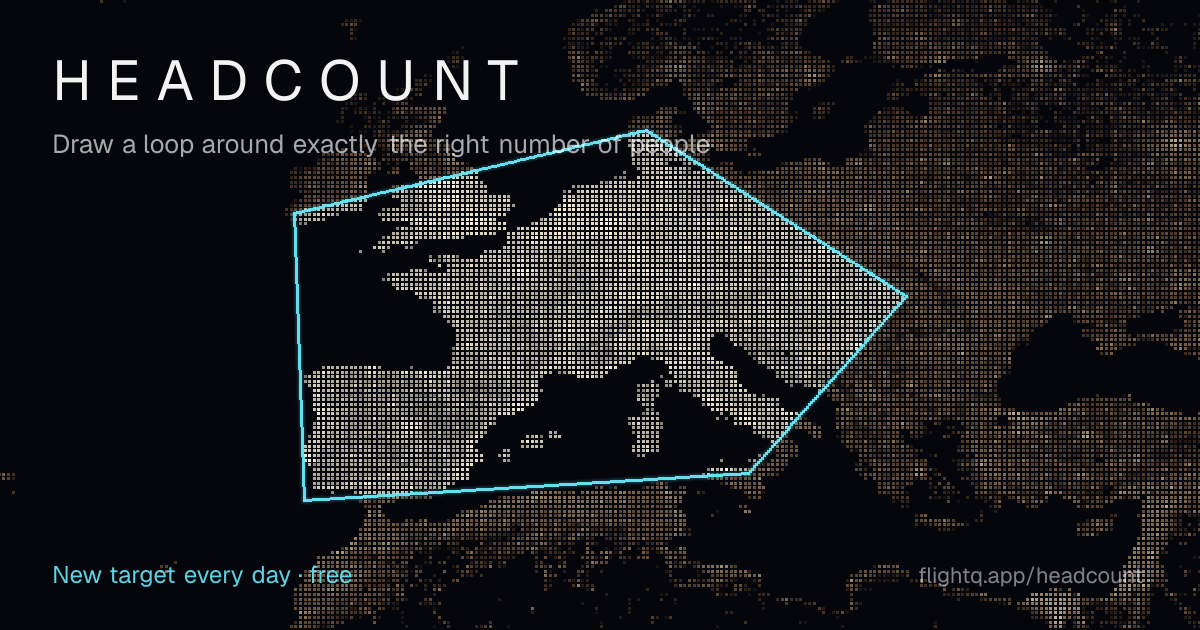
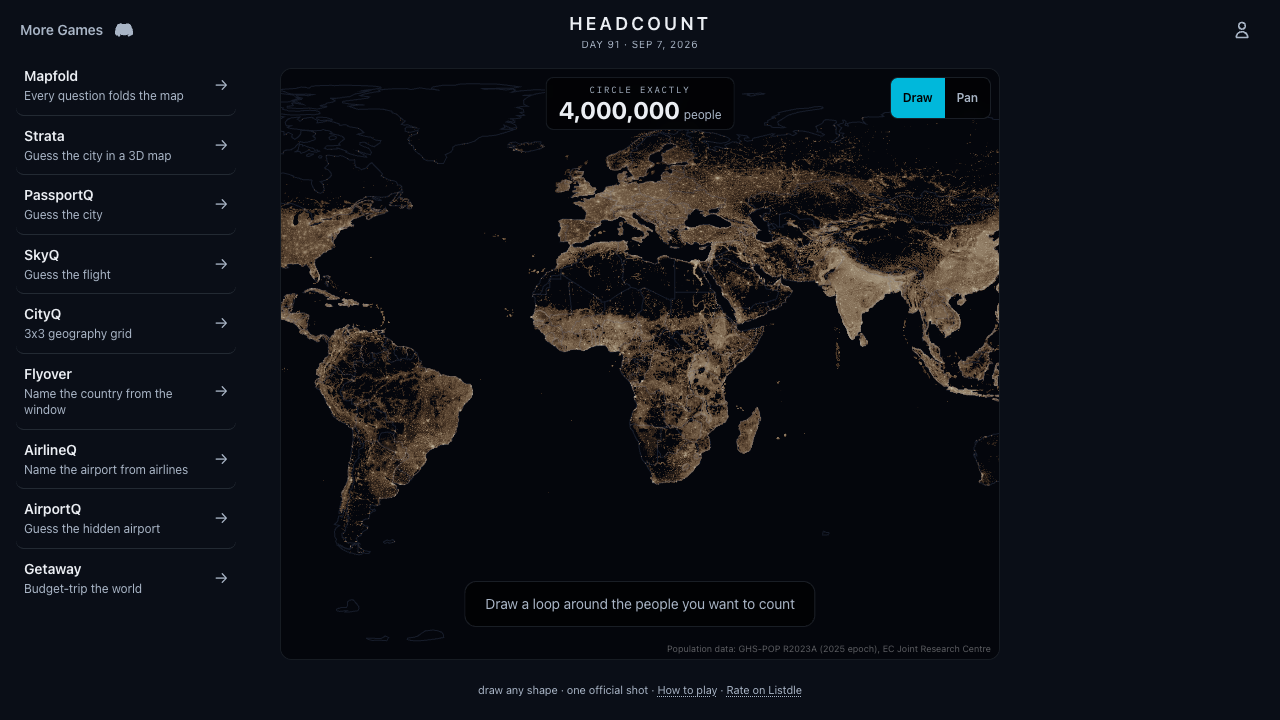
Headcount is FlightQ's daily population-estimation game. You receive a target number of people and draw a loop on a world map, trying to enclose a population as close to that target as possible. Dense settlements glow against darker, sparsely populated regions.
The challenge is about density, not land area. A small loop around a major urban cluster can contain more people than a much larger shape over a desert.
One official submission, with room to plan
Use Draw to trace the shape and Pan to navigate the map. You can move or redraw your loop before committing, so the one-attempt rule applies to the official locked result rather than your first pencil stroke.
The official attempt does not show a live population total while you draw. After you lock the shape, the game counts the population represented inside it and scores your closeness from 0 to 100. The score compares the ratio to the target: enclosing twice as many people and half as many people receive equivalent penalties.
How to make a measured attempt
- Read the target population and choose a region whose scale you know reasonably well.
- Pan or zoom to inspect the distribution of dense and sparse areas.
- Draw a loop around the settlements you think will add up to the target.
- Adjust or redraw the boundary if it captures an unintended urban cluster.
- Lock the official attempt and review the enclosed population and score.
Tips for estimating from the map
Use a familiar metropolitan area as an anchor, then think about what you are adding around it. A city's wider urban region may extend well beyond the boundary you picture when hearing its name.
Follow the visible concentration of people rather than drawing a neat geometric shape for its own sake. Coastlines and empty stretches can help you isolate a cluster, while dense neighboring corridors are easy to include accidentally. The map uses modeled population data, so the result is an estimate based on the game's dataset, not a live census count.