
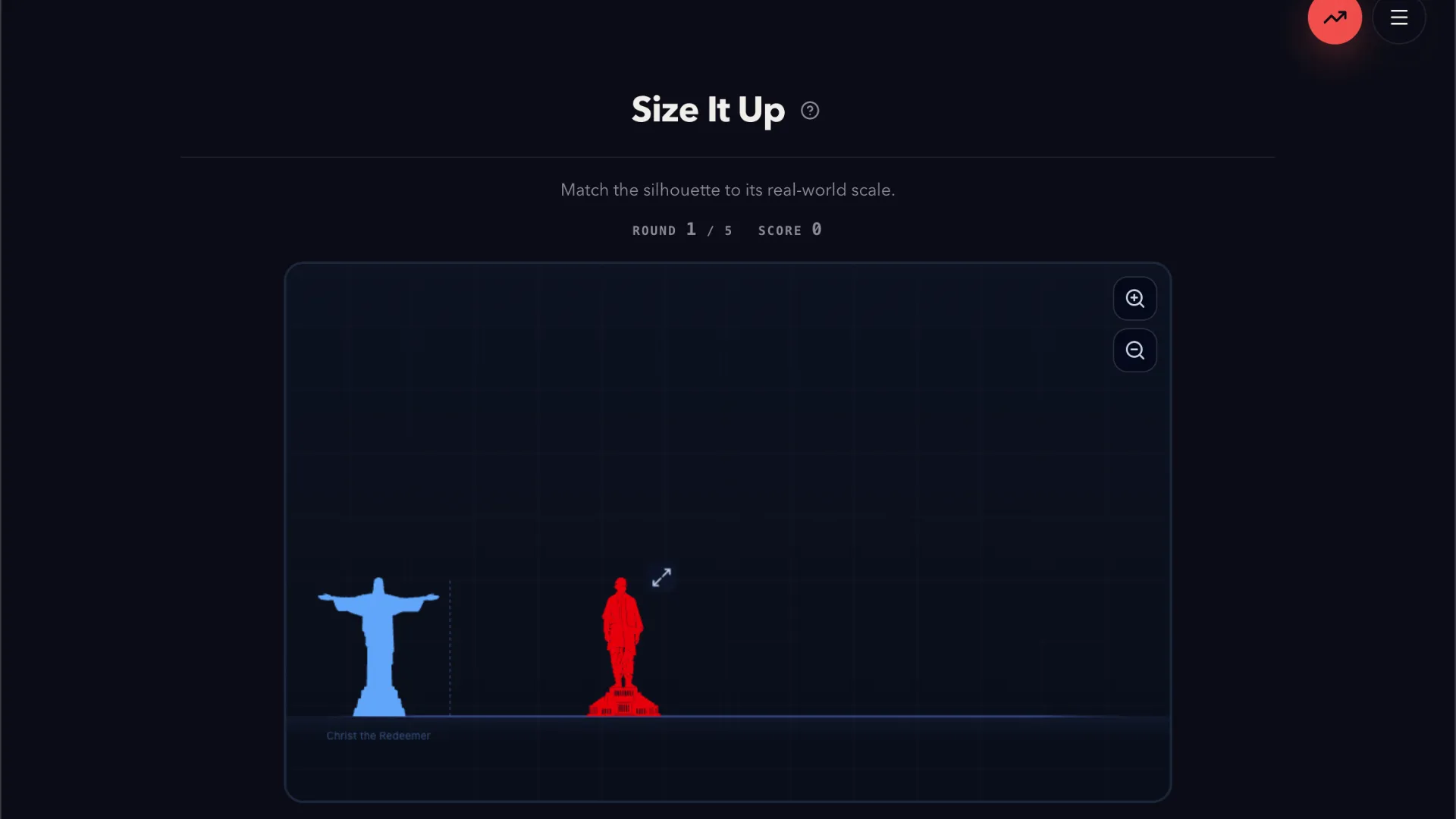
What Is Size It Up?
Size It Up is a daily visual estimation game from Magnitudle built around one deceptively simple question: how big is something compared with something you already know?
Instead of typing a measurement, you work visually. Each round shows a reference silhouette at a fixed, known scale and a second target silhouette whose size you can change. Resize the target until the relationship between the two looks realistic, then lock in your answer.
The true scale is revealed after your guess, along with a score based on how close you were. A daily game contains five comparisons, with up to 100 points per round and 500 points total.
The Core Size It Up Twist
Size It Up is about estimating proportions rather than exact numbers.
Imagine a round showing a bus as the fixed reference and a whale as the adjustable target. You are not being asked to type something like 27 metres. Instead, you decide visually whether the whale should look roughly the same length as the bus, twice as long, three times as long, or somewhere in between.
You then resize the whale silhouette to represent that belief.
That makes the reveal especially satisfying. Objects whose names and shapes are familiar can turn out to have surprisingly unintuitive real-world sizes when they are finally placed on the same scale.
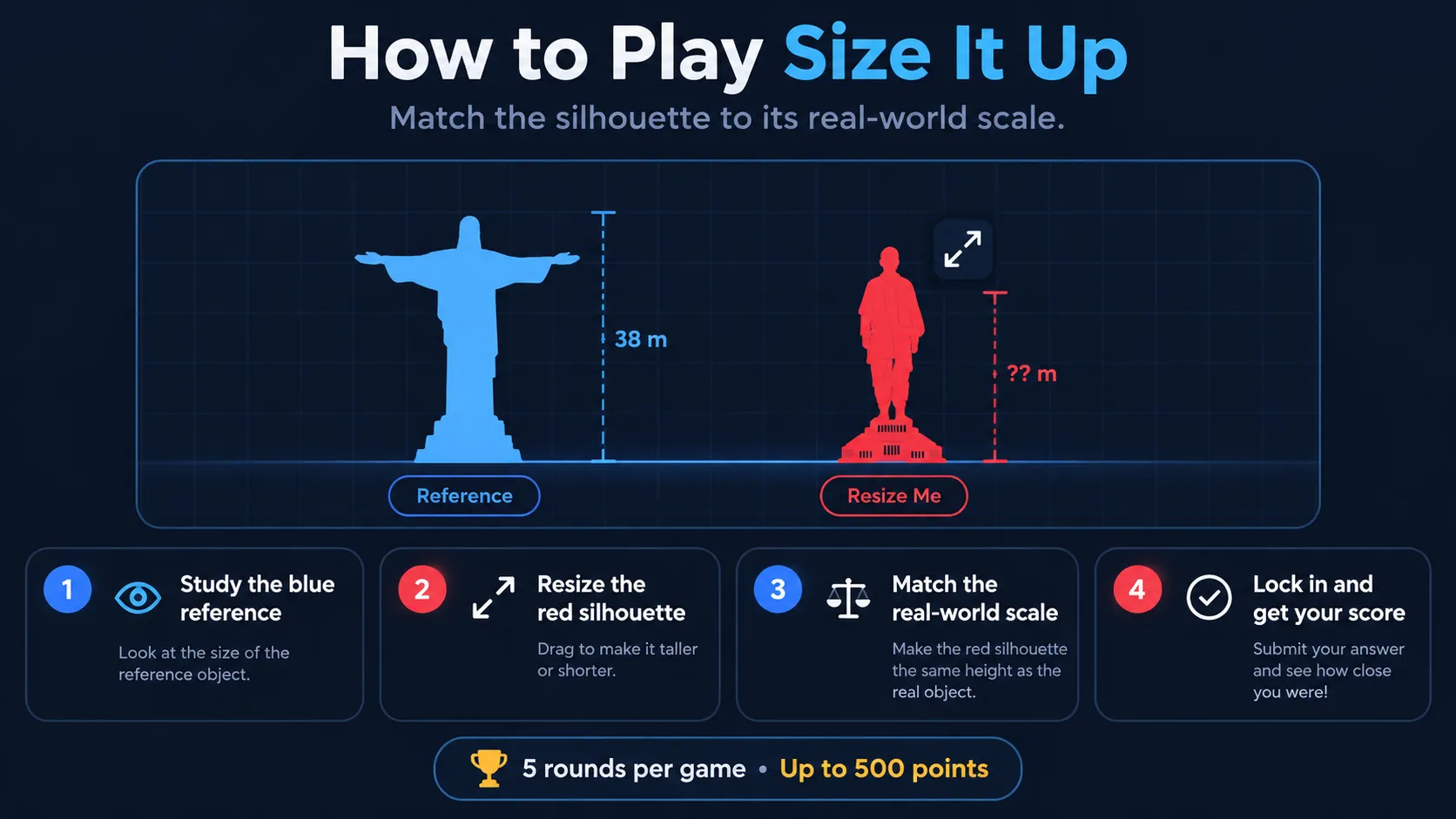
How to Play Size It Up
Study the reference. Each round gives you one silhouette that stays at its correct scale. Treat it as your measuring stick for the round.
Inspect the target object. Look at the second silhouette and think about its real-world size relative to the reference. Ask yourself whether it should be smaller, similar in size, twice as large, or many times larger.
Resize your guess. Adjust the target silhouette until the two objects look correctly scaled beside one another. The target changes size while the reference remains fixed.
Lock in the estimate. Commit when the proportion looks right. The game reveals the target's true scale and shows how close your visual estimate was.
Complete all five rounds. Each comparison can award up to 100 points, giving you a maximum daily score of 500.
A Simple Visual Example
Suppose the fixed reference is an animal about this large:
Reference: ████████
You initially think the mystery animal is only slightly larger:
Your guess: ██████████
But after locking in, the revealed scale might be closer to:
Actual: ████████████████
The important part is not reproducing an exact measurement. You are trying to make the ratio between the two silhouettes match reality.
Size It Up Strategy Tips
Think in ratios first. Before touching the controls, decide whether the target is approximately half, equal, twice, five times, or ten times the size of the reference. A rough ratio is easier to reason about than continuously resizing at random.
Use familiar objects as anchors. If you roughly know how large the reference is in real life, translate the mystery object into multiples of that reference. For example, ask how many reference lengths could fit inside the target's length.
Pay attention to the measured dimension. A long animal can have a modest height, while a tall structure may have a narrow footprint. Judge the dimension the game is comparing rather than the overall area of the silhouette.
Do not let shape fool you. A detailed or bulky silhouette can feel larger simply because it occupies more visual area. Size It Up rewards the correct scale relationship, not which object looks more visually imposing.
Remember surprising reveals. Daily rounds gradually build your intuition for animals, objects, landmarks, and other real-world scales. A wildly wrong answer today can become a useful reference point in a future puzzle.
Other Size It Up Modes
Magnitudle also offers themed Size It Up variants. Pop Culture applies the same scale-matching idea to fictional characters and objects, while Geography focuses on geographic shapes and places.
The original Size It Up is the best starting point if you enjoy estimation games, visual comparisons, surprising real-world facts, or short daily puzzles that can be finished in just a few minutes.