
What Is Perceptle?
Perceptle is a daily browser game that tests how accurately you can judge what you see, hear, and feel. Each session combines five short perception challenges into one overall score, asking you to estimate quantities, predict motion, measure angles by eye, maintain a rhythm, and judge proportions.
Instead of solving a hidden word or recalling trivia answers, you make intuitive judgments and discover how close they come to reality. The five challenges use different controls and skills, so being excellent at one doesn't guarantee a strong overall result. The game is designed around a quick session of approximately two minutes, but improving your accuracy across all five tests can take practice.
Perceptle Rules and Core Twist
Perceptle's standard daily challenge consists of five tests played in a fixed order: Count, Track, Angle, Tempo, and Split. Each asks for a different kind of estimate, replacing traditional puzzle deduction with visual observation, spatial reasoning, and timing.
The Five Perception Tests
| Test | Your Challenge | How You Respond |
|---|---|---|
| Count | Estimate how many dots appeared during a brief flash | Enter a number |
| Track | Predict where a moving ball will land after it disappears | Click or tap a landing position |
| Angle | Match a requested angle without a protractor | Rotate a line using its handle |
| Tempo | Maintain a musical pulse after the guiding beats stop | Tap in rhythm |
| Split | Identify a requested fraction or percentage along a line | Drag to the correct position |
Count: How Many Dots Did You See?
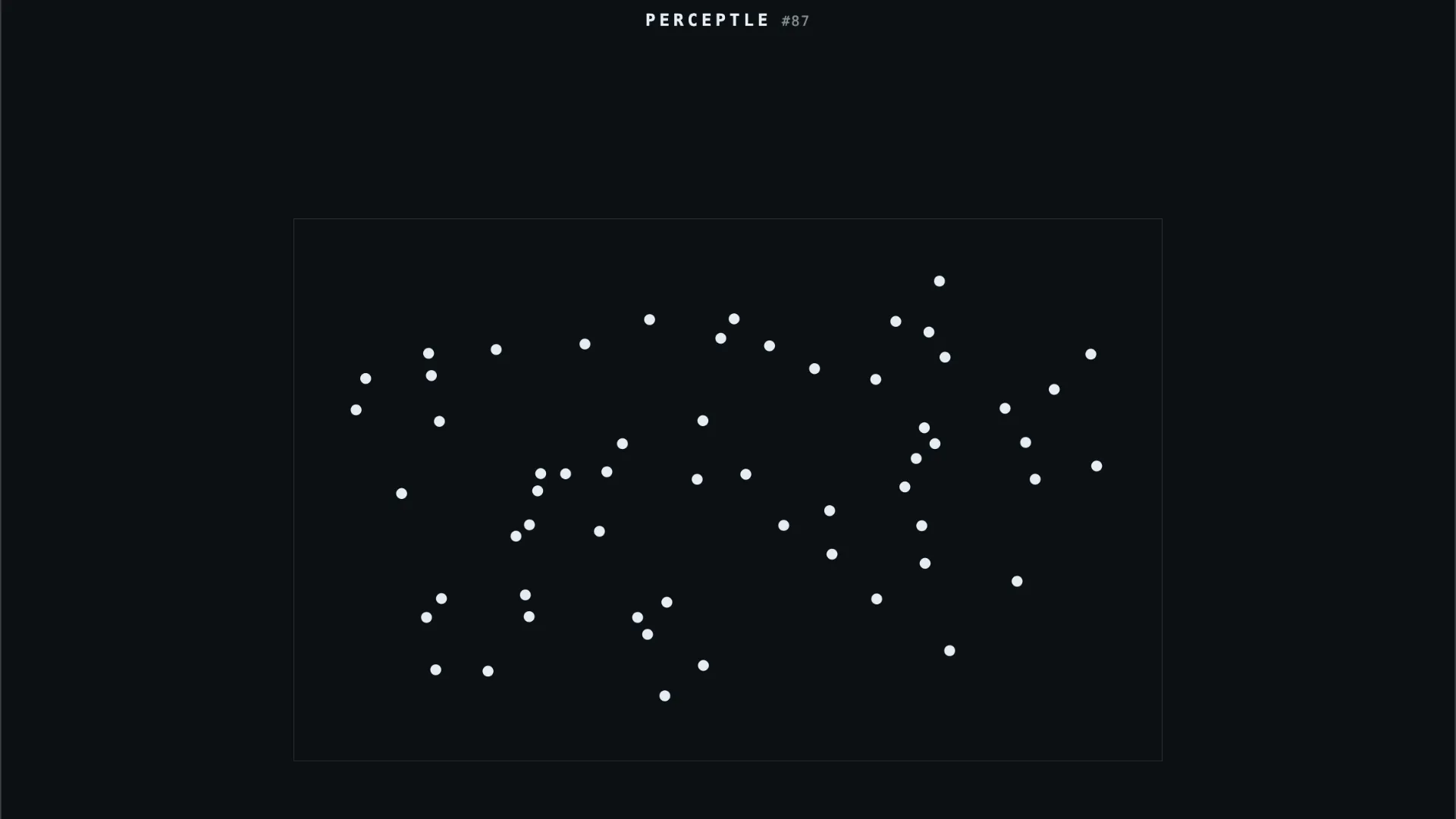
A group of dots appears briefly before disappearing. In a normal round, the dots are visible for approximately two seconds. Your task is to estimate their total and enter a whole number.
The challenge is recognizing quantity quickly rather than counting every dot individually. A crowded or unevenly distributed pattern makes this harder than it initially appears.
Track: Where Will the Ball Land?
Watch a ball move along a curved trajectory. Partway through its flight, the ball disappears. You must predict where it will eventually reach the ground and select that horizontal position.
The ball's visible motion provides clues about its direction and trajectory. Simply selecting the spot directly beneath its last visible position can produce a poor estimate because the ball continues moving horizontally.
Angle: Can You Rotate to the Target?
The game provides an angle in degrees. Drag a handle to rotate a line counterclockwise from the dashed reference baseline until it matches the requested measurement.
A target of 90° represents a quarter turn, while 180° represents a half turn. Other angles require a more precise visual estimate.
The important distinction is that you are constructing an angle rather than guessing the measurement of an existing shape.
Tempo: Can You Keep the Beat?
Tempo tests your internal sense of timing. Listen to four audible beats and tap along to establish the rhythm. When the guiding beats stop, continue the same pulse for eight additional taps.
The challenge is maintaining consistent timing without an audible reference. You can tap the game area or use the Space bar on a keyboard.
Because this test depends on sound, make sure your device volume is enabled before starting.
Split: Where Does the Fraction Belong?
The game displays a line and asks you to mark a particular fraction or percentage of its length. The instruction specifies which endpoint to measure from.
For example, locating one-quarter of a line from the left means placing the marker 25% of the way toward the right endpoint. Measuring from the opposite end would produce a different position.
Read the starting endpoint carefully before dragging your marker into place.
How Scoring Works
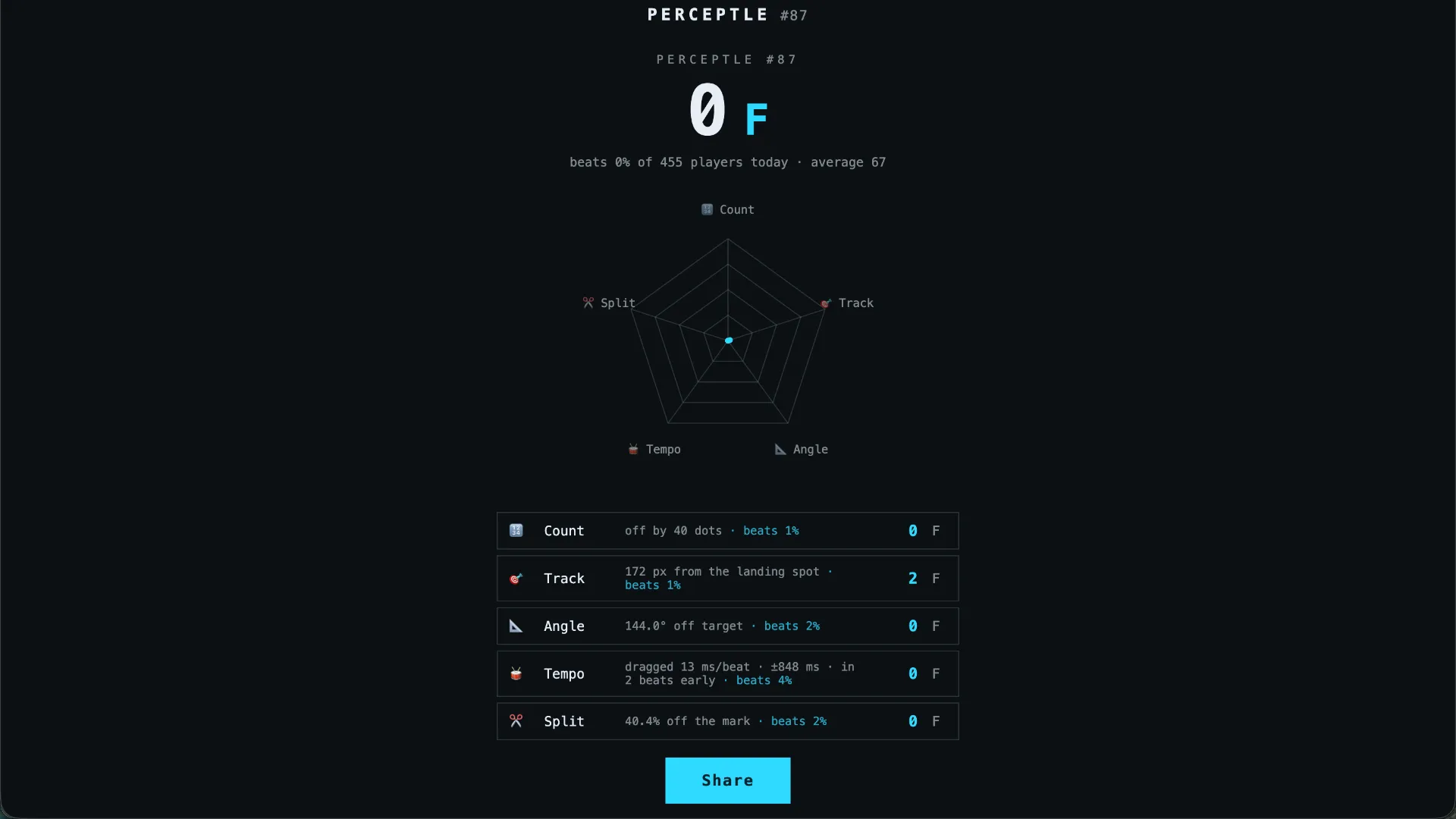
Each of the five tests awards an accuracy score out of 100. Your estimate is compared with the correct value or target, and smaller errors generally produce higher scores.
The final result is the rounded average of your five test scores, rather than the sum of all five.
For example, suppose your five scores are:
| Test | Example Score |
|---|---|
| Count | 80 |
| Track | 90 |
| Angle | 70 |
| Tempo | 85 |
| Split | 95 |
The combined result would be (80 + 90 + 70 + 85 + 95) ÷ 5 = 84 out of 100.
This is an illustrative scoring example, not a recorded daily result. Perceptle also assigns a grade based on your overall performance.
The central twist is consistency: an excellent result in one test can be offset by a much weaker result in another.
What Changes on Fridays?
Perceptle also features special Friday variations that modify the normal challenges. These can introduce moving dots, bouncing ball trajectories, angles requiring more than a complete revolution, off-beat rhythm tasks, and fractions extending beyond the original line segment.
Read the instructions for the current round instead of assuming every challenge follows its standard behavior. In particular, a Friday angle may require multiple complete turns, not just the correct final direction.
How to Play Perceptle
Step 1: Estimate the Dot Count
Start the daily challenge and read the Count instructions. When the dots appear, look at the overall density and distribution rather than trying to count them one by one.
After the display disappears, enter your estimated total. The game reveals the actual number and your error, showing how accurately you judged the quantity.
Step 2: Predict the Ball's Landing
In Track, observe the ball's visible trajectory and pay attention to its direction and movement before it disappears.
Select the horizontal position where you believe the ball will land. The result compares your prediction with the actual landing point, helping you see whether you estimated too far to the left or right.
Step 3: Set the Requested Angle
Read the target angle and locate the dashed reference line. Drag the handle counterclockwise around the center to position the line at your estimated angle.
Release the handle to submit your judgment. The game reveals the difference between your selected angle and the target, making it easier to recognize whether you tend to overrotate or underrotate.
Step 4: Follow and Continue the Rhythm
Turn on sound before the Tempo challenge. Listen to the four guiding beats and tap along to establish their spacing.
When the audible guidance stops, continue tapping eight times at the same interval. The result evaluates your timing accuracy, revealing how closely your taps maintained the intended pulse.
Step 5: Mark the Fraction and Review Your Score
For Split, read the fraction or percentage and check whether the measurement begins from the left or right endpoint.
Drag your marker to the estimated position and release it to submit. The game compares your placement with the target.
After completing all five tests, review the combined score and grade. The game's Keep playing option provides another practice set, while Archive allows access to previous daily puzzles.
Perceptle Strategy Tips
1. Estimate Dot Groups Instead of Individual Dots
For Count, mentally divide the field into smaller regions. Estimate how many dots occupy one region, then scale up while adjusting for differences in density.
For example, if four similarly sized regions appear to contain roughly 15 dots each, an initial estimate would be around 60. This is an estimation technique, not a specific Perceptle puzzle answer.
Avoid spending the entire brief display counting a single corner while ignoring the rest of the field.
2. Follow the Ball's Direction, Not Just Its Last Position
In Track, focus on the visible arc and how far the ball is moving horizontally. The landing position depends on where its trajectory continues, not merely on where it disappears.
Try to visualize the remaining curve before selecting your answer. For rounds with bouncing trajectories, account for changes in direction after a collision.
3. Use Familiar Angle Landmarks
For Angle, establish the nearest familiar reference before making smaller adjustments:
- 45°: Half of a right angle.
- 90°: One-quarter of a full turn.
- 180°: Half of a full turn.
- 270°: Three-quarters of a full turn.
- 360°: One complete revolution.
For a target of 110°, first identify 90°, then rotate another 20° counterclockwise.
For Friday challenges involving angles greater than 360°, count the complete revolutions before positioning the final direction. A 450° rotation requires one full turn plus another 90°.
4. Maintain a Physical Rhythm
For Tempo, concentrate on the interval between beats rather than reacting independently to each sound.
Continue a consistent tapping motion after the guidance stops. Players sometimes accelerate or slow down without noticing, so maintaining the same physical movement can help preserve the pulse.
If you are using a keyboard, the Space bar provides an alternative to clicking or tapping the screen.
5. Check the Starting Endpoint in Split
For Split, identify the measurement origin before estimating the requested fraction.
A fraction of one-quarter measured from the right is not the same screen position as one-quarter measured from the left.
Use familiar proportions such as halves, quarters, and thirds as visual anchors. If a special challenge requests a fraction greater than one whole, recognize that the correct position may extend beyond the displayed segment.
6. Learn From the Direction of Your Errors
Perceptle's accuracy feedback is more useful when you pay attention to how you missed, not just how many points you received.
If your landing predictions consistently fall short, consider whether you are underestimating the ball's remaining horizontal motion. If your rhythm drifts late, focus on keeping your tapping interval consistent.
Your final average also identifies opportunities for improvement. Raising a weaker test score can improve the overall result more efficiently than trying to perfect a round in which you already performed exceptionally well.
7. Adjust Your Approach to Each Test
Perceptle deliberately changes the skill being tested from one round to the next. A useful numerical grouping method for Count does not help with Tempo, and the spatial references used for Angle are different from the motion cues needed for Track.
Read each prompt carefully, switch to the appropriate estimation technique, and use the revealed errors to make more informed judgments in future rounds.