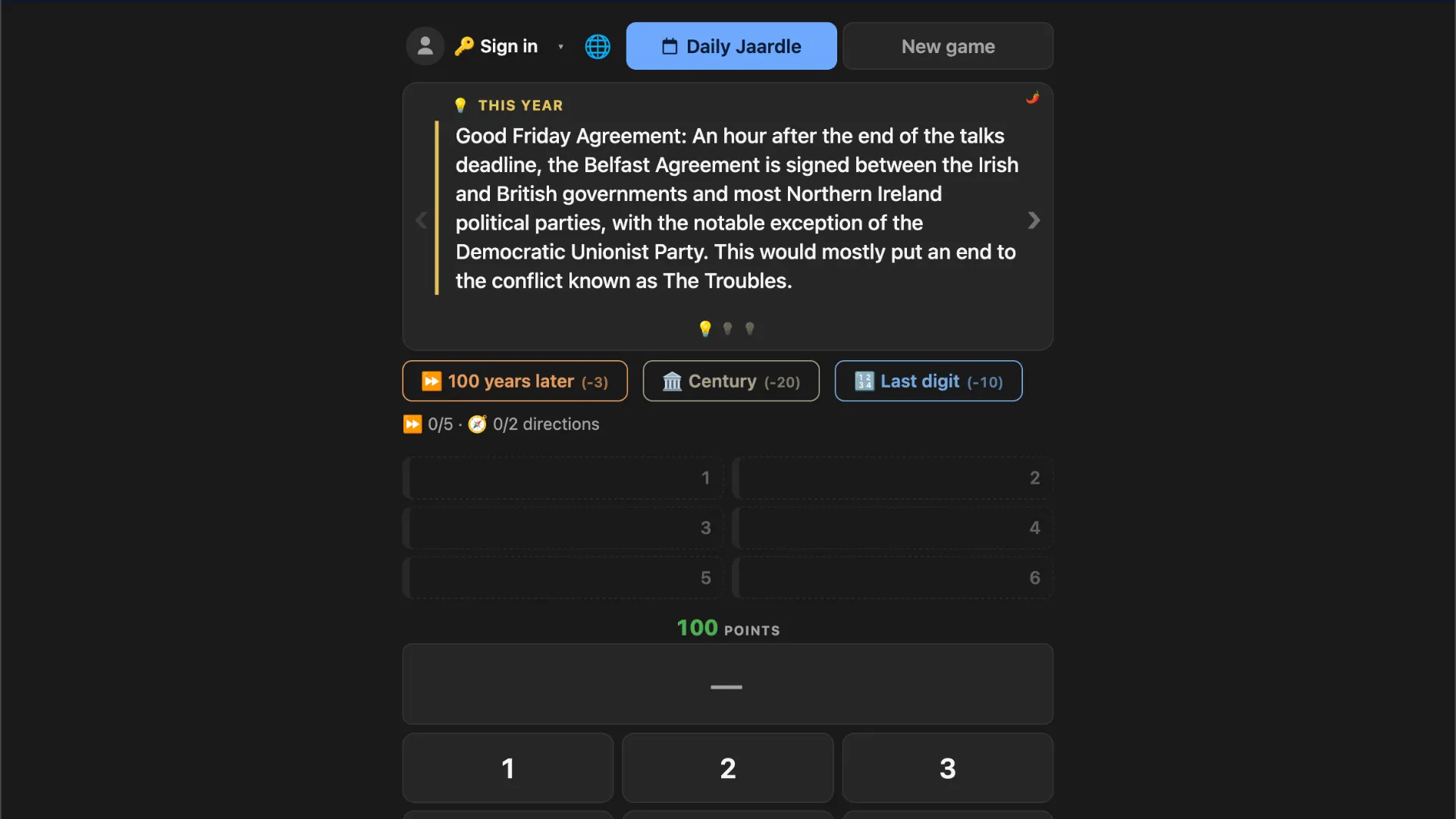

What Is Jaardle?
Jaardle is a daily history guessing game built around one simple question: what year did this happen? You begin with a historical event and have up to six guesses to identify the exact year.
The appeal is that Jaardle is not purely a memory test. Wrong answers tell you how far away you are, and early misses reveal additional historical facts tied to the same target year. That gives you new evidence to work with instead of leaving you to guess blindly. There is a shared daily puzzle as well as an endless mode for more rounds.
Rules and Core Twist
Enter a year for the event shown on screen. If the event is from BC/BCE history, years can be entered with a minus sign.
You get six attempts. After each guess, Jaardle shows a distance badge indicating how close your year is to the answer. The closest bands include:
- Green: exact year
- Purple: 1–2 years away
- Yellow: 3–10 years away
- Increasingly distant feedback for larger gaps, reaching black at 600+ years away
After the first two guesses, Jaardle also reveals bonus facts from the target year. These clues can be more useful than the original event because they let you triangulate the date from several pieces of history.
Optional hints add another strategic layer. You can ask for higher-or-lower direction help, and other hints can reveal information such as the century or final digit of the year. Using help costs points, so solving from knowledge and proximity feedback is rewarded more strongly.
Example of the Feedback
If the hidden answer were 1945, a sequence could look like this:
| Guess | Feedback | What it tells you |
|---|---|---|
| 1940 | Yellow | You are within 3–10 years |
| 1944 | Purple | You are only 1–2 years away |
| 1945 | Green | Exact year |
The important information is the distance from the answer, not letter placement or a Wordle-style grid.
How to Play Jaardle
- Read the starting event carefully. Place it in a broad era first: ancient, medieval, early modern, industrial, twentieth century, or recent history.
- Enter a plausible year. Your first guess establishes a reference point, and the distance feedback tells you whether your mental timeline is close.
- Use the new facts after early guesses. Compare the bonus events with dates you know and look for intersections between politics, science, wars, culture, or technology.
- Narrow to the exact year. Once the feedback reaches the 3–10-year or 1–2-year range, make precise guesses. If you are stuck, spend a hint rather than throwing away the remaining attempts.
Strategy Tips
Start with the century or decade, not the exact date. Recognizing that an event belongs around the 1780s is much more useful than making an unsupported exact-year guess.
Treat bonus facts as independent anchors. If the first clue is unfamiliar but a later clue mentions a ruler, invention, conflict, or cultural milestone you recognize, use that better-known event to reset your estimate.
Save paid hints for when they can collapse the remaining search space. A century hint is far more valuable when your initial guess is hundreds of years away than when you already know you are within a decade.
When you are very close, avoid large jumps. Purple feedback means the answer is only one or two years from your guess, so test the adjacent years systematically.
For ancient-history rounds, remember that Jaardle accepts BC/BCE years as negative numbers, which lets the same guessing mechanic cover a much wider historical range.