What Is Jihanki?
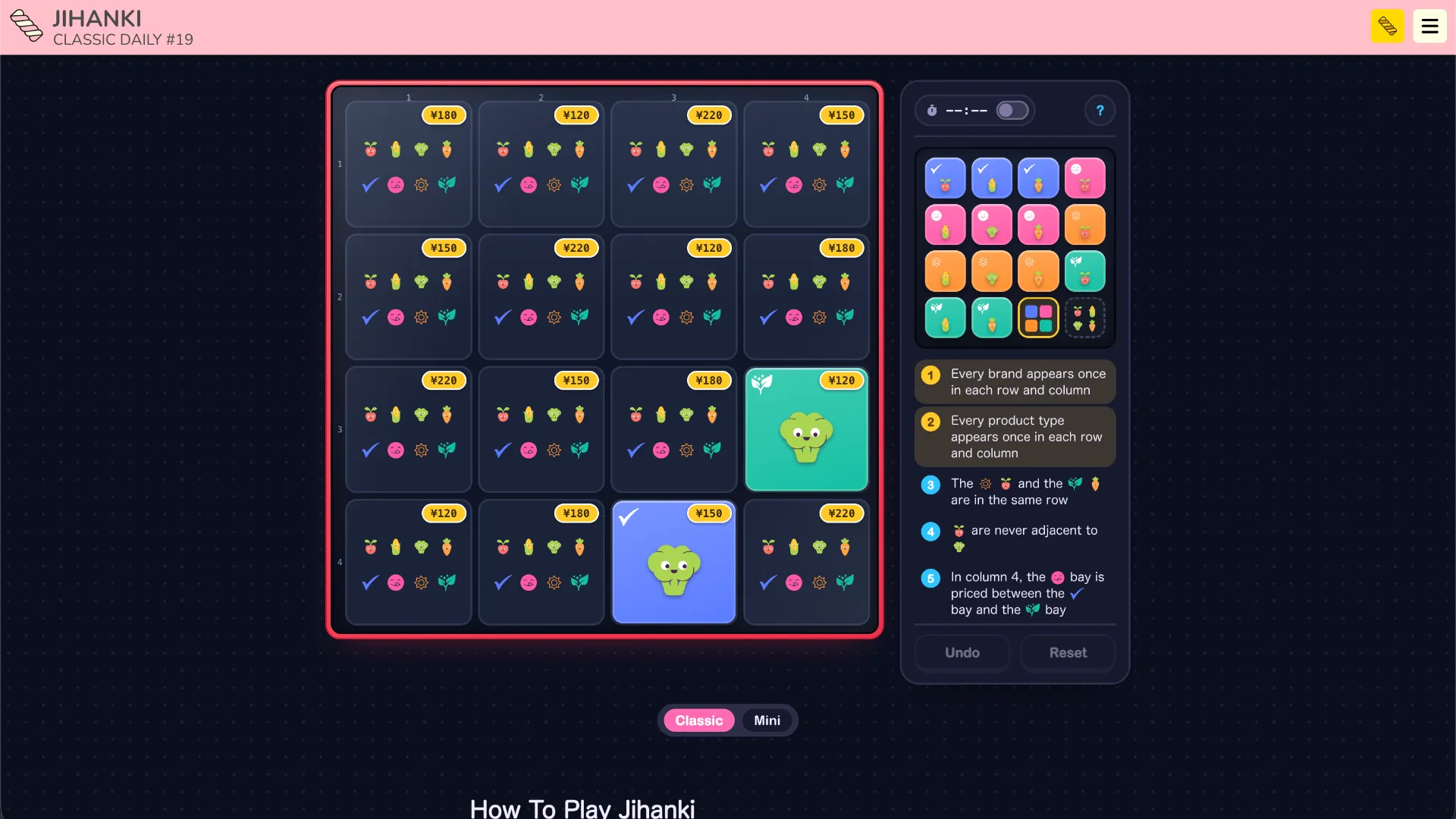
Jihanki is a daily logic puzzle created by Puzzmallow that transforms the familiar rules of Sudoku into a Japanese vending machine restocking challenge.
The name comes from the Japanese word for vending machine, 自販機 (jihanki). Instead of filling a grid with numbers, players must arrange products inside a vending machine according to a collection of logical constraints.
Every product combines two attributes: a brand and a product type. Your goal is to place the products into the machine so that each brand appears exactly once in every row and column, and each product type follows the same rule.
However, Jihanki introduces an additional challenge beyond traditional Sudoku. Every possible brand-and-type combination must appear exactly once across the entire board. Daily placement rules involving positions, neighboring products, and sometimes prices provide further clues about where everything belongs.
The game offers two free daily difficulty formats: Mini, a 3×3 grid designed for a quicker introduction, and Classic, a more challenging 4×4 puzzle. Puzzmallow also lists an additional members-only board.
Every puzzle has exactly one solution that can be reached through logical deduction without guessing.
Jihanki Game Rules
The objective is to restock the vending machine by placing every available product into the correct bay.
Several important rules apply to every puzzle.
1. Every Brand Appears Once Per Row and Column
Each product belongs to a particular brand.
In Classic mode, four brands appear in the puzzle. Each brand must appear exactly once in every row and once in every column.
For example, if a row already contains an Allgood product, no other product from Allgood can occupy another bay in that row.
2. Every Product Type Appears Once Per Row and Column
Products also have types, such as fruit, vegetables, drinks, or meals, depending on the daily theme.
Each type must appear exactly once in every row and column.
This means a product placement must satisfy two independent conditions simultaneously: its brand cannot repeat in the row or column, and neither can its type.
3. Every Brand-and-Type Pairing Is Unique
A central Jihanki rule is that every possible combination of brand and product type appears exactly once.
For example, if a particular brand sells both carrots and broccoli, there is one product representing each pairing. You cannot use the same pairing twice or leave one out of the finished machine.
This creates an additional deduction constraint that is not present in ordinary number-based Sudoku.
4. Follow the Daily Placement Rules
Every puzzle includes extra conditions that determine how products should be arranged.
These may involve where particular products belong, which items sit next to one another, or information associated with the price labels displayed in the vending machine bays.
The specific conditions change between puzzles, so reading the Placement Rules section is essential before starting.
5. Adjacency Is Orthogonal
When a clue says two products are adjacent, they must share an edge.
Valid adjacent positions are directly above, below, left, or right. Diagonal contact does not count.
If a rule states that every product of one kind must be adjacent to a product of another kind, each qualifying product needs at least one such neighbor. The same neighboring product can satisfy that requirement for multiple items.
6. Pre-Stocked Products Cannot Be Moved
Some vending machine bays contain products when the puzzle begins.
These are fixed starting clues. You must leave them in place and work out how to arrange the remaining products around them.
How to Play Jihanki
- Choose your puzzle size: Visit Jihanki on Puzzmallow. Select Mini for a quick 3×3 introduction or Classic for a more challenging 4×4 daily puzzle.
- Read the placement rules: Examine the vending machine grid, its pre-stocked products, the available products in the restock crate, and the daily rules. Identify any restrictions involving brands, types, prices, or adjacent bays.
- Pick up a product: Tap or click a product in the Restock section to select it. Then tap an empty vending machine bay to place that product.
- Continue using logical deduction: Check every placement against the row, column, pairing, and special-rule requirements. If you need to change a placement, tap a loaded bay to return its product to the crate. Use the game's note-taking and Undo tools to manage your deductions.
- Complete the vending machine: Place all remaining products until the entire grid satisfies every rule. Every puzzle has one logically deducible solution, so careful reasoning is more useful than random experimentation.
Example: How Jihanki's Logic Works
Consider a simplified 3×3 vending machine puzzle with three imaginary brands and three product types.
Brands:
- Brand A
- Brand B
- Brand C
Product types:
- Apple
- Banana
- Cherry
Because there are three brands and three types, the completed machine contains nine unique combinations.
An illustrative valid arrangement is:
| Column 1 | Column 2 | Column 3 | |
|---|---|---|---|
| Row 1 | A + Apple | B + Banana | C + Cherry |
| Row 2 | B + Cherry | C + Apple | A + Banana |
| Row 3 | C + Banana | A + Cherry | B + Apple |
Notice how this arrangement satisfies the core rules.
Every row contains each brand once. Row 1 contains A, B, and C. The other rows follow the same principle.
Every column contains each brand once. Column 1 contains A, B, and C in a different order.
Every row and column contains each product type once. Apple, Banana, and Cherry are never repeated within any individual row or column.
Every pairing is unique. Across the complete grid, Brand A appears once with Apple, once with Banana, and once with Cherry. The same is true for Brands B and C.
In a real Jihanki puzzle, some bays would already be filled, and the daily placement rules would provide additional restrictions. Your task would be to reconstruct the one arrangement that satisfies everything.
This example demonstrates the game's core logic rather than reproducing an actual daily solution.
Understanding Jihanki's Special Clues
The additional placement rules distinguish Jihanki from an ordinary Latin-square puzzle.
Adjacency Clues
An adjacency clue restricts which products must appear next to one another.
Imagine a hypothetical rule stating that every apple must be adjacent to a banana.
Under that rule, each apple would need at least one banana directly above, below, left, or right. A banana positioned between two apples could satisfy the adjacency requirement for both of them.
Diagonal relationships would not satisfy the rule.
Position Clues
Some daily restrictions concern where products can be placed within the machine.
Use those clues alongside the row and column rules rather than treating them independently.
A placement that initially seems possible may become impossible once you consider its effect on the remaining products.
Price-Related Clues
Jihanki displays price labels on its vending machine bays, and some daily rules involve those prices.
Read the exact wording carefully. A price-related condition can eliminate otherwise valid brand-and-type arrangements.
Because prices are tied to bays, it is important to consider where an item is placed rather than assuming every product has one unchanging price.
Jihanki Game Modes
Jihanki provides different grid sizes for players with different levels of experience.
| Mode | Grid Size | Number of Bays | Experience |
|---|---|---|---|
| Mini | 3×3 | 9 | Shorter, easier introduction |
| Classic | 4×4 | 16 | More demanding logical deduction |
| Members-only board | Not specified | Not specified | Additional puzzle for members |
Mini Mode
Mini uses a 3×3 grid and is the recommended starting point for new players.
With fewer products and fewer possible positions, it is easier to understand how brand uniqueness, type uniqueness, and special placement rules work together.
Mini is also suitable for players who want a quick daily logic challenge.
Classic Mode
Classic expands the vending machine to a 4×4 grid.
With 16 bays, four brands, four product types, and additional placement constraints, the number of possible arrangements becomes much larger.
The challenge is to eliminate impossible combinations systematically until only one valid solution remains.
Classic is particularly appealing to experienced Sudoku and logic-grid players.
Jihanki Controls and Helpful Tools
Jihanki includes several tools designed to support logical problem-solving.
Product Selection
Select a product from the restock crate and tap an empty bay to place it.
If you change your mind, tap a product you previously loaded into the machine to return it to the crate.
Products supplied as fixed starting clues cannot be removed.
Cross-Out and Highlight Notes
You can cross out or highlight icons in individual bays to record possible placements.
Highlighting one icon crosses out the remaining icons in its group, making it easier to track deductions.
These markings are especially useful in Classic mode, where each empty position can initially have several candidates.
Undo
The Undo button reverses your most recent action.
Use it when you accidentally move a product or change a note.
Reset
Reset clears your work so you can begin solving the current board again.
This is useful when an earlier incorrect assumption has caused multiple conflicting placements.
Sort the Restock Crate
You can toggle between sorting the available products by brand and sorting them by product type.
Grouping items by brand can make missing brand combinations easier to identify, while grouping by type can help reveal gaps in the row and column constraints.
Optional Timer
Jihanki includes a timer that you can toggle while solving.
Players who enjoy speed-solving can use it to track their completion times, while those who prefer a relaxed deduction experience can focus on accuracy.
Jihanki Strategy and Tips
1. Begin With Fixed Products
Start by examining the bays that are already stocked.
Every fixed product eliminates its brand and type from the other positions in its row and column.
Mark those exclusions before placing anything else.
2. Track Brands and Types Separately
A product has two independent attributes, so do not evaluate it using only one.
For example, a carrot from Brand A might satisfy a row's brand requirement but violate the column's product-type requirement.
The placement is valid only when both attributes work together.
3. Use the One-of-Everything Rule
Every brand must be paired with every product type exactly once.
If three combinations involving a particular brand have already been placed in Classic mode, the brand's remaining product type is determined.
This can reveal information that is not immediately obvious from the row and column rules alone.
4. Read Special Rules Before Filling Easy Spaces
A product may look like the only logical option for a bay based on brand and type restrictions, but you must also consider the daily special rules.
Check adjacency, position, and price conditions before committing to a placement.
5. Use Notes Instead of Guessing
If multiple products appear possible for one bay, record those candidates rather than choosing randomly.
As you solve neighboring positions, previously ambiguous choices may become forced.
The puzzle creator states that every board has a unique solution reachable through logic alone, so trial-and-error guessing is unnecessary.
6. Check Adjacency Both Ways
When evaluating an adjacency condition, consider every product affected by the rule.
If one item must touch another, confirm that there is at least one available neighboring bay that can contain the required product.
A proposed placement may be impossible if it leaves another item with no valid neighbor.
7. Change Your Sorting View
If you become stuck while thinking about brands, switch the restock crate to product-type sorting.
Looking at the same remaining products from a different perspective can expose missing combinations that were previously overlooked.
8. Practice in Mini Before Classic
The 3×3 Mini puzzle teaches the same core principles with fewer possibilities.
Once you are comfortable tracking two simultaneous row-and-column constraints, the larger Classic puzzle becomes easier to approach systematically.
Jihanki vs Sudoku
Jihanki shares Sudoku's emphasis on unique values in rows and columns, but adds several distinctive mechanics.
| Feature | Jihanki | Traditional Sudoku |
|---|---|---|
| Main theme | Japanese vending machine | Number grid |
| Standard grid | 3×3 or 4×4 | 9×9 |
| Pieces | Branded products | Numbers 1–9 |
| Row uniqueness | Brands and types | Numbers |
| Column uniqueness | Brands and types | Numbers |
| Unique pairings | Required | Not applicable |
| Extra daily rules | Yes | Not in standard Sudoku |
| Pre-filled clues | Yes | Yes |
| Main skill | Constraint deduction | Numerical placement logic |
Jihanki is best described as a Sudoku-inspired constraint puzzle rather than a direct Sudoku clone.
It requires players to manage two overlapping sets of attributes while satisfying additional relationships between products and positions.
Is Jihanki Free to Play?
Yes. Puzzmallow provides free daily Mini and Classic versions of Jihanki on its website.
The game runs directly in a browser without requiring a separate application download.
Puzzmallow also describes an additional members-only board, so not every available puzzle is necessarily part of the free offering.
The daily themes rotate among categories such as drinks, fruit, vegetables, and meals, providing visual variety while keeping the underlying logical structure consistent.
Frequently Asked Questions
What is Jihanki?
Jihanki is a daily vending machine logic puzzle from Puzzmallow. Players restock a grid with products while ensuring that every brand and product type appears once in every row and column and that all additional placement rules are satisfied.
What does Jihanki mean?
Jihanki refers to a vending machine in Japanese. The puzzle uses this concept as its theme, turning product restocking into a logical deduction challenge.
Is Jihanki a Sudoku game?
Jihanki is inspired by Sudoku but has different mechanics. Instead of numbers, it uses products with two attributes: brand and type. It also requires unique brand-and-type pairings and introduces additional placement conditions.
How many products are in Jihanki?
Mini has nine bays in a 3×3 grid, while Classic has 16 bays in a 4×4 grid. Each product represents a unique combination of brand and type.
Does Jihanki have a new puzzle every day?
Yes. Puzzmallow describes Jihanki as a daily puzzle game with changing placement rules and rotating product themes.
Can Jihanki be solved without guessing?
Yes. According to the official instructions, every Jihanki puzzle has exactly one solution reachable through logical deduction.
What does adjacent mean in Jihanki?
Adjacent means directly above, below, left, or right. Diagonal positions do not count.
Can you move pre-stocked products?
No. Products already placed in the machine when the puzzle begins are fixed clues and cannot be returned to the restock crate.
What is the difference between Mini and Classic?
Mini is a quicker 3×3 puzzle intended for beginners, while Classic uses a larger 4×4 grid and presents a more challenging deduction experience.
Does Jihanki have a timer?
Yes. The game includes an optional timer that players can toggle to track their solving time.
What should you do if you get stuck?
Review the daily placement rules, check which brands and types remain available in each row and column, and use cross-out notes to eliminate impossible combinations. Switching how the restock crate is sorted can also help.
Who Should Play Jihanki?
Jihanki is particularly appealing to players who enjoy Sudoku, logic grids, constraint-satisfaction puzzles, and daily brain teasers.
Its vending machine setting gives abstract deduction a playful visual theme, while the two-attribute product system creates an additional challenge beyond ordinary number placement.
Mini offers an approachable introduction, and Classic provides a deeper challenge for players who enjoy methodically eliminating possibilities.
The daily rotating themes and changing placement rules help keep the format interesting without requiring players to learn a completely different game each day.
Conclusion
Jihanki is a creative Sudoku-inspired puzzle that replaces numbers with vending machine products and adds a distinctive combination of brand, product type, adjacency, position, and price constraints.
Its most satisfying moments come from identifying how several independent clues intersect to force a particular product into one specific bay.
With free daily Mini and Classic puzzles, useful deduction tools, and uniquely solvable boards, Jihanki is a strong choice for players who prefer thoughtful logic challenges over random guessing.
Ready to restock the machine? Play Jihanki for free on Puzzmallow and see whether you can solve today's vending machine puzzle.