What is Metaflora?
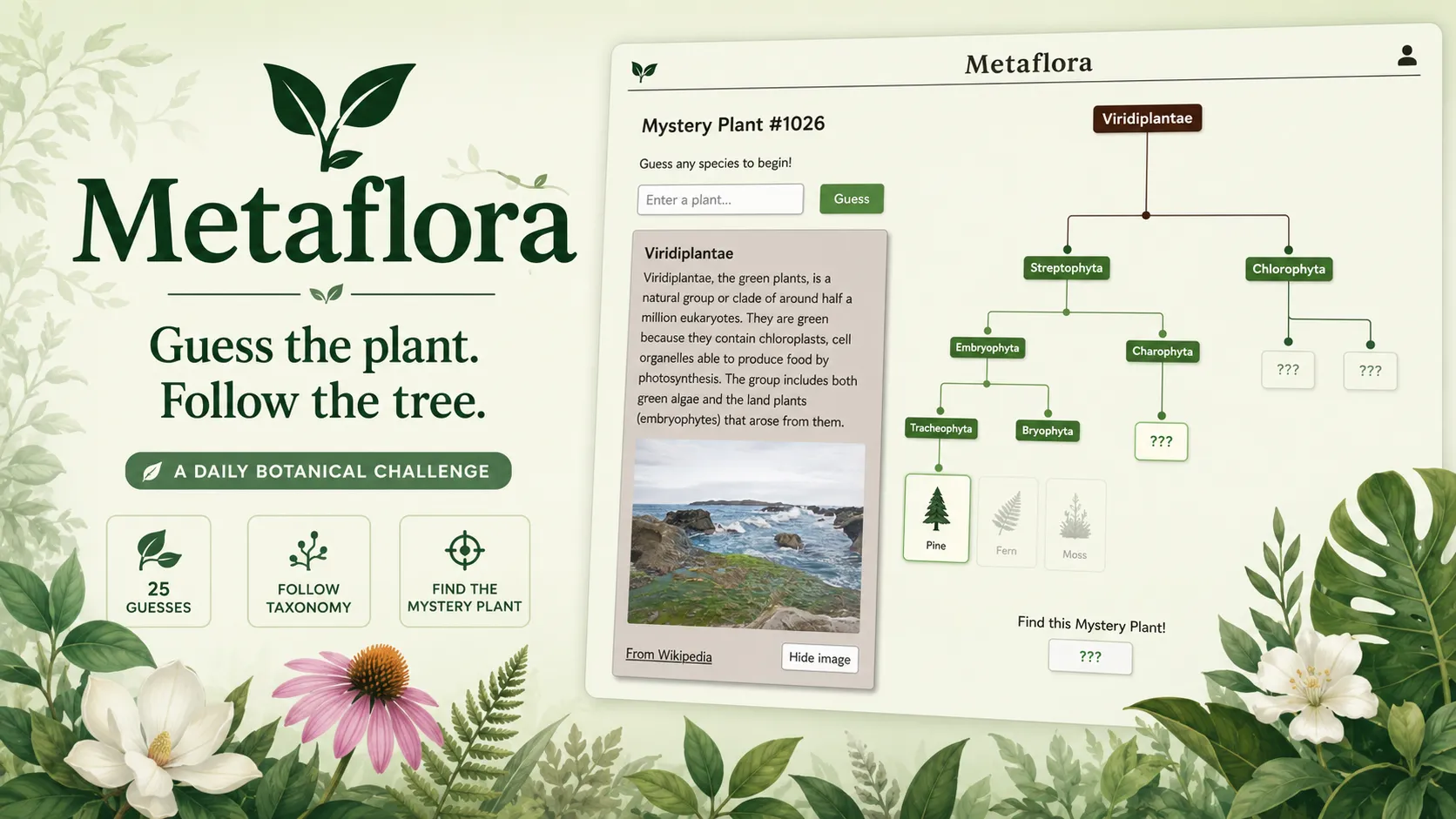
Metaflora hides one plant somewhere inside the enormous family tree of green life. Enter any plant you know, and the game reveals how closely your guess is related to the Mystery Plant. Every attempt adds another branch to the investigation.
This is not a photo-identification quiz. You are navigating taxonomy itself, moving through broad groups, orders, families, genera, and species until the answer has nowhere left to hide. You receive 25 guesses, but unfamiliar botanical branches can make that generous limit disappear surprisingly fast.
Metaflora Game Rules (The Catch / The Trap)
The daily botanical hunt follows this cycle:
GUESS A PLANT → REVEAL SHARED TAXONOMY → GROW THE TREE → NARROW THE BRANCH
- One Mystery Plant per day: Everyone hunts for the same hidden species.
- Twenty-five guesses: You MUST identify the plant before all 25 attempts are spent.
- Enter a plant name: Choose a recognized plant from the game's search list.
- Wrong guesses remain useful: Each attempt is placed on a phylogenetic tree beside the hidden answer.
- Shared branches reveal closeness: A guess sharing only a broad clade is cold; one sharing an order, family, or genus is much warmer.
- Deeper matches are stronger clues: Reaching the correct family or genus sharply reduces the possible answers.
- Exact plant wins: The puzzle ends when your guess matches the Mystery Plant.
The trap is that everyday similarity does not always equal evolutionary closeness. Two plants may both be trees, vegetables, or flowers while belonging to distant branches. Metaflora rewards taxonomy, not appearance alone.
Shared kingdom → very broad clue
Shared family → getting warm
Shared genus → answer nearby
Exact species → solved
How To Play Metaflora?
Step 1: Plant a broad opening guess
Player Guesses: Oak
Game Response: The guess joins the tree, but its branch separates from the Mystery Plant relatively early.
What This Means: The answer is a green plant, but oak is not a close relative. You need a different botanical direction.
Step 2: Test another major branch
Player Guesses: Tomato
Result: The tree shows a much deeper shared path, reaching the nightshade family.
Shared family: Solanaceae
Next Constraint: The Mystery Plant is likely another member of the nightshade family.
Step 3: Probe inside the family
Player Guesses: Bell pepper
Result: It shares the correct family but splits before the genus level.
You now know the answer is probably not in Capsicum, so another Solanaceae genus deserves attention.
Step 4: Follow the closest branch
Player Guesses: Eggplant
Result:
Shared genus: Solanum
What This Means: You are extremely close. The answer belongs to the same genus as eggplant.
Step 5: Name the Mystery Plant
Player Guesses: Potato
Result: Mystery Plant found!
The final branch connects, the daily plant is revealed, and the taxonomic expedition is complete.
Metaflora Strategy & Tips
Begin with plants from very different groups. A flowering plant, conifer, fern, grass, and moss can quickly reveal which major branch contains the answer.
Once a guess shares a family or genus with the Mystery Plant, stop exploring distant categories. Concentrate every remaining attempt inside that confirmed branch.
Use familiar crops and garden plants as anchors. Tomato, rose, wheat, pine, sunflower, bean, and cabbage belong to well-known groups and can provide useful early reference points.
Read the tree from broad to specific. The important question is not merely whether two guesses look close on screen, but which named taxonomic rank they share before their paths divide.
Finally, switch to the table view when the growing tree becomes crowded. Comparing shared ranks directly can make the next botanical move easier to see.