
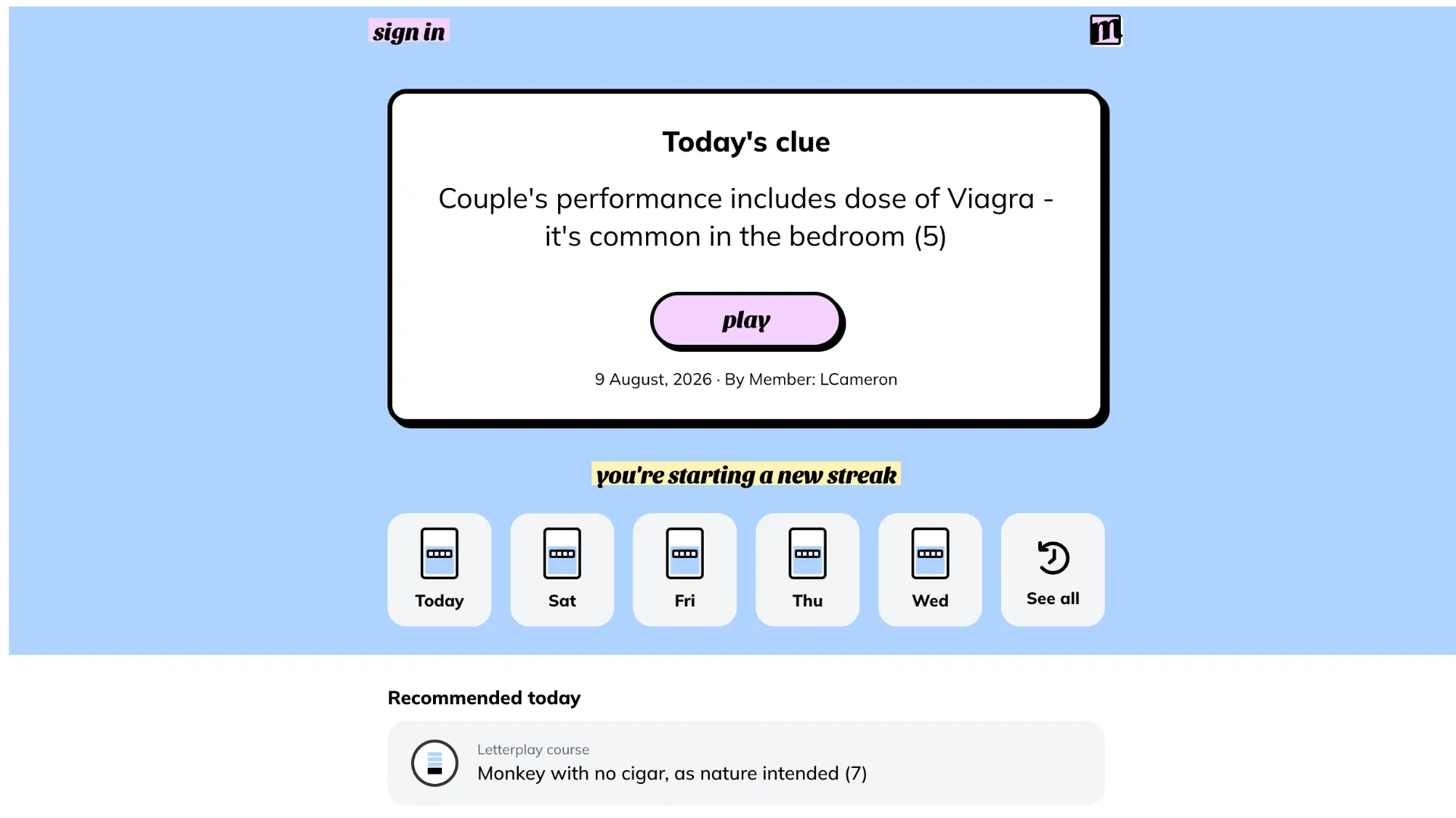
What is minute cryptic?
Minute Cryptic takes one of the most intimidating parts of a traditional crossword — the cryptic clue — and turns it into a compact daily challenge. Instead of facing an entire grid packed with mysterious clues, you get one clue a day, with hints and explanations available when you need them.
The battle is not simply finding a word that matches the clue. A cryptic clue usually contains two routes to the same answer: a direct definition and a disguised piece of wordplay. The sentence on the surface may sound perfectly normal, ridiculous, or deliberately misleading, while hidden underneath are instructions telling you how to construct the answer.
minute cryptic Game Rules (The Catch / The Trap)
The central trap is simple: do not read the clue only as an ordinary sentence. Almost every word may be doing another job underneath the surface.
A typical clue can be mentally split like this:
DEFINITION + WORDPLAY → ANSWER
The wordplay can contain:
- Definition: A relatively direct meaning of the final answer.
- Fodder: Letters or words that will be manipulated.
- Indicator: A word telling you what operation to perform — for example, rearranging, reversing, selecting, hiding, deleting, or combining letters.
- Enumeration: The number in brackets shows the expected answer length, such as
(5).
Minute Cryptic uses familiar cryptic-crossword techniques including anagrams, hidden answers, reversals, substitutions, containers, deletions, homophones, double definitions, and other forms of letterplay.
If you get stuck, you CAN use the built-in hints. These can expose parts of the clue structure or reveal letters from the answer, making the game useful for learning cryptic solving rather than turning every puzzle into an all-or-nothing guess.
How To Play minute cryptic?
Here is a simulated solve using a simple cryptic-style example:
Clue: Rock from mixed notes (5)
1. Read the surface
Player sees: Rock from mixed notes (5)
At first it sounds like something involving music. That natural interpretation is the disguise.
What you learn: The answer contains 5 letters, but the sentence probably has a second meaning.
2. Hunt for the definition
Possible Definition: Rock
Cryptic definitions are often positioned near the beginning or end of a clue, so Rock is a strong candidate.
Next Constraint: Find a five-letter word meaning rock.
3. Decode the wordplay
Fodder: NOTES
Indicator: mixed
mixed suggests rearranging the letters:
N O T E S → rearrange → S T O N E
What you learn: The wordplay independently produces STONE.
4. Lock in the answer
Player Enters: STONE
Definition check: STONE = rock
Wordplay check: STONE = anagram of NOTES
✅ Both halves agree, so the clue is solved.
That double confirmation is the satisfying core of Minute Cryptic: you are not merely guessing a plausible word — you are proving why it must be the answer.
minute cryptic Strategy & Tips
Look at the edges first. The definition is often found near the beginning or end of a cryptic clue.
Learn indicator vocabulary. Words suggesting mixing, reversing, hiding, removing, surrounding, or sounding alike can expose the clue's mechanism.
Use the answer length aggressively. If you need five letters, immediately discard otherwise tempting six- or seven-letter possibilities.
Demand two explanations. A candidate answer should normally satisfy both the definition and the wordplay. If only one side works, you probably have not cracked the clue yet.
Use hints as training tools. Revealing part of the clue structure can help you recognize the same cryptic mechanism much faster the next time it appears.