
What Is Noggin?
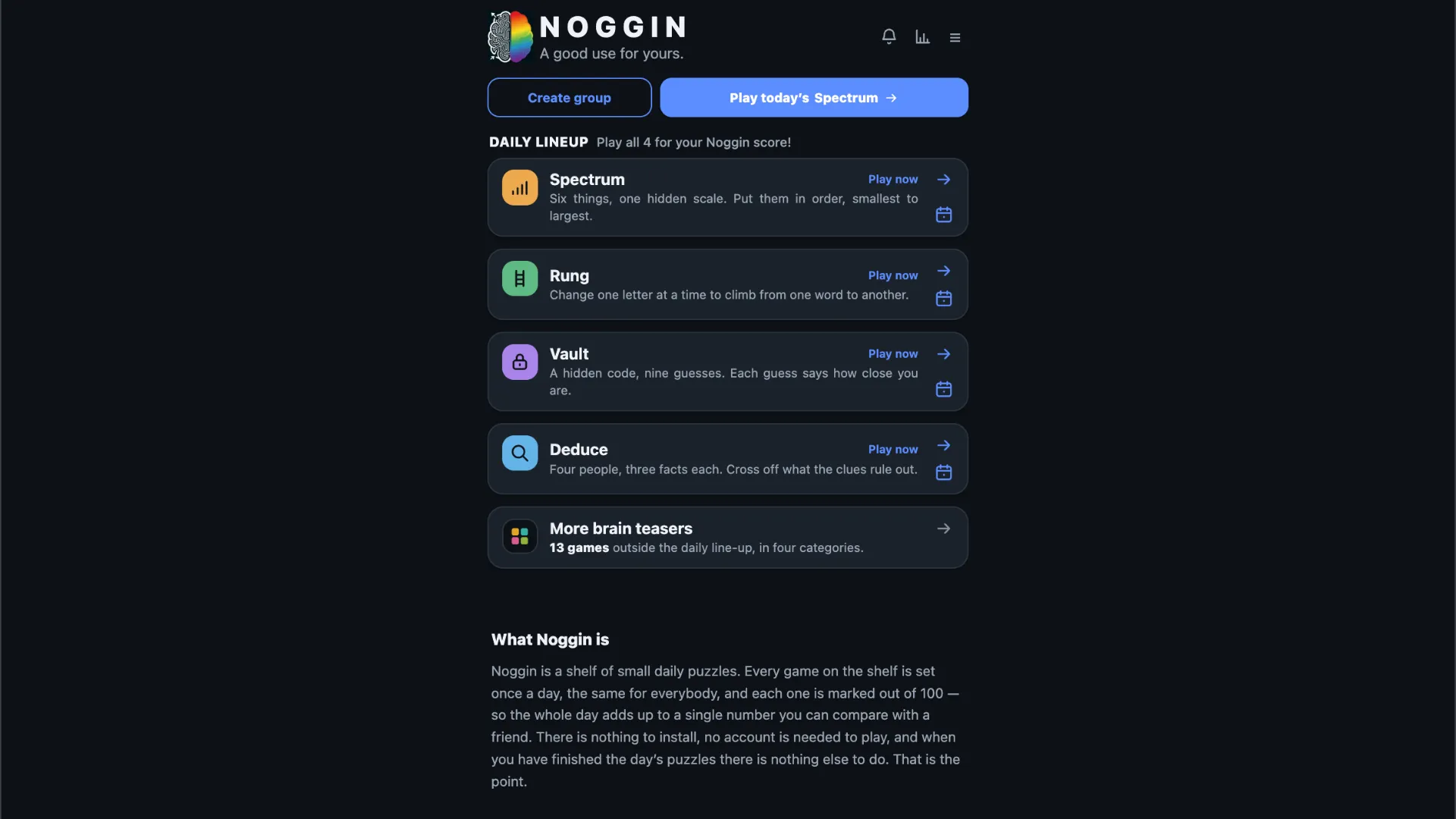
Noggin is a free browser-based collection of short daily brain puzzles designed to challenge different thinking skills. Instead of offering just one type of puzzle, Noggin brings together four distinct daily games: Spectrum, Rung, Vault, and Deduce.
Each game tests a different ability, from arranging objects in the correct order to building word ladders, cracking hidden codes, and solving logic grids. Every player receives the same puzzles each day, making it easy to compare results with friends.
The main attraction is Noggin's combined scoring system. Each of the four daily puzzles is worth up to 100 points, giving players a possible total of 400 points per day. Completing puzzles efficiently earns higher scores, while partial progress can still receive credit even when a puzzle is not fully solved.
Beyond the four main challenges, Noggin features 13 additional daily brain teasers covering words, numbers, estimation, visual reasoning, spatial skills, and memory.
Noggin is free to play at noggin.games. No download or account is required, and results are saved automatically in your browser. Optional email sign-in helps preserve your progress across devices.
The Four Daily Noggin Games
Noggin's main daily lineup contains four puzzles with different mechanics. Completing all four produces your combined daily score.
1. Spectrum – Put Six Things in Order
Spectrum is an ordering puzzle built around a hidden numerical scale.
You receive six items and must arrange them in the correct order according to a specified property. Depending on the puzzle, that might mean sorting things from smallest to largest, lightest to heaviest, oldest to newest, or mildest to hottest.
The game does not require you to know exact measurements. Instead, it rewards your ability to make reasonable comparisons and estimate relative positions.
How Spectrum works:
- Examine the six items and the direction of the scale.
- Drag tiles into position or tap two tiles to swap them.
- Press Check to evaluate your arrangement.
- Correctly positioned tiles turn green and lock in place.
- Rearrange the remaining tiles before your next check.
You have three checks to complete the board. Solving it on your first check earns 100 points, while success on the second or third check earns 85 or 70 points respectively.
Even if you cannot finish the entire arrangement, correctly locked tiles contribute to a partial score.
Strategy tip: Start by identifying the obvious extremes. Once you know the smallest and largest items, compare the remaining candidates against one another instead of trying to estimate every item's exact value.
2. Rung – Climb a Word Ladder
Rung is a word transformation puzzle where players move from a starting word to a target word by changing one letter at a time.
Every intermediate step must form a real word accepted by the game. The goal is not simply to reach the destination, but to use as few steps, called rungs, as possible.
For example, an illustrative ladder from COLD to WARM could be:
COLD
  ↓
CORD
  ↓
CARD
  ↓
WARD
  ↓
WARM
Each transition changes exactly one letter, and every intermediate result is a valid English word.
How Rung works:
- Examine the starting word and target word.
- Select a letter in your current word.
- Replace it with another letter to create a valid word.
- Continue changing one letter at a time until you reach the target.
- Try to finish within the displayed par to earn the maximum score.
Rung also includes a special Leap move, available once per daily puzzle. It allows you to change two letters in a single move, but costs two rungs. The destination must still be a valid word.
Undo, Reset, and Hint controls help when you become stuck. However, undoing ordinary steps and resetting the ladder do not erase previously spent rungs from your score. A hint reveals a useful next word and adds two rungs to your total.
Strategy tip: Work backward from the target word and look for short connecting chains. Avoid changing letters randomly, because detours increase the number of rungs you use.
3. Vault – Crack a Hidden Symbol Code
Vault is a deduction puzzle inspired by classic code-breaking games such as Mastermind.
Your objective is to discover a secret sequence of symbols within nine guesses. The code contains five positions, and the available symbol palette consists of five shapes selected from a larger set.
After each guess, the game provides three types of feedback:
- Exact: A symbol is correct and appears in the correct position.
- Near: A symbol appears in the hidden code within one position of where you placed it.
- Far: A symbol belongs in the code but is more than one position away from your guessed location.
The feedback tells you how many symbols fall into each category, but does not identify which particular symbols produced those results.
For example, a response might be:
Exact: 2
Near:  1
Far:   1
This tells you that two symbols are in the correct positions, one is close to its correct position, and another belongs elsewhere in the sequence. It does not reveal which symbols received each classification.
Symbols can repeat, so players must consider both placement and the number of occurrences of each symbol.
Vault includes optional hints that identify the status of individual symbols from previous guesses. Each hint costs 10 points.
Strategy tip: Use early guesses to discover which symbols appear in the code before concentrating on their precise order. Avoid repeating guesses that provide little new information.
4. Deduce – Solve a Logic Grid Mystery
Deduce is Noggin's traditional logic-grid challenge.
Each puzzle features four people and three categories of information to determine for each person. The clues reveal relationships, exclusions, and ordering constraints, allowing players to work out the only possible arrangement.
For example, a fictional puzzle might ask you to determine which person owns each pet, works in each profession, and lives on each floor.
A clue could say:
- Ben does not own the parrot.
- Eve owns the parrot.
- The musician lives exactly two floors above another person.
Players use these statements to eliminate impossible combinations until every person's attributes are known.
How Deduce works:
- Read the clues carefully.
- Tap possibilities in the grid to cross them out.
- When only one possibility remains, that cell is settled.
- Use confirmed relationships to eliminate further possibilities.
- Complete all 12 cells and press Check to verify the solution.
Deduce provides three checks and up to three hints. Each hint offers an additional clue rather than revealing a completed answer.
The puzzle is designed to have exactly one solution that can be reached through logical elimination, without requiring random guesses.
A correct solution checked on the first attempt starts at 90 points. Finishing in under seven minutes adds a 10-point bonus, while hints and slower completion can reduce the result.
Strategy tip: Apply every confirmed fact in both directions. If Eve owns the parrot, Eve cannot own any other pet, and nobody else can own the parrot. These secondary eliminations are often the key to solving the grid.
How to Play Noggin
Getting started with Noggin takes only a few minutes.
- Visit the website. Open noggin.games on your phone or computer. The homepage displays the four daily puzzles and your available score information.
- Choose your first puzzle. Select Spectrum, Rung, Vault, or Deduce. Each game has its own rules and mechanics, so beginners can start with whichever challenge looks most approachable.
- Solve the challenge. Follow the on-screen instructions, make your moves, and use the available checking or hint features when necessary. Aim to solve efficiently because additional attempts or hints may reduce your score.
- Complete the daily lineup. Return to the homepage and play the remaining challenges. Your results combine into a daily total worth up to 400 points.
- Track and share your progress. View your daily score, average, and streak. Share your result with friends or create a group to compare scores side by side, then return the next day for fresh puzzles.
You do not need to complete all four games in one sitting. Even playing a single puzzle on a given day is enough to maintain your daily streak.
How Noggin's Scoring System Works
Noggin uses a unified scoring system to make different puzzle types comparable.
Each main daily game is worth up to 100 points, with a maximum combined score of 400.
| Daily Game | Maximum Score | What Affects Your Score |
|---|---|---|
| Spectrum | 100 | Number of checks and correctly placed tiles |
| Rung | 100 | Number of rungs used compared with par |
| Vault | 100 | Guesses compared with par and hints used |
| Deduce | 100 | Checks, completion time, and hints |
| Daily Total | 400 | Sum of the four main game scores |
The scoring rules vary because each game challenges a different skill.
Spectrum rewards efficient sorting. Rung measures how directly you reach the target word. Vault evaluates code-breaking efficiency against a puzzle-specific par, while Deduce considers accuracy, speed, and hint usage.
A major difference from many daily puzzle games is that failing to finish does not necessarily mean receiving zero points. Several games award partial credit for correct progress.
The system also prevents repeated attempts from improving an already recorded result. Your first genuine attempt at a daily puzzle determines its official score. Replaying a completed puzzle is allowed, but it does not overwrite that score or change your statistics.
More Brain Teasers: 13 Additional Games
Beyond the four main puzzles, Noggin includes a separate collection called More brain teasers.
These games provide additional challenges in four categories. They are played and scored separately, and their results do not contribute to the main 400-point daily total.
Word Games
- Mini: A compact 5×5 crossword puzzle where players fill the grid using word clues while the clock runs.
- Grow: A word-building challenge that starts with three letters and adds another letter to each successive row. Every new arrangement must form a valid word.
- Crumble: A themed word-search puzzle where players trace matching words and watch the remaining letters fall into new arrangements.
Logic and Number Games
- Weigh: Identify five parcels with known weights using a balance scale, aiming to solve the mystery in as few weighings as possible.
- Split: Divide twelve numbers into four groups of three that each match a target sum. Some apparently valid combinations are decoys, so the complete arrangement matters.
- Sudoku: Solve classic Sudoku puzzles at Easy, Medium, or Hard difficulty. The puzzles are designed to be solvable through logic without guessing.
Knowledge and Estimation Games
- Bracket: Answer numerical questions by positioning a range around the correct value. Narrow, accurate ranges earn better scores.
- Chrono: Place historical events into the correct chronological order as new event cards are introduced to a growing timeline.
- Eyeball: Test visual estimation through challenges involving angles, quantities, proportions, distances, and other measurements.
Spatial and Memory Games
- Blink: Watch a scene and identify the single shape that changes between successive displays.
- Connect: Observe a path being drawn and try to reproduce it from memory.
- Trace: Recreate shapes through tracing, recall, and mirrored drawing challenges.
- Fold: Mentally unfold punched paper and identify where the holes will appear after the sheet opens.
This expanded selection makes Noggin more varied than a typical single-puzzle daily game. Players who prefer words, logic, memory, or visual reasoning can explore the additional challenges that suit them best.
Explore the complete selection on the More brain teasers page.
Daily Puzzles, Archives, and Streaks
Noggin is built around a simple routine: new puzzles appear each day, the challenges are shared by all players, and results can be compared afterward.
The main lineup is intentionally finite. Rather than providing an endless stream of levels, Noggin encourages players to complete a short set of challenges and return the following day.
Daily Streaks
Noggin tracks consecutive days of participation. Completing at least one puzzle from the main daily lineup preserves your streak.
This makes the game approachable even when you do not have time to finish all four challenges.
Puzzle Archives
Noggin provides an archive for playing previous daily puzzles.
A missed puzzle can still receive a recorded score when played for the first time. However, completing an older puzzle does not retroactively repair a broken daily attendance streak.
Previously completed puzzles can also be replayed for practice without replacing their original scores.
Optional Progress Sync
Players can use Noggin without creating an account. Scores and streaks are stored locally in the browser.
For anyone who wants to protect their progress when changing phones or browsers, Noggin offers optional email-based sign-in. Authentication uses an emailed link or code instead of a traditional password.
Playing Noggin With Friends
Noggin's shared daily puzzles make friendly competition a natural part of the experience.
Because everyone receives the same challenges, players can compare scores without worrying about different puzzle difficulties on the same day.
The website supports score sharing and friends' groups. A player can create a group, send its link to friends, and view daily results side by side.
Group members do not need to create accounts simply to join through a shared link.
The website also includes statistics and leaderboard features for comparing daily results and longer-term performance.
This creates a lightweight social experience without turning the games into real-time multiplayer competitions. Everyone solves independently, then compares their achievements.
Tips and Strategies for Getting a Higher Noggin Score
1. Understand Each Puzzle's Scoring Rules
A good strategy in Spectrum is different from a good strategy in Vault. Take a moment to understand what costs points in each game, particularly checks, hints, and unnecessary moves.
2. Use Process of Elimination
Deduce and Vault reward systematic reasoning. Keep track of confirmed facts and eliminated possibilities rather than making random guesses.
3. Find the Easy Comparisons First
In Spectrum, begin with items that are obviously at opposite ends of the scale. Once those positions are established, focus on the harder comparisons between the remaining items.
4. Plan Word Ladders Before Moving
In Rung, consider possible intermediate words and compare their letters with the destination. Resetting after several unsuccessful moves does not erase the rungs already spent, so planning can save points.
5. Make Every Vault Guess Informative
Use guesses to discover which symbols appear in the code and where they might belong. A guess that tests several unresolved possibilities can be more helpful than repeating an arrangement you already know is incorrect.
6. Do Not Overlook Secondary Clues
In Deduce, one confirmed relationship can eliminate several possibilities at once. Apply positive clues, negative clues, and ordering restrictions across the entire grid.
7. Preserve Your Streak on Busy Days
You only need to complete one of the four main daily puzzles to maintain your streak. If time is limited, choose the challenge you can finish comfortably and return for the others when possible.
Is Noggin Free to Play?
Yes. Noggin is free to play directly through its website, and an account is not required.
Players can access all four main daily puzzles and the additional brain teasers through their browser. Results are stored locally, with optional email sign-in available for progress preservation.
The game is suitable for short sessions on a computer or mobile device, and no separate software installation is necessary.
Who Should Play Noggin?
Noggin is a good choice for players who enjoy:
- Daily puzzle routines: Return each day for a fixed selection of shared challenges.
- Logic and deduction: Solve grids, interpret clues, and crack hidden codes.
- Word games: Build word ladders, complete crosswords, and construct words from letter arrangements.
- Estimation games: Compare quantities, weights, measurements, and numerical relationships.
- Brain training: Practice memory, pattern recognition, ordering, and spatial reasoning through varied puzzles.
- Friendly competition: Track daily scores and compare achievements with friends.
Noggin is especially appealing to people who enjoy games such as Wordle, Connections, Mastermind, Sudoku, and logic-grid puzzles but want several different challenges in one place.
Rather than specializing in vocabulary or trivia alone, it offers a balanced mix of wordplay, spatial reasoning, numerical judgment, and logical deduction.
Frequently Asked Questions
What is Noggin?
Noggin is a free daily brain-puzzle website featuring four main games: Spectrum, Rung, Vault, and Deduce. Players complete different logic, word, ordering, and code-breaking challenges to earn a combined daily score.
Is Noggin free?
Yes. Noggin can be played for free in a web browser without downloading software or creating an account.
How many daily games does Noggin have?
The main daily lineup contains four games. Noggin also offers 13 additional brain teasers outside the main scoring lineup, making 17 puzzle types available across the site.
What is the maximum Noggin daily score?
The four main games are worth up to 100 points each, giving a maximum combined daily score of 400 points.
Does Noggin have a new puzzle every day?
Yes. Its games receive new daily challenges, and the same puzzle is presented to all players for that day.
Can I play old Noggin puzzles?
Yes. Noggin provides puzzle archives. Previously missed challenges can be played later, although completing an old puzzle does not restore a missed day's streak.
Do I need an account to play Noggin?
No. An account is optional. Scores and streaks are automatically stored in your browser, while email-based sign-in can help preserve progress across devices.
Can I play Noggin with friends?
Yes. Players can share scores and create groups to compare daily results. Friends can join a group using an invitation link.
What happens if I cannot solve a puzzle?
Several Noggin games award partial credit for correct progress. Depending on the game, you may still receive points for correctly positioned tiles, solved cells, or partially correct guesses.
Does Noggin have word games?
Yes. Rung is one of its four main daily games, and the additional collection includes Mini, Grow, and Crumble. However, Noggin is primarily a mixed brain-puzzle collection rather than a traditional word-guessing game.
Which Noggin game is best for beginners?
Spectrum offers an approachable introduction because its basic objective is arranging six items in order. Rung is another accessible choice for players who enjoy vocabulary and word transformations.
Conclusion
Noggin brings together multiple styles of brain puzzles in one convenient daily destination. Its four main games offer a satisfying combination of ordering, vocabulary, code-breaking, and logical deduction, while the shared 400-point scoring system makes each day feel like a complete challenge.
The additional 13 brain teasers, puzzle archives, streak tracking, and friend groups provide plenty of variety without requiring players to commit to long gaming sessions.
Whether you enjoy solving word ladders, cracking codes, arranging hidden scales, or working through logic grids, Noggin offers a fresh reason to exercise your problem-solving skills every day.
Play Noggin for free and see how close you can get to a perfect 400-point day.