
What Is Ponder Club?
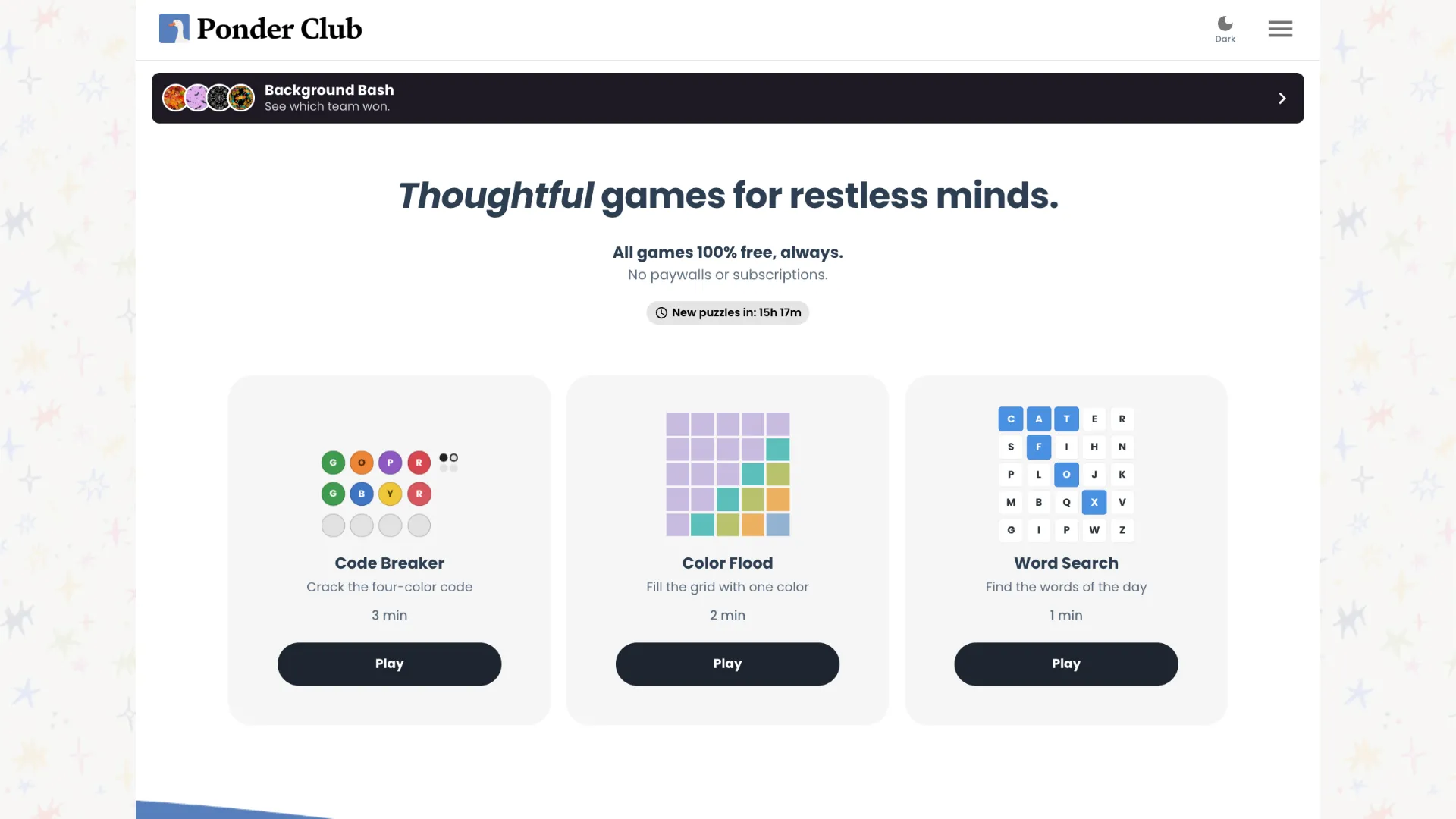
Ponder Club is a free browser-based collection of daily brain games designed for players who enjoy short, thoughtful puzzles. Rather than offering one specific game, it brings together word challenges, number puzzles, logic games, color puzzles, and classic card and tile games in one place.
The idea is simple: take a short break, solve something satisfying, and return tomorrow for a new challenge.
The collection includes familiar puzzle formats such as mini crosswords, Wordle-style word guessing, Sudoku, Klondike Solitaire, and Mahjong Solitaire, alongside original games including Common Three, Slideways, Double Up, and Reverse Sweeper.
Every established daily game receives a fresh puzzle or board at midnight Pacific Time. Players tackling the same daily challenge can compare their results, while free archives make it possible to revisit earlier puzzles.
Ponder Club is created by Calli and Eden, a two-person independent development team operating as Flying Comet Games. They describe the project as a positive alternative to endless social media scrolling, emphasizing short games that encourage concentration and provide a sense of accomplishment.
The entire collection is free to play without an account or subscription. Optional accounts provide additional features such as leaderboards, streak tracking, saved progress, and player profiles.
How Does Ponder Club Work?
Ponder Club functions as a collection of individual browser games rather than a single puzzle with one set of rules.
The homepage organizes challenges into several categories, allowing players to choose the kind of mental exercise they want.
Word Games
These challenges focus on vocabulary, spelling, word relationships, and finding hidden words.
Examples include Mini 5x5 Crossword, Common Three, Wordie, Word Search, and Slideways.
Number and Logic Games
These puzzles reward planning, pattern recognition, arithmetic, and deduction.
Examples include Double Up, Digit Shift, Sudo-goose, Reverse Sweeper, and Operator.
Visual and Classic Games
These include color-based challenges, pattern deduction, traditional Solitaire, and Mahjong Solitaire.
Examples include Color Flood, Code Breaker, Solitaire, and Mahjong Solitaire.
Experimental Games
Ponder Club also features a Beta Labs section containing games that are still being tested.
Experimental titles have included Flappy Goose, Goose Ladder, and Birdoku. Beta games may offer comments and archives while not yet recording official scores or streaks.
The exact lineup can change as new games are introduced and existing games receive updates.
How to Play Ponder Club
Getting started is straightforward because every game runs directly in a web browser.
- Open Ponder Club. Visit Ponder Club and browse the available daily games. The homepage groups puzzles by type and displays brief descriptions and estimated playing times.
- Choose a game. Select a challenge that interests you. Mini 5x5 is a good starting point for crossword fans, while Color Flood and Digit Shift offer quick visual and logic challenges.
- Learn the rules. Each game has its own objective and controls. Follow the instructions on the game page before beginning. Some games use typing, while others involve dragging tiles, selecting cells, or clicking colors.
- Complete today's challenge. Solve the daily puzzle, improve your score, or finish within the game's limits. Some games reward speed, others reward accuracy, and some focus on finding the most efficient solution.
- Review and share your result. After completing a puzzle, check your result and use the available sharing options. You can play another game immediately or open the calendar archive to try a previous challenge.
You do not need to finish one game before accessing another. Each title can be played independently.
Ponder Club Word Games
Word games make up an important part of the collection, offering several alternatives to traditional daily word puzzles.
Mini 5x5 Crossword
Mini 5x5 Crossword is a compact daily crossword designed for quick solving sessions.
The board contains a 5-by-5 grid with across and down clues. Every letter participates in both an across answer and a down answer, allowing crossing words to help confirm uncertain guesses.
The game is especially suitable for players who enjoy traditional crosswords but prefer challenges that can often be completed in about a minute.
Common Three
Common Three is an original daily word-grouping puzzle built around a three-circle Venn diagram.
Each puzzle contains seven words and three category themes. You must place each word into the region where it belongs.
Some words match only one category, while others belong in overlapping regions because they satisfy two or all three themes.
The puzzle allows five mistakes, creating a challenge that rewards careful consideration of the relationships between categories.
Wordie
Wordie is Ponder Club's five-letter word-guessing game.
Players have six attempts to identify the hidden word. After each guess, colored feedback indicates which letters are correct and whether they occupy the correct positions.
Green means a letter is correctly positioned, while yellow means the letter belongs in the word but appears elsewhere.
The familiar format makes Wordie a natural choice for Wordle fans who want another daily word challenge with access to previous puzzles.
Word Search
Word Search offers a classic daily letter-grid puzzle.
Players locate the listed words by tracing them horizontally, vertically, diagonally, or backward through the grid.
The objective is to find every hidden word, making this one of the more relaxed options for players who prefer visual scanning over complicated deduction.
Slideways
Slideways challenges players to rearrange letters into valid words.
In the current version, you slide rows horizontally to align letters into vertical words. Each valid alignment contributes to your progress, and the challenge encourages players to discover as many words as possible from the available board.
Unlike a standard crossword, Slideways is about experimenting with letter arrangements and recognizing words that emerge from shifting rows.
Ponder Club Number and Logic Games
Players who prefer mathematics, reasoning, and structured puzzles can choose from several number and logic challenges.
Double Up
Double Up is a number-merging game in which you drop numbered blocks into columns.
When matching values meet, they combine into a block with twice the value. A single placement can trigger several merges, allowing players to build larger numbers and increase their scores.
The challenge is to plan placements strategically and avoid filling the board in ways that prevent useful combinations.
Because everyone receives the same daily board, players can compare their scores under shared conditions.
Digit Shift
Digit Shift is a number-ordering puzzle based on shifting numbered tiles into the correct arrangement.
The objective is to arrange the digits in order while using as few moves as possible.
It is a good choice for players who enjoy sliding puzzles and planning efficient sequences of moves.
Sudo-goose
Sudo-goose adds a playful presentation to traditional Sudoku.
Players fill the grid so that every row, column, and box contains each required symbol exactly once.
The game follows standard Sudoku logic, and pencil marks can help players track possibilities before committing to a placement.
Despite its humorous goose theme, it remains a genuine deduction puzzle.
Reverse Sweeper
Reverse Sweeper offers an unusual twist on Minesweeper.
Instead of revealing safe cells while avoiding hidden mines, the board begins with numerical information visible. Players use the numbers to determine where hidden geese are located.
Each number indicates how many geese occupy neighboring cells.
The objective is to identify every hidden goose without making an incorrect guess.
This inversion of traditional Minesweeper makes it particularly interesting for players who prefer logical deduction over uncertain clicking.
Operator
Operator is an arithmetic puzzle in which players arrange digits and mathematical operations to reach a target value.
The game challenges you to build valid equations using the available numbers and operations. Once a valid solution is found, additional solutions can provide further progress.
Operator is particularly suitable for players who enjoy mental arithmetic and number-combination challenges similar to Countdown.
Ponder Club Visual and Classic Games
The collection also includes puzzles based on color, pattern recognition, and traditional tabletop mechanics.
Color Flood
Color Flood is a quick visual puzzle in which players attempt to turn an entire grid into one color.
The game begins with a colored region in one corner. Each time you select a color, your region changes to that color and absorbs adjacent tiles of the same color.
Your objective is to fill the entire board within the available move limit.
Color Flood is one of the shortest games on the platform, with the developer estimating approximately one minute for a typical challenge.
Code Breaker
Code Breaker is a Mastermind-style deduction game.
The hidden answer is a sequence of four colors, and you have ten attempts to identify it.
After each guess, feedback provides information about matching colors and their positions.
Use the clues to eliminate impossible combinations and gradually narrow down the secret code.
Solitaire
Solitaire offers the classic Klondike card game with a shared daily deal.
Players arrange cards in descending order with alternating colors, then build foundation piles from ace to king by suit.
Everyone receives the same daily shuffle, allowing players to compare how they approached the deal.
The game also includes an archive of previous daily deals.
Mahjong Solitaire
Mahjong Solitaire is a tile-matching puzzle in which the goal is to remove every tile from the stack.
You can match two identical free tiles. A tile is considered free when nothing is positioned above it and at least one of its horizontal sides is open.
Successfully clearing the entire stack completes the puzzle.
The daily layout changes at midnight Pacific Time.
Example: How a Color Flood Puzzle Works
Consider a simplified example of Color Flood using a small grid of colored cells.
Imagine a board that starts with the following arrangement:
| Red | Red | Blue |
|---|---|---|
| Blue | Green | Blue |
| Green | Green | Red |
Your starting region is the red area in the upper-left corner.
Suppose you select blue as your next color. The starting region changes to blue and absorbs any connected blue cells that touch it.
You can then select green to expand into adjacent green tiles.
The objective is to keep expanding the controlled region until the entire board has been absorbed, preferably with as few color changes as possible.
This is an illustrative miniature board rather than an actual daily puzzle, but it demonstrates why planning matters.
Choosing the color covering the largest immediate area is not always the best move. A different color might create access to a larger connected region on the following turn.
That kind of approachable strategic decision is representative of Ponder Club's game collection: simple rules with enough depth to reward thoughtful play.
What Makes Ponder Club Different?
Ponder Club stands out because it brings several different daily puzzle experiences into one organized website.
Multiple Puzzle Types in One Place
Instead of visiting separate websites for crosswords, Wordle-style games, Sudoku, and Solitaire, players can access a broad collection from the same homepage.
This is convenient for anyone who enjoys playing several short games as part of a daily routine.
Shared Daily Challenges
The established games receive new puzzles or boards every day at midnight Pacific Time.
Players tackling the same daily edition can compare their results, whether the goal is solving faster, making fewer mistakes, or earning a higher score.
Free Historical Archives
Every established daily game has an archive accessible through a calendar icon.
You can choose a previous date and replay that day's puzzle without waiting for the next release.
Archived games do not contribute to your current daily streak.
Optional Social Competition
Players who create accounts can participate in leaderboards, track streaks, customize profiles, and interact through comments.
The site offers daily and all-time leaderboard views for supported games.
A Relaxed Playing Experience
The developers emphasize thoughtful games rather than constant notifications or endless content feeds.
Players can choose a quick one-minute challenge or spend more time exploring a difficult puzzle.
For supported timed games, a Hide Timer setting allows players to avoid seeing the clock while solving.
Ponder Club Strategy Tips
1. Start With a Game That Matches Your Interests
If you enjoy vocabulary, try Wordie, Common Three, or Mini 5x5.
If you prefer logical reasoning, start with Sudo-goose, Reverse Sweeper, or Code Breaker.
Players who want something visual and quick may prefer Color Flood or Digit Shift.
2. Learn Each Game's Objective Before Starting
Different games reward different types of success.
Color Flood encourages completing the board within a move limit, while Wordie limits your guesses and Double Up rewards strategic number merging.
Understanding the objective helps you avoid applying the wrong strategy to a new game.
3. Use the Archives for Practice
The calendar archive is useful when you want additional puzzles after finishing today's challenge.
Older games can help you learn recurring patterns and improve your approach without affecting your current daily streak.
4. Focus on Information Before Guessing
In deduction-based games such as Code Breaker, Sudo-goose, and Reverse Sweeper, carefully examine the available clues before committing to an answer.
A systematic approach often produces better results than trial and error.
5. Plan Ahead in Move-Based Games
In Color Flood and Digit Shift, the number of moves matters.
Try to identify how one move affects the possibilities available afterward rather than focusing only on immediate progress.
6. Compare Results With Friends
Shared daily puzzles create opportunities for friendly competition.
Comparing a score or completion time with someone who played the same challenge can reveal new approaches and encourage improvement.
7. Choose a Comfortable Playing Pace
Some games are designed to take only one or two minutes, while others reward longer sessions.
If a visible timer makes a puzzle less enjoyable, check whether the game's settings allow you to hide it.
8. Explore Original Games
Familiar formats are an easy starting point, but Ponder Club's original games provide some of its most distinctive experiences.
Common Three introduces overlapping category relationships, Reverse Sweeper reverses the usual Minesweeper objective, and Slideways explores unusual word arrangements.
Ponder Club Daily Reset and Archives
Ponder Club releases new daily puzzles at midnight Pacific Time.
Because Pacific Time observes daylight saving time, the corresponding reset time in other time zones changes during the year.
The website displays a countdown showing how much time remains before the next set of daily puzzles becomes available.
Every established daily game includes a calendar archive. To access it, open a game and select the calendar icon near the upper-left area of the interface.
Choose a previous date to load that day's challenge.
The archive is free to use, making Ponder Club appealing to players who want more than one puzzle per day.
Is Ponder Club Free to Play?
Yes. Ponder Club states that all its games are free, with no gameplay paywalls or required subscriptions.
Players can access the collection, current daily challenges, and historical puzzle archives without purchasing anything.
The platform does display advertisements. Players who want to remove them can make an optional one-time purchase for ad-free access.
Supporter perks can also include cosmetic features such as avatar accessories.
This purchase is optional and does not unlock the core games, which remain free for everyone.
Do You Need a Ponder Club Account?
No. You can start playing without creating an account.
However, registration provides additional features, including:
- Daily and all-time leaderboard participation.
- Streak tracking and saved progress.
- A customizable player handle and avatar.
- Profile-related features and comments.
- Progress associated with your account.
Ponder Club uses email-based magic-link authentication rather than requiring players to remember another password.
You enter your email address and receive a login link that allows you to access your account.
For players who simply want to enjoy a few puzzles, guest access is sufficient.
Can You Play Ponder Club on Mobile?
Yes. Ponder Club works in mobile browsers as well as on desktop computers.
The developers also offer a web-app installation option, allowing players to add Ponder Club to their phone or tablet's home screen.
This creates an app-like shortcut without requiring a separate download from an app store.
Different games use different controls, including typing, dragging tiles, tapping cells, selecting colors, and moving cards.
Players can choose titles that feel comfortable on their preferred device.
Ponder Club vs. NYT Games
Ponder Club is often compared with NYT Games because both offer collections of daily puzzles.
| Feature | Ponder Club | NYT Games |
|---|---|---|
| Main focus | Mixed daily brain games | Word, number, and logic puzzles |
| Word guessing | Wordie | Wordle |
| Mini crossword | Mini 5x5 | The Mini |
| Word grouping | Common Three | Connections |
| Sudoku-style puzzle | Sudo-goose | Sudoku |
| Original games | Slideways, Reverse Sweeper, Double Up, and others | Connections, Strands, and others |
| Daily updates | Yes | Yes |
| Previous puzzles | Free archives for established games | Archive availability varies by game and subscription |
| Account required to start | No | Varies by game and feature |
| Core access | Free | Mix of free and subscription-supported features |
Ponder Club's main appeal is the breadth of its free puzzle collection and the ability to replay older challenges without a subscription.
NYT Games offers a different selection of established titles, while Ponder Club includes independent experiments and original mechanics not found in the same form on NYT Games.
Players who enjoy daily puzzle collections may find the two platforms complementary rather than interchangeable.
Who Should Play Ponder Club?
Ponder Club is a good choice for anyone who enjoys short puzzles and wants several different types of challenges in one place.
It is particularly appealing to:
- Daily puzzle enthusiasts who enjoy maintaining a routine of solving several games.
- Word game fans looking for crosswords, word searches, Wordle alternatives, and category puzzles.
- Logic puzzle players who enjoy Sudoku, code-breaking, and deductive challenges.
- Casual gamers interested in Solitaire, Mahjong, and relaxing visual games.
- Competitive players who enjoy leaderboards, streak tracking, and sharing results.
- Players looking for free games without mandatory accounts or subscriptions.
The collection is approachable because you can choose your preferred difficulty and game type instead of committing to one large challenge.
Who Created Ponder Club?
Ponder Club was created by Calli and Eden, two friends and independent developers working under the name Flying Comet Games.
According to the official website, they built the platform as a positive alternative to doomscrolling and wanted to create short experiences that help people feel productive, engaged, and entertained.
Their philosophy is summarized by the phrase Be kind to your mind.
The developers continue experimenting with new puzzle ideas through the site's Beta Labs section and publish updates about the platform's development.
Players can also submit feedback and suggestions through the website.
For more information, visit the official Ponder Club FAQ.
Frequently Asked Questions
What is Ponder Club?
Ponder Club is a free collection of daily browser games featuring word puzzles, Sudoku, logic challenges, number games, Solitaire, Mahjong, and original puzzle concepts.
Is Ponder Club one game or a collection?
It is a collection of separate games. Each title has its own rules, objectives, and daily puzzle.
Is Ponder Club free?
Yes. All core games and historical archives are free. An optional one-time purchase removes advertisements.
How many games are available?
The official FAQ lists 13 established daily games. The homepage also features newer additions and experimental games, so the available selection may grow over time.
When do new puzzles appear?
New daily puzzles are released at midnight Pacific Time.
Can you play previous puzzles?
Yes. The established games include free calendar archives that allow players to select earlier dates.
Do you need an account?
No. Registration is optional, although an account is needed for leaderboards, streak tracking, and certain social features.
Does Ponder Club have leaderboards?
Yes. Supported games offer daily and all-time leaderboards for registered players.
Can you share results?
Yes. Completed games include sharing options, including shareable result images for social media.
Is Ponder Club available on mobile?
Yes. It works in mobile browsers and can be added to a device's home screen as a web app.
Is there a Ponder Club app in the App Store?
The developers offer a mobile-friendly web app rather than a separate native App Store application.
Can you hide the timer?
Yes. Supported timed games include a Hide Timer option in their settings.
Who created Ponder Club?
Ponder Club was created by Calli and Eden at Flying Comet Games.
Conclusion
Ponder Club brings a broad collection of daily brain games into one free, accessible website. From quick crosswords and word guessing to Sudoku, code-breaking, number puzzles, and Solitaire, it offers plenty of variety for players who enjoy thoughtful challenges.
Its most appealing features are the shared daily puzzles, free historical archives, original game mechanics, and optional social competition.
The platform also avoids requiring an account or subscription for basic gameplay, making it easy to try a few puzzles without any commitment.
Whether you want a one-minute mental warm-up or a longer challenge that rewards careful reasoning, Ponder Club provides a convenient place to explore different puzzle styles.
Ready for a thoughtful break? Visit Ponder Club, choose your first daily game, and discover which puzzles keep you coming back.