
What Is Quiple?
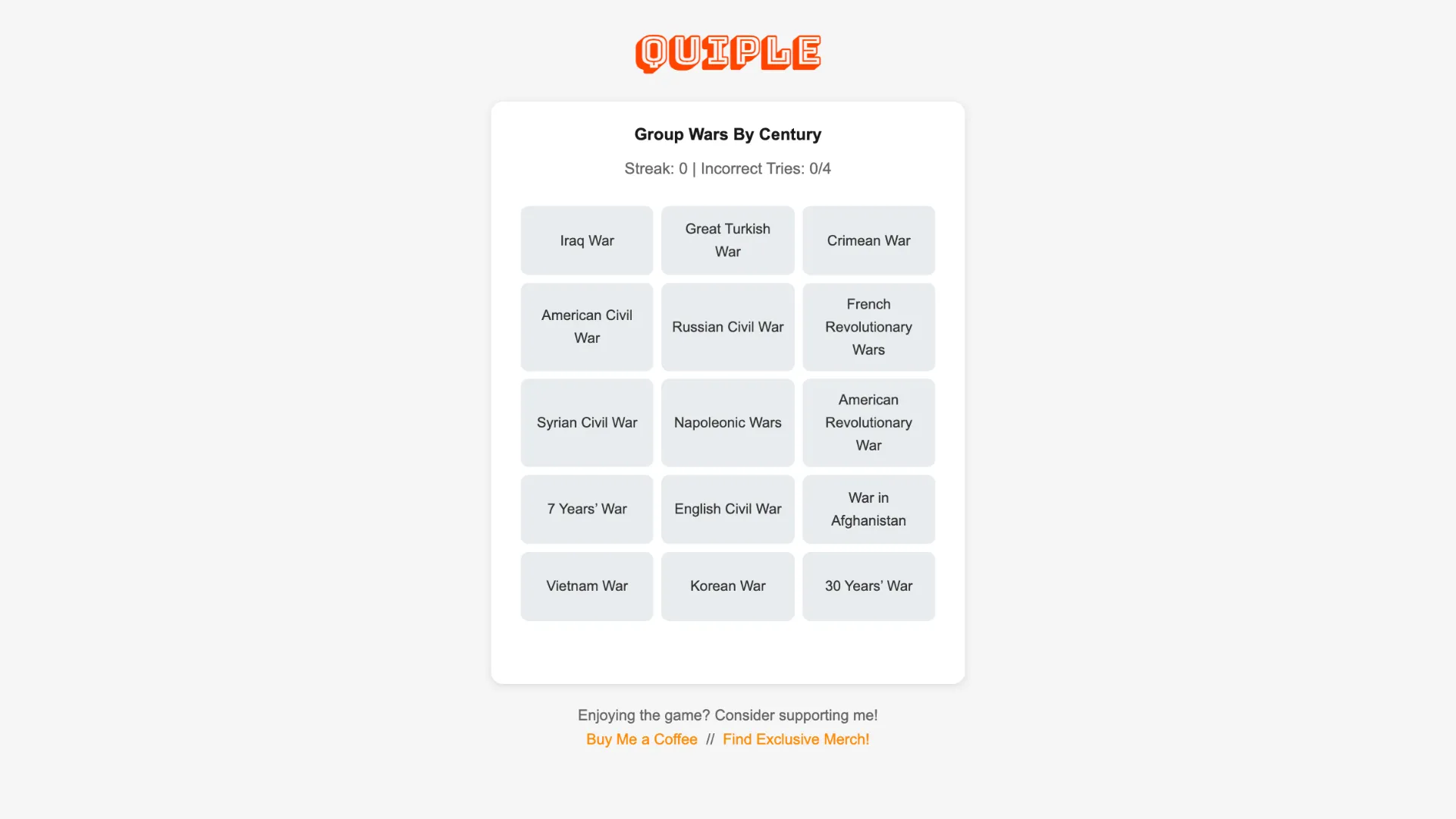
Quiple is a daily trivia game built around finding connections between items. Each puzzle presents a grid of items and asks you to select three that belong together. You have four incorrect tries before the game ends, and solving the full board contributes to your daily streak.
The full board contains 15 tiles, which are divided into five groups of three according to the day's criterion.
Quiple Rules and Core Twist
The key difference from a normal trivia quiz is that Quiple does not ask you to type an answer. Instead, the answers are already on the board and your job is to work out how they should be grouped.
- Start with 15 tiles.
- Find three items that satisfy the day's grouping rule.
- Selecting the third tile submits that trio, so there is no separate submit step.
- A correct trio becomes one completed group.
- An incorrect trio costs one of your four allowed mistakes.
- Complete all five groups to win the day's puzzle.
The challenge comes from deciding which relationship the puzzle expects. Several tiles may look related at first, so committing to an obvious-looking trio too quickly can waste a mistake.
How to Play Quiple
- Read the day's criterion. It tells you what kind of relationship you need to find across the board.
- Scan all 15 tiles before selecting anything. Look for three items with a particularly strong connection.
- Select three matching tiles. The third selection sends the group automatically.
- Use the result to narrow the board. Correct groups remove possibilities, while an incorrect attempt uses one of your four mistakes.
- Repeat until all five trios are solved. Finishing the board gives you the daily win and helps maintain your streak.
Example of a Quiple Group
One Quiple puzzle uses the prompt “Group Cities by NA Region.” A board can contain tiles such as:
text [ Anchorage ] [ Juneau ] [ Fairbanks ] → Alaska [ Houston ] [ Austin ] [ Dallas ] → Texas
The important part is not simply noticing that every tile is a city. You have to identify the more specific relationship that creates valid groups of exactly three.
Strategy Tips
- Solve the strongest trio first. Three unmistakably related items give you more information than a speculative group.
- Think about the entire board. A trio is more convincing when the remaining tiles can still divide cleanly into groups of three.
- Watch for overlap. A tile may seem to fit multiple possible ideas, so save ambiguous items until other groups are clearer.
- Use elimination. Every completed group reduces the number of possible combinations significantly.
- Protect your mistakes. With only four incorrect tries available, testing random combinations is much riskier than reasoning from the full set.