What is Radiordle?
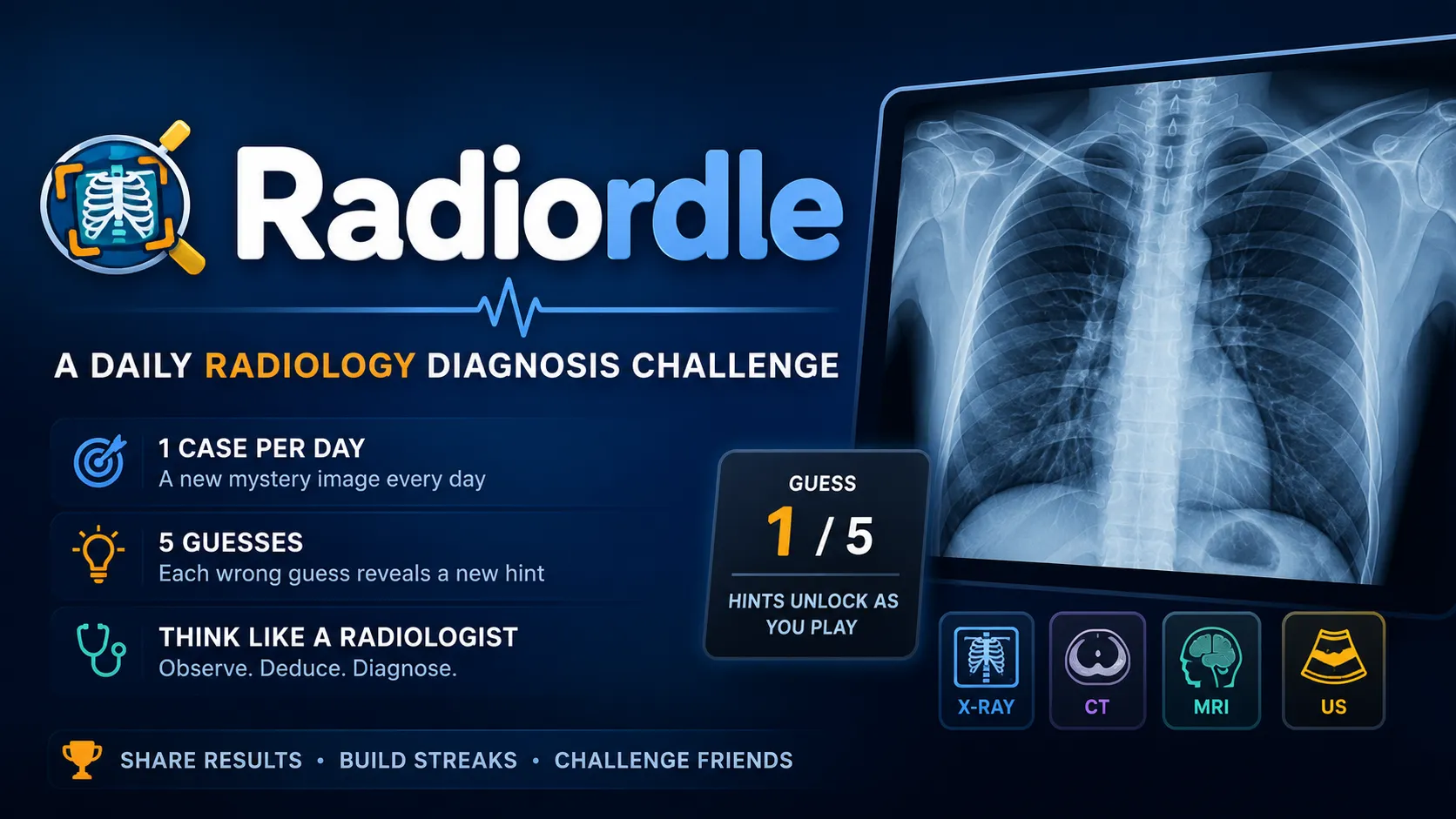
Radiordle places a medical image on the screen and asks the question every diagnostic detective both loves and fears: what is the diagnosis? Study the scan, enter your best answer, and try to identify the condition before five attempts disappear.
Cases can use X-rays, CT scans, MRIs, and ultrasounds, so the visual battlefield changes from day to day. An obvious fracture may offer quick relief, while a subtle chest finding can send you through several convincing but incorrect diagnoses. Progressive hints make the game approachable, but each clue arrives only after you have paid for it with a failed guess.
Radiordle Game Rules (The Catch / The Trap)
The daily diagnostic loop looks like this:
MEDICAL IMAGE → ENTER DIAGNOSIS → WRONG? REVEAL HINT → REASSESS
- One case per day: A new medical imaging puzzle is released daily at midnight Eastern Time.
- Inspect the image: Study the visible anatomy, abnormalities, positioning, and imaging modality.
- Enter a diagnosis: Submit the condition you believe best explains the case.
- Five attempts: You MUST reach the accepted diagnosis before the fifth attempt is exhausted.
- Wrong answer reveals a hint: Each failed diagnosis unlocks another clue to narrow the possibilities.
- Correct answer ends the case: Once the diagnosis matches, the puzzle is solved and your result is recorded.
- Past cases are playable: The archive lets you return to earlier puzzles for extra practice.
- Results can be shared: Compare attempts, statistics, and streaks with friends or colleagues.
The trap is that recognizing the body part is only the beginning. Radiordle wants the diagnosis, not merely a description such as abnormal chest X-ray or bone lesion.
Correct modality + wrong condition = another attempt lost
Useful hint + careful reassessment = possible recovery
Radiordle is an educational game, not a clinical decision-making tool or a substitute for professional medical evaluation.
How To Play Radiordle?
Step 1: Examine the opening image
Image shown: A frontal chest X-ray with an abnormal appearance on one side.
Player notices:
Modality: X-ray
Region: Chest
Finding: Asymmetric lung appearance
Player Guesses: Pneumonia
Step 2: Pay for the first clue
Result: Incorrect — Guess 1 of 5 used
New Hint: The patient developed sudden pleuritic chest pain and shortness of breath.
What This Means: A gradual infectious process now seems less likely. The player should reconsider acute pleural or vascular causes.
Step 3: Reinspect the image
The player zooms in and looks for a pleural line, peripheral lung markings, fluid levels, and mediastinal shift.
Player Guesses: Pleural effusion
Result: Incorrect — another hint revealed
Next Hint: Peripheral lung markings are absent beyond a visible pleural line.
Step 4: Submit the refined diagnosis
Player Guesses: Pneumothorax
Game Response: Correct diagnosis
The case is solved in three attempts, the remaining hints stay unnecessary, and the daily Radiordle survives another round.
Radiordle Strategy & Tips
Identify the modality and anatomical region before naming diseases. Knowing whether you are viewing a chest X-ray, abdominal CT, brain MRI, or ultrasound immediately reduces the diagnostic field.
Use a systematic search pattern rather than staring only at the most dramatic feature. Check alignment, density, symmetry, borders, surrounding tissues, and any abnormal displacement.
Treat every revealed hint as a hard constraint. Symptoms, age, location, and imaging characteristics should eliminate diagnoses rather than merely inspire more possibilities.
Avoid spending guesses on several names for nearly identical ideas unless the game requires a specific condition. Choose the clearest standard diagnosis supported by both the image and the available clues.
Finally, learn from the reveal. Even a failed case can sharpen your ability to recognize the same imaging pattern when it returns in a future puzzle.