
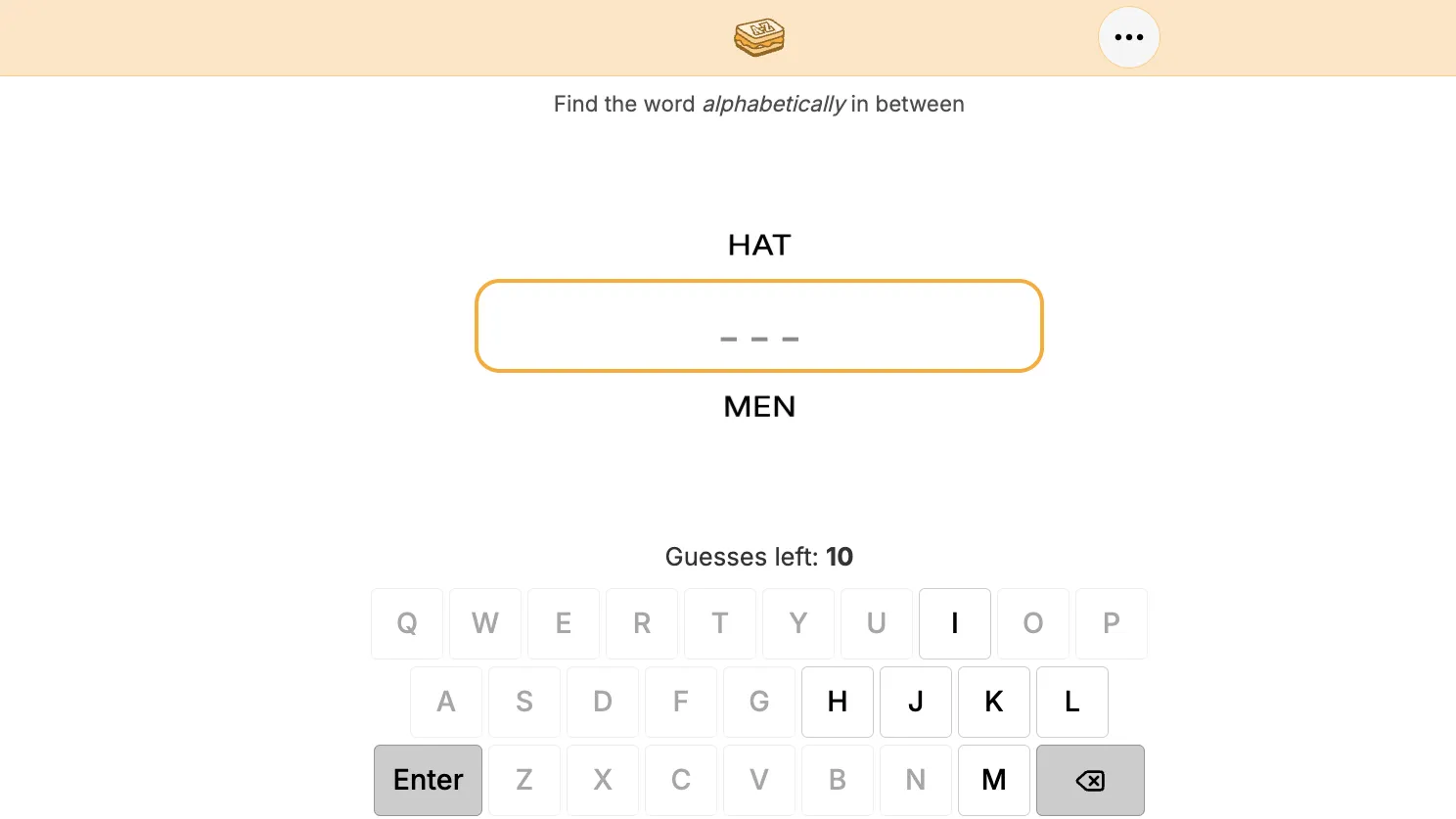
What Is Sandwich?
Sandwich is a daily vocabulary game from Daily Mail built around a simple idea: find the word hidden alphabetically between two other words.
At the beginning of a puzzle, two words act like the top and bottom slices of a sandwich. The secret word — the filling — appears somewhere between them in dictionary order.
For example:
text CAT ??? SUN
The answer must come alphabetically after CAT and before SUN. Unlike games that reveal individual correct letters, Sandwich tells you whether each complete guess belongs above or below the hidden answer. Every valid wrong guess then becomes one of your new boundaries.
This makes Sandwich part vocabulary test and part deduction puzzle. Knowing lots of words helps, but choosing guesses that efficiently divide the remaining alphabetical range is just as important.
Rules and the Core Twist
You get 10 guesses to identify the hidden word.
The main rules are straightforward:
- The puzzle begins with two words surrounding the answer alphabetically.
- Enter a valid word that falls between the current boundaries.
- If your guess comes before the answer alphabetically, it becomes the new lower boundary.
- If your guess comes after the answer, it becomes the new upper boundary.
- Keep narrowing the interval until you enter the exact hidden word.
- If you use all 10 guesses without finding it, the puzzle is over.
A new Sandwich puzzle is released each day, making it a short daily challenge designed for repeat play and streaks.
The unusual part is that a perfectly valid English word can still be a poor guess. A word sitting very close to one of your current boundaries may barely reduce the search area, while a well-chosen word near the alphabetical middle can eliminate a much larger portion of the possibilities.
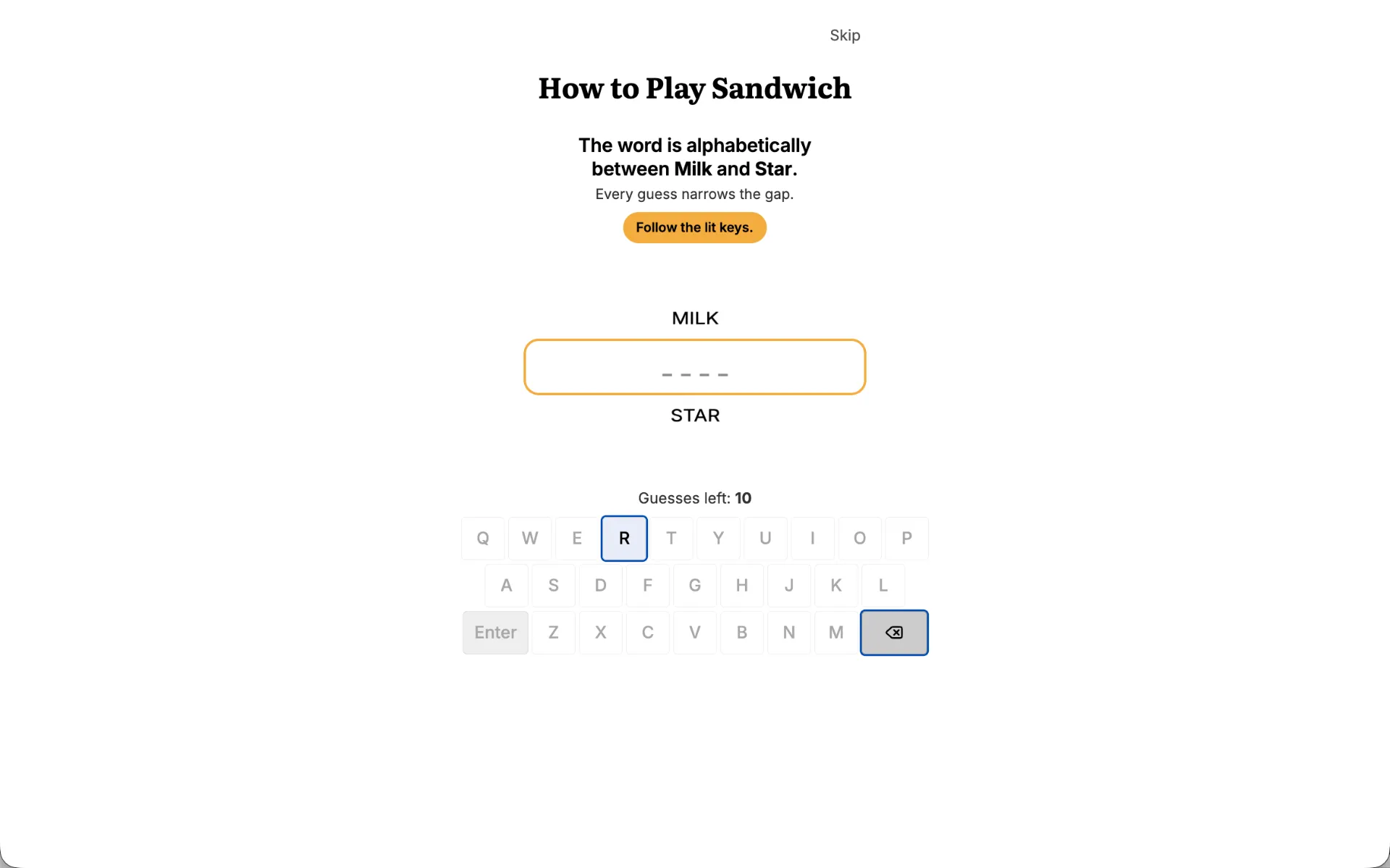
How to Play Sandwich
Imagine a puzzle begins with:
text CAT ??? SUN
Suppose the hidden answer is MOUSE. A round could unfold like this:
Look at the starting range. You know the answer comes after
CATand beforeSUN, so choose a word somewhere well inside that alphabetical interval.Guess
HOUSE. SinceHOUSEcomes beforeMOUSE, the lower boundary moves up:
text HOUSE ??? SUN
- Guess
ROAD.ROADcomes afterMOUSE, so it becomes the new upper boundary:
text HOUSE ??? ROAD
- Guess
MOUSE. It matches the hidden word, completing the day's Sandwich.
Every incorrect guess therefore gives you useful positional information. The puzzle becomes easier as the two boundary words move closer together — provided your guesses are chosen efficiently.
Strategy Tips
Aim for the alphabetical middle
Treat the puzzle a little like a binary search. Instead of guessing words immediately next to one boundary, try to think of a familiar word roughly halfway between the two. A central guess can dramatically shrink the remaining range.
Think beyond the first letter
When both boundaries begin with the same letter, later letters become increasingly important. For example, narrowing a range from PLAN to PLAY requires paying attention to the third and fourth letters rather than simply thinking of another P-word.
Use ordinary vocabulary first
The daily answers are intended to be recognizable words rather than extremely obscure dictionary entries. Before reaching for unusual spellings or specialist terms, consider common words that fit the remaining alphabetical interval.
Learn from every miss
A wrong answer is not wasted. Each valid miss creates a tighter boundary, so use the updated pair of words rather than continuing with unrelated guesses.
Sandwich is particularly satisfying for players who enjoy daily word games but want something different from letter-position puzzles. Its challenge comes from understanding where words sit relative to one another in the dictionary and gradually squeezing the answer into an increasingly small alphabetical gap.