
What Is Sufuku?
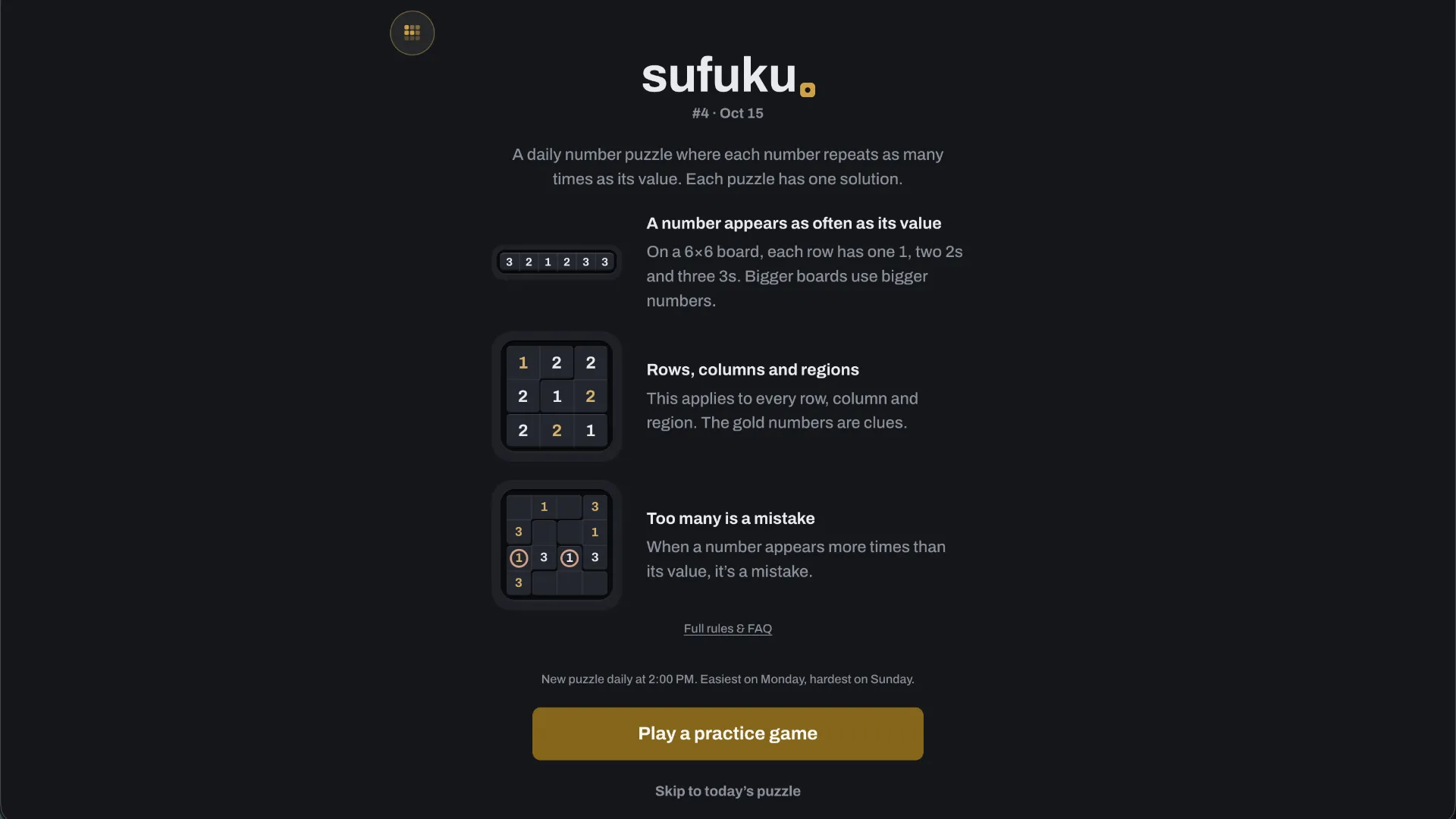
Sufuku is a free browser-based number puzzle that takes inspiration from Sudoku while introducing an important twist: numbers can repeat.
Traditional Sudoku challenges players to fill a grid without repeating the same digit in any row, column, or designated box. Sufuku changes that familiar expectation, encouraging players to reconsider how they interpret numbers and solve a grid.
The game is designed for puzzle enthusiasts who enjoy number placement, pattern recognition, and logical deduction. Its familiar Sudoku-inspired concept makes it particularly interesting for experienced players looking for something different.
Sufuku runs directly in a web browser at sufuku.com. It is free to play, requires no installation, and supports touch controls for mobile devices.
Sufuku Rules: What Makes It Different From Sudoku?
The defining feature of Sufuku is its approach to repeating numbers.
In standard Sudoku, the rules are strict:
- Each row must contain the digits 1 through 9 without duplicates.
- Each column must contain the digits 1 through 9 without duplicates.
- Each 3×3 box must also contain the digits 1 through 9 without duplicates.
Sufuku breaks from the traditional no-repetition assumption. Its central idea is that numbers may repeat, so familiar Sudoku elimination techniques cannot automatically be applied in the same way.
This distinction changes how players approach a puzzle. Rather than immediately rejecting a number because it appears elsewhere, players must determine whether the placement satisfies Sufuku's own conditions.
The precise repetition restrictions and any additional placement rules should be checked in the game's interface before solving. A repeating number is part of the concept, but that does not mean every possible placement is valid.
How to Play Sufuku
Getting started with Sufuku is straightforward, especially for players familiar with grid-based number puzzles.
- Open the game. Visit sufuku.com on your computer or mobile browser. No download is required.
- Understand the puzzle rules. Review the game's instructions and identify how repeated numbers are handled. Do not automatically apply traditional Sudoku restrictions.
- Examine the number grid. Look at the available numbers, empty spaces, and any clues or constraints shown on the board. Consider how different placements affect the surrounding cells.
- Place numbers logically. Select a cell and enter a number using the available controls. Compare your choices against the puzzle's conditions rather than relying entirely on standard Sudoku habits.
- Complete the puzzle. Continue using deduction and checking your placements until the grid satisfies the game's requirements.
The key to solving Sufuku is understanding which familiar Sudoku assumptions still apply and which ones have changed.
Example: Why Repeating Numbers Matter
Consider this hypothetical row in a number-placement puzzle:
2 | 4 | 2 | _ | 5
In traditional Sudoku, two instances of the number 2 in the same row would immediately violate the rules.
In a puzzle that permits repetition, however, the duplicated 2s are not necessarily a contradiction. You cannot decide whether the row is valid without considering the puzzle's specific restrictions.
This example illustrates Sufuku's central twist rather than a verified Sufuku board configuration. The important lesson is that a familiar Sudoku rule should not be treated as universal.
Instead of assuming every repeated number is an error, players need to pay closer attention to the game's actual conditions.
Sufuku Tips and Strategies
1. Forget Automatic No-Repeat Assumptions
Traditional Sudoku experience is useful for understanding grids and logical relationships, but it can also create misleading instincts. Before eliminating a candidate number, confirm that the game's rules actually prohibit it.
2. Focus on Constraints, Not Just Numbers
Look for relationships between neighboring cells and any restrictions indicated by the puzzle. A number appearing multiple times may be perfectly acceptable, while a different placement could violate another condition.
3. Start With the Most Informative Areas
Identify parts of the grid with the clearest available clues. Solving well-constrained positions first can make the remaining decisions easier.
4. Keep Track of Possible Values
When several numbers appear plausible, consider the available alternatives before committing. Revisit those possibilities as additional placements reveal more information.
5. Avoid Random Guessing
A Sudoku-inspired puzzle is most rewarding when solved through deduction. If a cell remains ambiguous, move to another part of the board and look for information that could help resolve it.
Sufuku vs. Traditional Sudoku
Although Sufuku shares its inspiration with the classic number puzzle, there is a meaningful difference in how players must approach the game.
| Feature | Traditional Sudoku | Sufuku |
|---|---|---|
| Main concept | Number-placement puzzle | Sudoku-inspired number puzzle |
| Repeating numbers | Forbidden within rows, columns, and boxes | Repetition is part of the core twist |
| Solving approach | Elimination using fixed uniqueness rules | Deduction using modified placement conditions |
| Familiar Sudoku strategies | Directly applicable | Must be reconsidered |
| Primary appeal | Classic logical deduction | An unconventional Sudoku-style challenge |
Players who regularly solve standard Sudoku may find Sufuku interesting because it challenges established solving habits rather than simply increasing the difficulty of a conventional puzzle.
Is Sufuku Free to Play?
Yes. Sufuku is available as a free browser game at sufuku.com.
The game can be opened directly without downloading software. It also supports mobile touch controls, making it accessible on phones as well as desktop browsers.
Specific features such as difficulty settings, daily challenges, hints, and puzzle archives have not been independently confirmed.
Who Should Play Sufuku?
Sufuku is worth exploring if you enjoy:
- Sudoku variants: Games that modify familiar number-placement rules.
- Logic puzzles: Challenges involving deduction, constraints, and careful reasoning.
- Number puzzles: Grid-based games where understanding numerical relationships is central to the experience.
- Casual browser puzzles: Games that can be opened without installing an application.
The concept is especially appealing to Sudoku veterans who want a change from ordinary no-repeat grids, although newcomers interested in logic puzzles can also try it.
Conclusion
Sufuku offers a distinctive Sudoku-inspired challenge built around repeating numbers. By changing one of the most recognizable assumptions in traditional Sudoku, it encourages players to think differently about number placement and logical deduction.
For anyone looking for an unusual number puzzle, play Sufuku online and explore how its repeating-number twist changes the solving experience.