
What Is Tastedle?
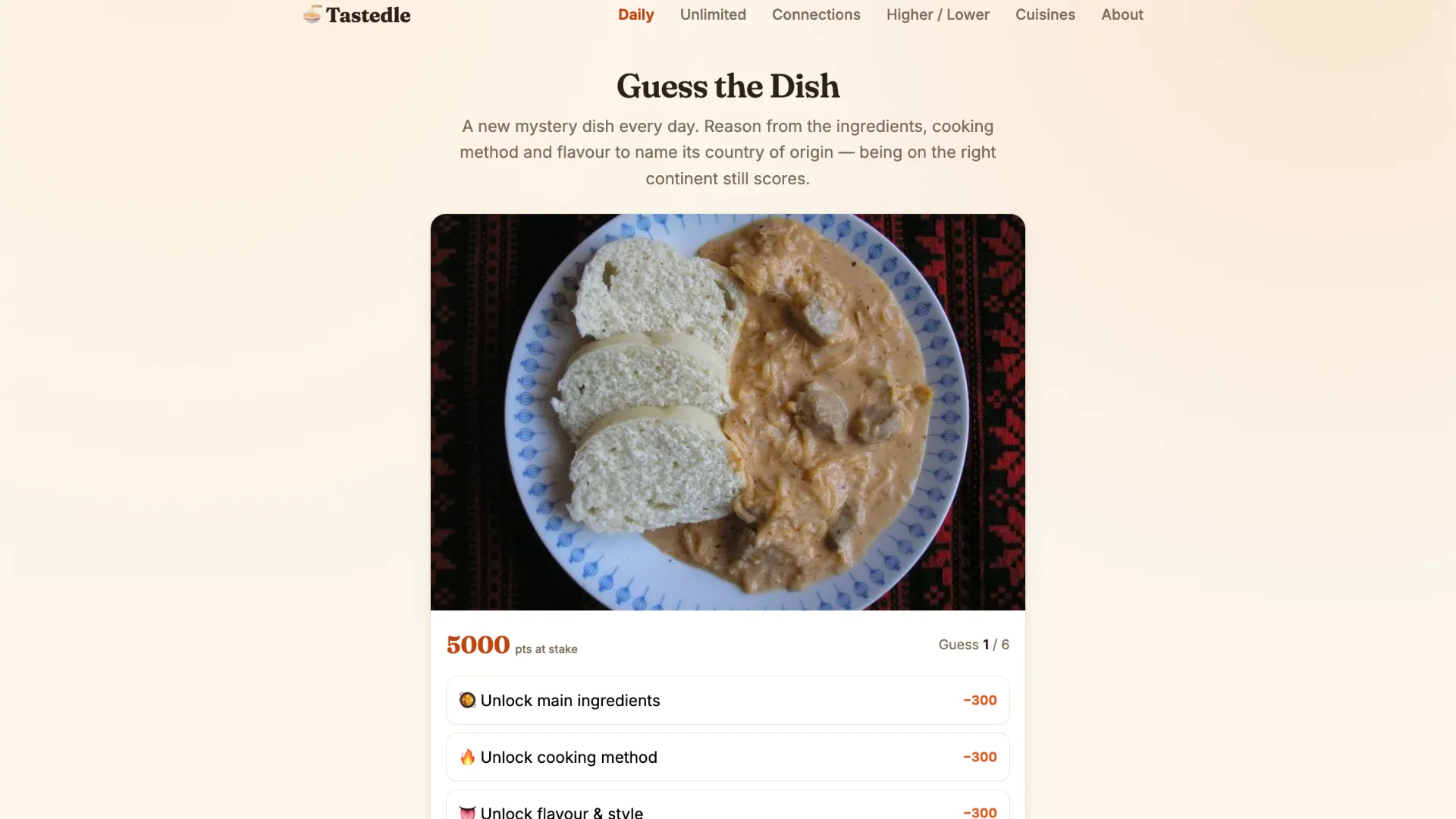
Tastedle is a free daily food guessing game that challenges players to identify the country of origin of a mystery dish. Each day presents a photograph of a dish from somewhere in the world, and your job is to work out which country it comes from using visual details, culinary knowledge, and optional clues.
Unlike traditional geography quizzes that ask you to recognize countries from flags or maps, Tastedle focuses on food. You examine ingredients, cooking techniques, and characteristic flavors to connect a dish with its cultural background.
Every daily puzzle begins with 5,000 possible points and six attempts to identify the country. You can spend points to reveal useful clues, but the more assistance you need, the lower your potential score becomes.
The game also rewards geographic knowledge. Even if you cannot identify the exact country, a guess within the correct sub-region or continent can still earn partial points.
Tastedle is playable directly in a web browser without downloading anything or creating an account. Alongside its daily challenge, the website includes an Unlimited mode, Food Connections puzzles, and a food-themed Higher or Lower game.
Tastedle Rules and Scoring
The main objective is to identify the country associated with the mystery dish in six guesses or fewer while preserving as many points as possible.
The Basic Rules
- One mystery dish each day: Study a photograph of a dish from a particular country.
- Six guesses: Enter country names to identify where the dish comes from.
- 5,000 starting points: Every puzzle begins with a maximum available score of 5,000 points.
- Optional clues: Reveal information about ingredients, cooking methods, flavors, and eating occasions by spending points.
- Geographic hints: After your first incorrect guess, the game reveals the dish's continent. After your second incorrect guess, it reveals the sub-region.
- Partial credit: Guesses within the correct geographic area can earn points even without an exact match.
- Daily results: Complete the puzzle and share your performance with friends.
How Much Do Clues Cost?
Tastedle offers four optional clues, each revealing a different aspect of the mystery dish:
| Clue | Point Cost | What It Reveals |
|---|---|---|
| Main ingredients | 300 | Important ingredients used in the dish |
| Cooking method | 300 | How the food is traditionally prepared |
| Flavour & style | 300 | Characteristic tastes and culinary style |
| When it's eaten | 200 | The occasion or time when the dish is commonly served |
The photograph itself is free. You can make an immediate guess without spending any points or purchase clues when the dish is difficult to recognize.
How Does Tastedle Scoring Work?
Your final score depends on your remaining points and how accurately you identify the country:
| Best Guess | Points Awarded |
|---|---|
| Exact country | 100% of remaining points |
| Correct sub-region | 50% of remaining points |
| Correct continent | 20% of remaining points |
| Wrong continent | 0% |
For example, suppose you unlock the main ingredients clue for 300 points. Your available score falls from 5,000 to 4,700. If you correctly identify the country, you receive the full 4,700 points. If your best guess only matches the correct sub-region, you receive half of that remaining score.
This creates the game's central strategic decision: spend points to improve your certainty or take a calculated risk to protect your score.
How to Play Tastedle
Step 1: Open the Daily Puzzle
Visit tastedle.com in your browser. The main page displays the current day's mystery dish and its photograph.
Examine the food before making any decisions. Look at the ingredients, presentation, garnishes, and preparation style. Even small details can provide clues about its culinary background.
Step 2: Decide Whether You Need a Clue
You can guess immediately or reveal additional information by selecting one of the available clue buttons.
Imagine seeing a rice dish cooked with saffron in a wide, shallow pan. Those details might make Spain a strong possibility because they resemble traditional paella preparation.
Alternatively, a dish featuring fish sauce and lemongrass might suggest Southeast Asian cuisine, although those ingredients alone would not prove a particular country.
These are illustrative reasoning examples rather than actual daily puzzle answers.
Step 3: Enter Your Country Guess
Type the country you believe is associated with the dish into the answer field and submit your guess.
You have a maximum of six guesses. If your first guess is incorrect, Tastedle reveals the correct continent to help narrow your search. A second incorrect guess reveals the sub-region, providing a more precise geographic clue.
Step 4: Refine Your Answer
Use the revealed geographic information alongside the photograph and any optional food clues to reconsider your answer.
For example, if a dish appears to be from Southeast Asia, you might compare the ingredients and preparation styles associated with Thailand, Vietnam, Malaysia, and neighboring countries.
Remember that nearby countries can have overlapping culinary traditions, so a recognizable ingredient is not always sufficient to identify a dish's precise origin.
Step 5: Finish and Check Your Score
Continue guessing until you identify the correct country or use all six attempts. Your result reflects the accuracy of your best guess and the points remaining after purchased clues.
You can share your result and return the following day for a new mystery dish. If you want additional practice immediately, try the Unlimited mode.
Tastedle Game Modes
Tastedle offers several ways to explore food-related puzzles beyond its main daily challenge.
Daily Food Guessing
The original Tastedle experience presents a new mystery dish each day. Players inspect its photograph, purchase clues if necessary, and identify its country of origin in up to six guesses.
This mode is ideal for people who enjoy short daily puzzles and tracking their performance over time.
Unlimited Food Guessing
Unlimited mode removes the once-per-day restriction. Every round presents another randomly selected mystery dish, allowing you to keep practicing your food and geography knowledge.
It is especially useful for players who want to discover more international dishes or improve their ability to identify culinary traditions.
Food Connections
Food Connections offers a different kind of puzzle inspired by grouping games.
You receive a 4×4 grid containing 16 dishes. Your goal is to organize them into four groups of four, with every group representing dishes associated with the same country.
Select four related dishes and submit your choice. You must complete all four groups before making four mistakes. The game also provides a 'one away' hint when three of your four selected dishes belong together.
A new Food Connections puzzle is available daily.
Higher or Lower: Food Edition
In this mode, two dishes are compared using their annual English Wikipedia page views as a measure of public interest.
You see the view count for one dish and must predict whether the next dish receives more or fewer views. Every correct answer extends your streak, while one incorrect answer ends the run.
This mode tests your instincts about the worldwide popularity of different foods rather than their ingredients or geographic origins.
Tips and Strategies for Tastedle
1. Study the Photograph Before Spending Points
The image is your only completely free starting clue. Examine the dish carefully before purchasing additional information.
Look for recognizable ingredients such as noodles, rice, bread, seafood, or specific garnishes. Preparation and serving styles can sometimes reveal the likely culinary region.
2. Use Ingredients to Narrow Down the Region
Certain ingredients are strongly associated with particular cuisines. Gochujang can suggest Korean cooking, while tahini may point toward dishes from the Middle East or eastern Mediterranean.
However, ingredients are not exclusive to individual countries. Treat them as supporting evidence instead of definitive proof.
3. Unlock Clues Selectively
Each clue reduces your maximum available score. Start by deciding which missing piece of information would help most.
The main ingredients clue is useful when the photograph is ambiguous. The cooking method may help distinguish between dishes that contain similar ingredients, while the flavor clue can narrow down closely related cuisines.
4. Make Use of Geographic Hints
After the first incorrect guess, the continent is revealed. After the second, the sub-region becomes available.
These hints make subsequent attempts more focused. Combine them with food knowledge instead of repeating guesses from unrelated parts of the world.
5. Remember That Countries Share Food Traditions
Many dishes have histories that cross modern national borders. Similar recipes may appear in multiple countries, sometimes with different names or local ingredients.
Tastedle associates each puzzle with a particular country, but recognizing the broader culinary tradition can still help you earn partial credit.
6. Practice in Unlimited Mode
If you consistently struggle to identify unfamiliar cuisines, Unlimited mode provides repeated opportunities to study dishes from different countries.
Pay attention to which clues helped you solve each puzzle. Over time, you may become more familiar with characteristic ingredients, cooking methods, and presentation styles.
Frequently Asked Questions
Is Tastedle free to play?
Yes. Tastedle is free to play in a web browser. No account, subscription, or application download is required.
How many guesses do you get in Tastedle?
You have six guesses to identify the country associated with the mystery dish in the main daily game.
How often does Tastedle update?
Tastedle provides a new daily mystery dish. Players who want more puzzles can use Unlimited mode to generate additional rounds without waiting for the next day.
What happens if I guess the wrong country?
An incorrect guess counts toward your six attempts. After the first wrong guess, the game reveals the dish's continent; after the second, it reveals the sub-region. You may still earn partial points if your best guess falls within the correct geographic area.
Can I play more than one Tastedle puzzle per day?
Yes. While the main daily challenge features a new dish each day, Unlimited mode lets you play additional random food guessing rounds.
Is Tastedle similar to Wordle?
Both games involve limited guesses and daily puzzles, but their mechanics are different. Wordle asks players to identify a hidden word using letter feedback. Tastedle asks players to identify a dish's country of origin using photographs, optional culinary clues, and geographic hints.
Does Tastedle save my statistics?
The game saves statistics and streak information locally on your device without requiring an account. Clearing your browser's stored data may remove that progress.
Where do Tastedle's food photographs come from?
According to the game's description, Tastedle uses dish information and photographs from Wikipedia and Wikimedia Commons, with attribution displayed beneath the images.
Who should play Tastedle?
Tastedle is especially appealing to food enthusiasts, home cooks, travelers, geography fans, and players interested in international cultures. You do not need professional culinary knowledge to enjoy the game, although familiarity with world cuisines can improve your results.
Conclusion
Tastedle offers an entertaining combination of food knowledge, geographic deduction, and daily puzzle strategy. Its biggest distinction is the points-based clue system: players must decide how much information they need before committing to an answer.
With six guesses, partial credit for geographically close answers, and multiple additional game modes, Tastedle provides more flexibility than a typical daily guessing game.
Whether you enjoy discovering international dishes or simply want a fresh daily challenge, Tastedle is an accessible way to test your culinary instincts.
Ready to put your food knowledge to the test? Play Tastedle for free, identify today's mystery dish, and see how close you can get to the perfect 5,000-point score.