
What Is thingdle?
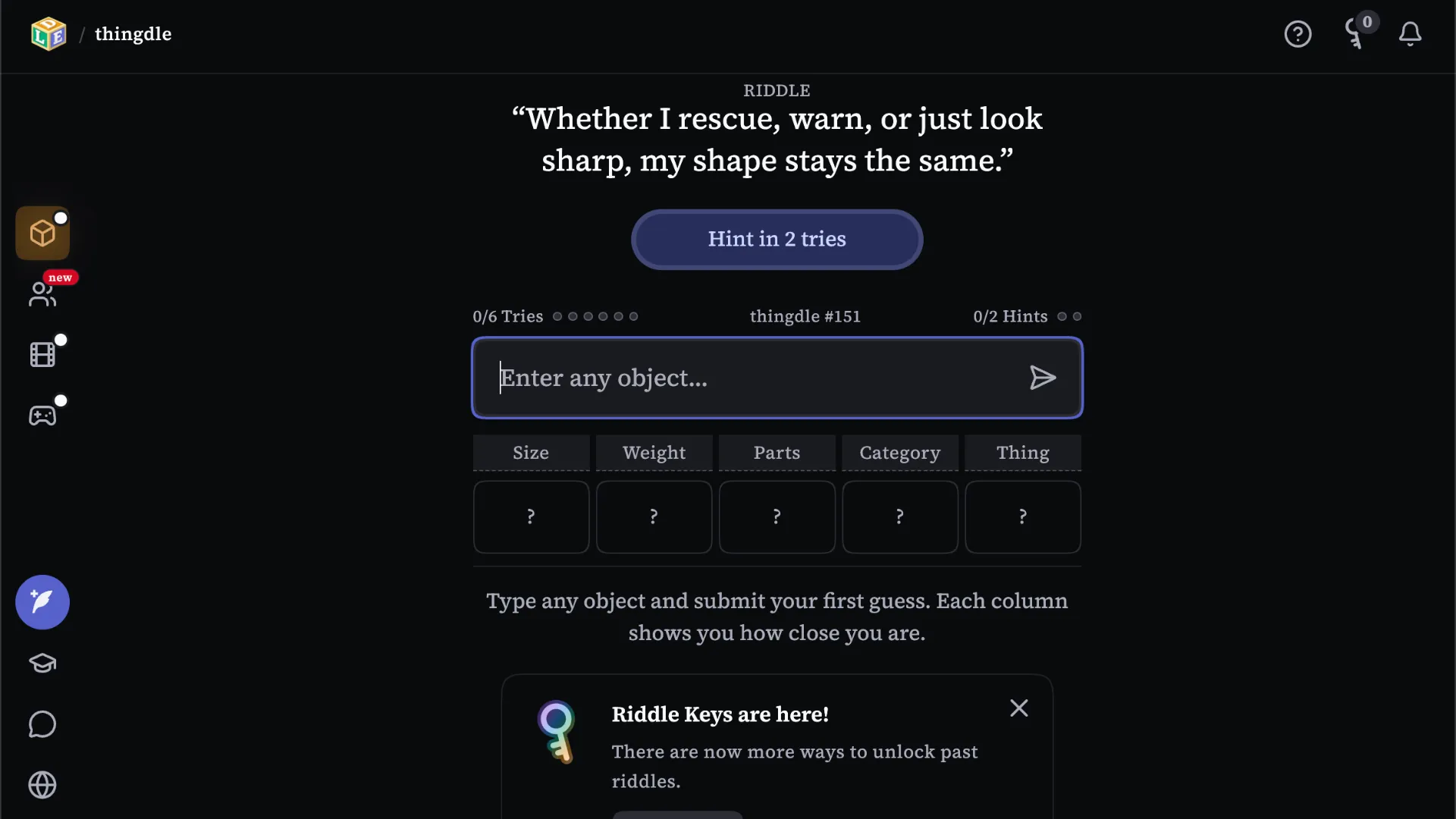
thingdle is a daily browser guessing game about everyday man-made objects. Instead of finding a hidden word from letter positions, you begin with a short riddle and try to identify the mystery thing in six guesses.
The target is an ordinary manufactured object rather than food, a drink, or something from nature. That means answers can come from the kinds of things you might find around a home, office, workshop, street, or other everyday setting.
Every guess gives you structured feedback about how your object compares with the answer. Properties such as weight, number of parts, and categories help you narrow the search, while additional hints appear as you use more attempts.
A fresh puzzle is available each day, so the game works well as a short daily challenge rather than an endless guessing session.
Rules and Core Twist
You have six tries to identify the day's object.
The opening riddle gives you your first direction. After you make a guess, thingdle compares properties of that object with the hidden answer and displays feedback in a grid.
For numerical or ordered properties, the game uses colors and arrows:
- Green means the value is in roughly the same range as the answer.
- ↑ or ↓ means the target is somewhat higher or lower than your guess.
- ↑↑ or ↓↓ means the target is much higher or lower.
For categories, the feedback works differently:
- Green means the answer matches all of the shown categories.
- Yellow means some categories overlap.
- Gray means those categories do not match the target.
For example, imagine you guess piano and its weight receives a downward indicator. That tells you the mystery object is lighter, so your next guess should move toward smaller or lighter everyday items while still respecting the other clues.
Additional hints unlock as the round progresses, including after your second and fourth guesses. If you still have not solved the puzzle after six attempts, the answer is revealed.
How to Play thingdle
- Read the daily riddle. Before entering anything, decide what broad family of objects could fit the wording: furniture, tools, electronics, clothing, transportation, household items, and so on.
- Make an informative first guess. Choose a plausible object that can also give you useful comparison data. Your guess does not have to be extremely close to help narrow the search.
- Study every feedback column. Check whether properties such as weight and number of parts should be higher or lower, and pay particular attention to category matches.
- Use the unlocked hints. More information becomes available after your second and fourth guesses. Combine those hints with the comparison grid instead of treating them separately.
- Identify the object within six tries. Keep narrowing the possibilities until one everyday object fits the riddle, category feedback, and physical characteristics together.
A Typical Deduction
Suppose the riddle suggests something you regularly interact with using your hands. Your first guess is a piano.
The feedback suggests that the answer:
- weighs much less,
- has fewer parts,
- shares only part of the same broad category information.
Rather than guessing another musical instrument immediately, you would look for a much smaller manufactured object that still makes sense with the original riddle. Each new comparison helps shrink the possible answer space.
That process of moving from a broad guess toward a specific object is the heart of thingdle.
Strategy Tips
Use guesses for information
A wild first guess is not necessarily wasted if it gives you useful boundaries. Pick familiar objects whose size, weight, complexity, and category are easy to understand, then use the arrows to move toward the target.
Prioritize category matches
Physical properties can fit many objects. A partial or complete category match can eliminate huge sections of the answer space, so category feedback is often one of your strongest clues.
Read arrows comparatively
Do not interpret an arrow as simply wrong. A double arrow tells you that your current guess is far from the target on that property, while a single arrow suggests you are getting closer.
Re-read the riddle after each guess
The opening clue can mean something different once you know more about the object's characteristics. A line that initially sounds metaphorical may become obvious after discovering that the target is small, lightweight, or belongs to a particular category.
Take advantage of later hints
If the solution is not obvious immediately, avoid throwing away guesses on near-identical objects. The extra hints that unlock during the round can provide the missing piece needed to make a much stronger next attempt.
thingdle Badges
Your result also receives a badge based on how quickly you solve the object:
- Psychic – solved on the first try
- Prodigy – solved in 2–3 guesses
- Sleuth – solved in 4–5 guesses
- Survivor – solved on the sixth guess
There is no timer, so thingdle rewards careful deduction more than speed. If you enjoy daily riddles and games where each guess reveals measurable information about a hidden answer, it offers a distinctive alternative to traditional word-based DLE games.