
What Is Timdle Math?
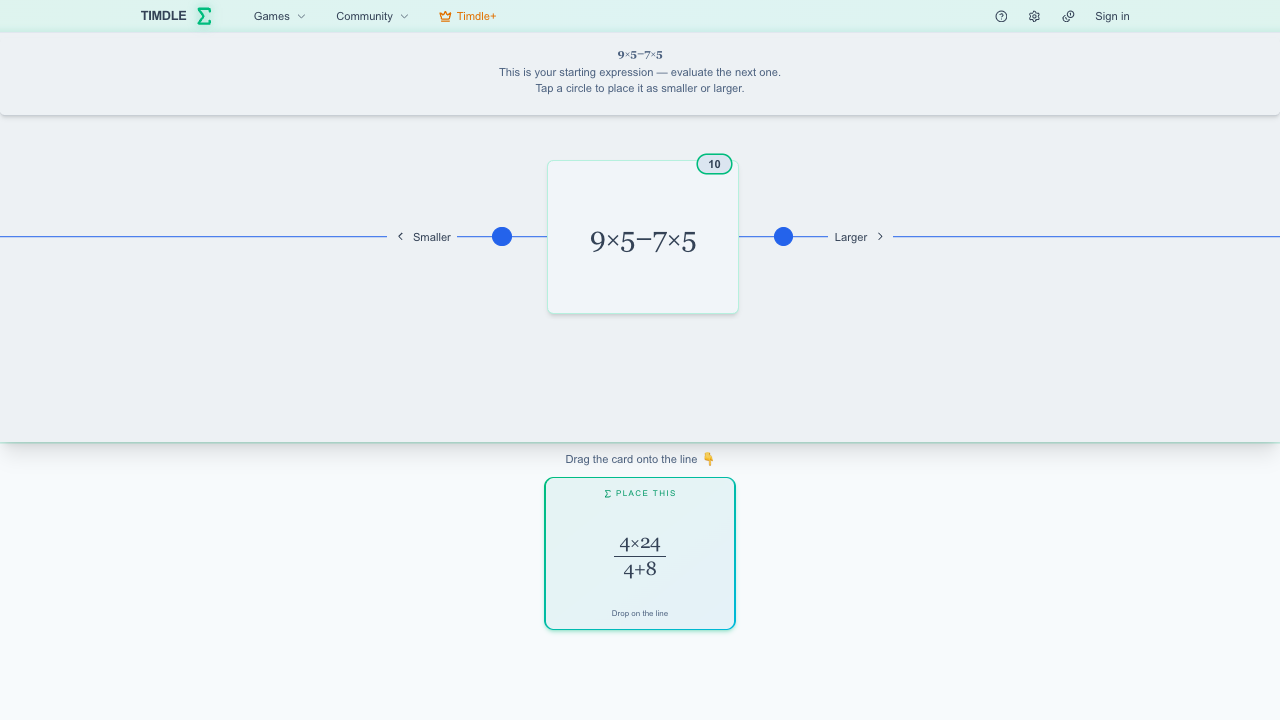
Timdle Math is a free daily mental-math sorting game from Timdle. Each puzzle gives you nine mathematical expressions representing different numerical values. One expression is already placed as an anchor, and your job is to position the remaining eight from smallest to largest.
The expressions can involve powers, roots, fractions, and order of operations, so the challenge is not simply doing basic arithmetic. You need to quickly judge how different mathematical forms compare with one another.
For example, you might need to decide whether:
√10 < π
or determine where a fraction belongs relative to a power or multi-step expression. Exact decimal answers are often unnecessary if you can estimate the values closely enough to determine their order.
The Core Math-Sorting Rule
The goal is to build one correctly ordered sequence:
smallest value → ... → ... → largest value
You work with one current expression at a time and decide where it belongs among the expressions already on the line. All nine expressions must ultimately appear in ascending numerical order.
Timdle Math is designed to be solved without a calculator. Instead of calculating every expression to many decimal places, the game rewards recognizing useful comparisons and approximations.
Accuracy also affects your score. Each card is worth points, while a wrong guess costs one point, so cleaner solutions produce better results.
How to Play Timdle Math
Look at the starting expression. One of the nine expressions is already positioned on the line and gives you a reference value for the puzzle.
Evaluate the current expression. Work out its value exactly or estimate it closely enough to compare it with the expressions already placed.
Place it in numerical order. Decide whether the expression belongs before, after, or between the values currently on the line.
Repeat for the remaining expressions. Continue solving one expression at a time until all nine are arranged from smallest to largest.
A new Timdle Math puzzle becomes available at midnight in your local timezone.
Strategy Tips
Compare instead of calculating everything
Suppose you are comparing √10 with π. You only need to recognize that √10 is a little above 3.16 while π is about 3.14. That is enough to place them correctly.
Memorize useful reference values
Knowing common values such as √2, √3, π, simple powers, and frequently used fractions can make comparisons much faster.
Respect order of operations
Expressions containing several operations can be deceptive. Apply parentheses, exponents, multiplication or division, and addition or subtraction in the proper order before deciding where the value belongs.
Use bounds when exact values are awkward
If an expression is difficult to calculate mentally, find a range instead. For example, knowing that √20 lies between 4 and 5 may already tell you where it belongs relative to nearby expressions.
Protect your score
Wrong placements reduce your score, so taking a few extra seconds to estimate a close comparison can be better than making a quick guess.
When Does Timdle Math Reset?
Timdle Math is a daily puzzle. A fresh set of expressions drops at midnight in your own timezone, making it suitable as a short daily mental-math challenge rather than an endless practice session.