What is Wend?
Wend is a daily word-finding puzzle from LinkedIn where the board is not just asking, “Can you spot a word?” It is asking, “Can you make every word fit without wasting a single tile?” You connect letters through a grid to uncover hidden words, but every open letter has to belong somewhere.
That makes Wend feel like a word search crossed with a logic maze. A word may look obvious, but if its path traps another word or leaves a lonely tile behind, the board quietly rejects your confidence. The real challenge is not finding one word — it is finding the full set of words that perfectly winds through the grid.
Wend Game Rules (The Catch / The Trap)
Wend gives you a letter grid with hidden words to trace.
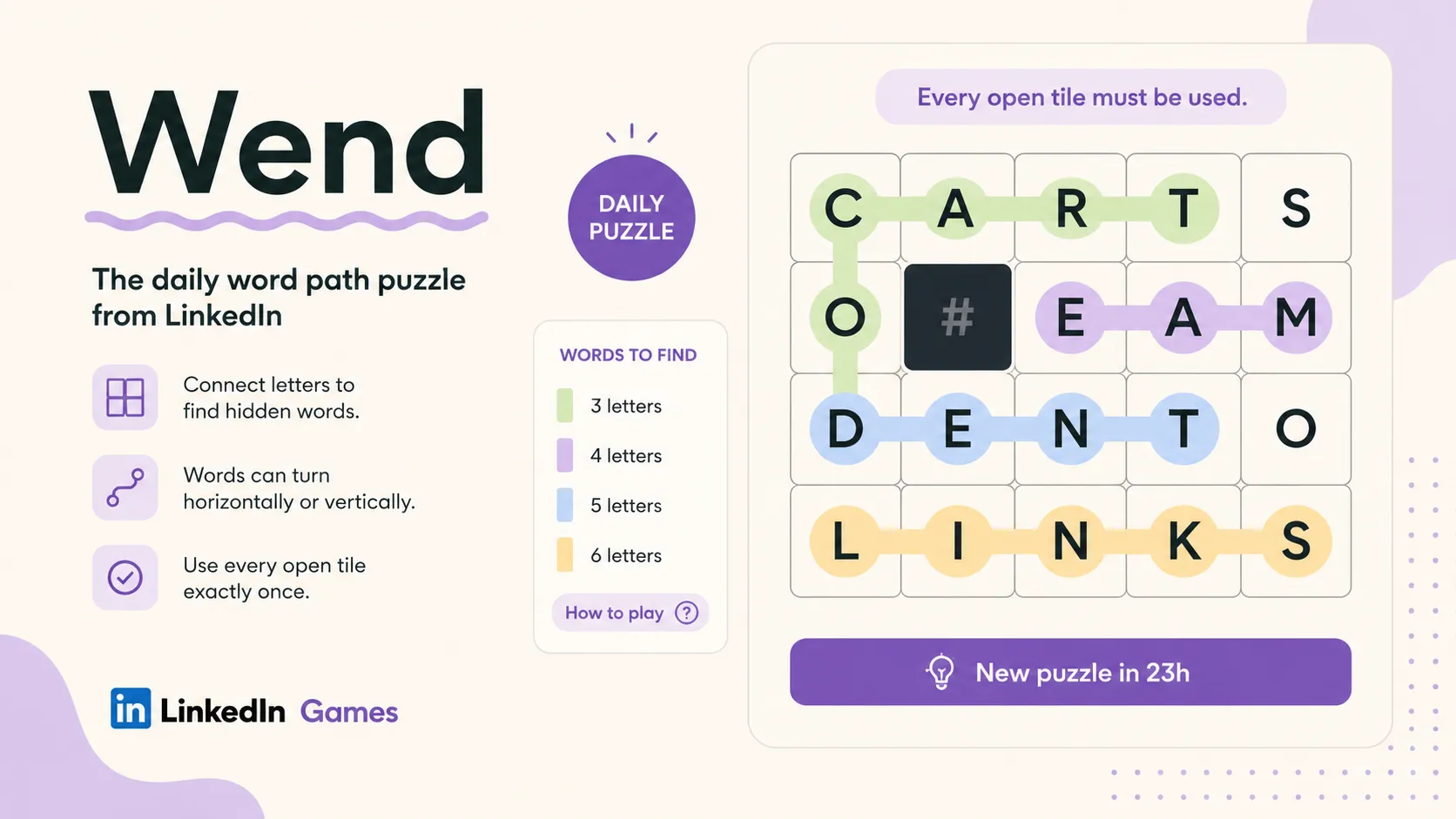
A small board might feel like this:
C A R T
O # E S
D E N T
L I N K
The # style space represents a blocked wall or unusable tile. The open letter tiles are the battlefield.
Core rules:
- You connect adjacent letters to form hidden words.
- Letters connect horizontally or vertically.
- Diagonal moves are not allowed in the standard rule set.
- Every open letter tile must be used exactly once.
- Words cannot overlap.
- The game shows how many words you need and their lengths, but not the answers.
Example path:
C → O → D → E
Result: CODE found.
The trap is that every word affects the whole grid. A tempting word can steal letters needed by another path. If one tile is stranded, the solution collapses. In Wend, the cleanest word is not always the correct word — the correct word is the one that lets the entire board survive.
How To Play Wend?
Read the word-length clues
Board Shows:3 letters • 4 letters • 5 letters • 6 letters
What You Learn: You know the shape of the hidden answers before you know the words themselves.Trace a possible word path
Player Connects:C → O → D → E
Game Response: If the path forms one of the hidden words, it locks in or is accepted.
What This Means: Those tiles are now part of the final solution.Check whether the remaining grid still works
Player Sees: a few unused letters split around a wall.
Next Constraint: If the remaining tiles cannot form the other word lengths, your first word may need to be undone.Build the paths together
Player Action: Try words that snake around walls without cutting off letters.
Game Response: More paths begin to fit into the board.
What You Learn: The puzzle is a connected system, not a list of separate answers.Use every open tile exactly once
Final Board: every letter belongs to one word path.
Result: The whole grid is solved, and the daily Wend is complete.
Wend Strategy & Tips
Start with the shortest word if it is obvious, but do not lock your brain onto it too early. Short words are flexible, while long words often control the shape of the board.
Look for forced paths near walls and corners. A corner tile usually has fewer escape routes, so it can reveal where a word must begin or end.
Avoid creating islands. If your traced word separates leftover letters into awkward pieces, it probably is not part of the final solution.
Think like a maze solver. The best Wend path is not just a valid word — it is a word that leaves the remaining tiles arranged into other valid words.