What Is Wordie?
Wordie is a free daily word puzzle developed by Ponder Club, the creators of a collection of short browser-based brain games. The challenge is simple: discover a hidden five-letter English word using no more than six guesses.
If you have played Wordle, the basic idea will feel familiar. Every guess reveals color-coded clues showing which letters belong in the answer and whether they occupy the correct positions. Each new attempt becomes a small deduction puzzle as you eliminate possibilities and narrow down the mystery word.
Wordie is designed for quick daily play. A fresh puzzle appears every day at midnight Pacific Time, and everyone receives the same daily challenge. Unlike many daily word games, Wordie also provides a free archive of previous puzzles, so you can play more than one challenge whenever you want.
The game works directly in a desktop or mobile browser, with no download, subscription, or account required to start playing.
Wordie Rules and Color Clues
Your objective is to identify the hidden five-letter word within six attempts.
The core rules are straightforward:
- Each guess must be a valid five-letter word.
- You have a maximum of six guesses to find the answer.
- After submitting a guess, each letter receives color feedback.
- Green indicates a correct letter in the correct position.
- Yellow indicates a letter that belongs in the answer but appears in the wrong position.
- Gray indicates a letter that is not included in the answer, subject to the usual handling of repeated letters.
- Correctly guessing the word completes the puzzle.
- A new daily puzzle becomes available at midnight Pacific Time.
Example: Reading the Clues
Imagine the hidden answer is PLANT, and your opening guess is SLATE.
Your guess:
S L A T E
Feedback:
⬛ 🟩 🟩 🟨 ⬛
Here is what those clues reveal:
- S is gray because it does not appear in PLANT.
- L is green because it occupies the correct second position.
- A is green because it occupies the correct third position.
- T is yellow because it belongs in the word but is not in the fourth position.
- E is gray because it does not appear in the answer.
You now know the answer follows the pattern _ L A _ _, contains a T somewhere other than the fourth position, and does not contain S or E.
A possible next guess is PLANT, which solves this hypothetical puzzle.
This is the heart of Wordie: every guess should reveal information that helps you make a more informed decision.
How to Play Wordie
Step 1: Open the Daily Puzzle
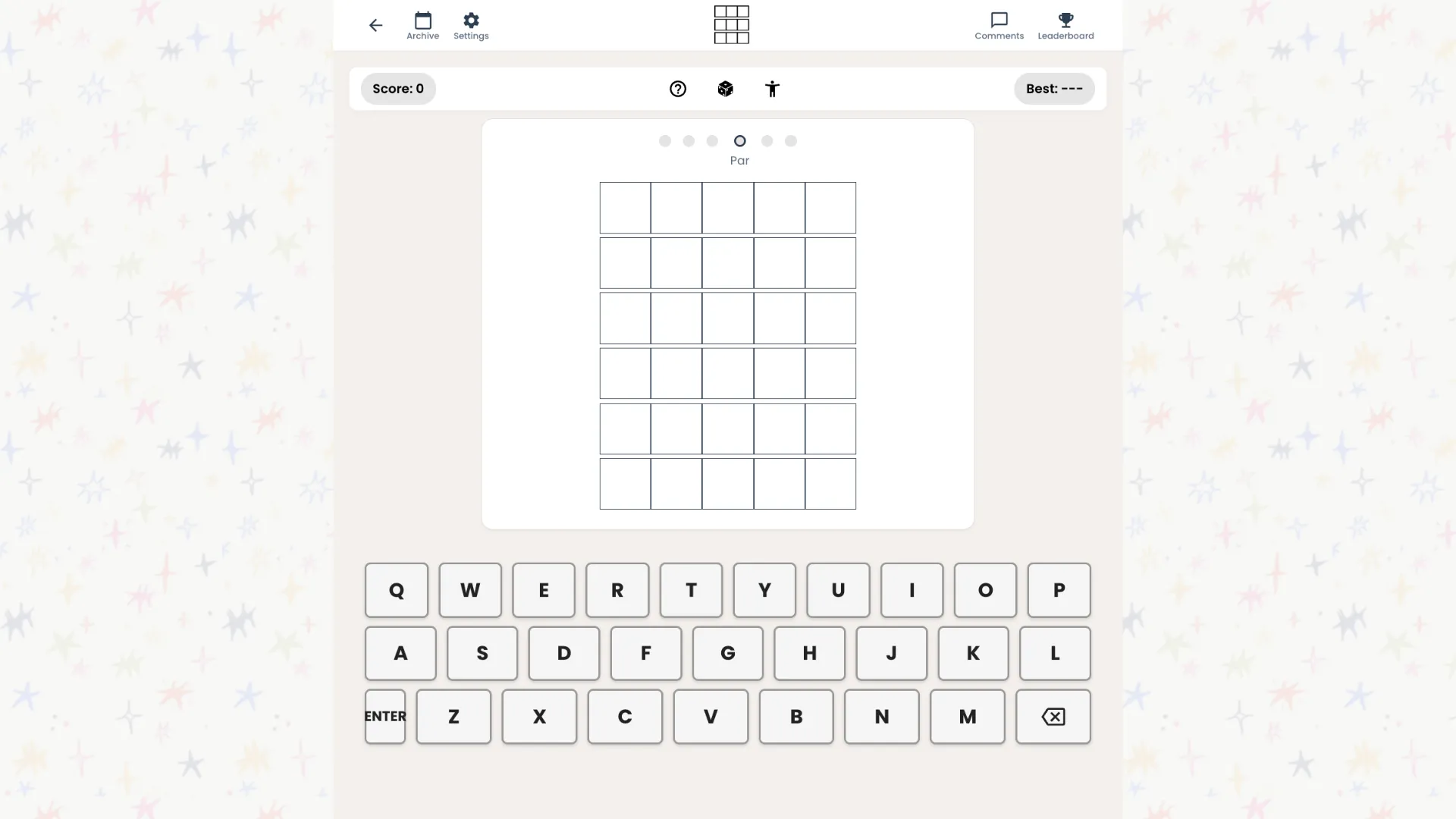
Visit the official Wordie page at Ponder Club and start today's challenge. The five-letter grid is ready for your first guess.
Step 2: Enter Your First Word
Type a valid five-letter word using your keyboard or the on-screen controls. A starting word such as CRANE, SLATE, or STARE can help test several frequently used letters.
Submit the word to receive your first set of clues.
Step 3: Interpret the Feedback
Examine the colored letters carefully. Keep green letters in their confirmed positions, try yellow letters elsewhere, and generally avoid gray letters in future guesses.
For example, if a guess reveals that A belongs in the third position and R is present but misplaced, your next word should account for both discoveries.
Step 4: Narrow Down the Answer
Use your remaining guesses to test possible words. Try to balance discovering new letters with checking likely solutions.
The goal is to solve the puzzle before using all six attempts. Once you identify the correct word, the round is complete.
Step 5: Share or Play Another Puzzle
After finishing, you can share your result with friends without revealing the answer. If you want another challenge, use Wordie's calendar archive to choose a previous day's puzzle.
Archived puzzles are available for free, although playing them does not contribute to your current daily streak.
What Makes Wordie Different?
Wordie follows the familiar five-letter guessing format, but several features make it convenient for regular puzzle players.
Free Puzzle Archive
One of Wordie's most useful features is its archive. Instead of waiting for tomorrow's challenge, players can revisit earlier dates and solve puzzles they missed.
This makes Wordie suitable for both quick daily sessions and longer word-game practice.
Daily Shared Challenges
Everyone receives the same daily word, making results easy to compare. You can challenge friends to solve the puzzle in fewer guesses or share your outcome without spoiling the answer.
Simple Browser-Based Gameplay
Wordie runs directly in a web browser on phones, tablets, and desktop computers. There is no application to install, and an account is not required for ordinary play.
Accessibility Options
Ponder Club offers a colorblind-friendly palette, helping players distinguish feedback more comfortably.
Optional Community Features
Ponder Club also supports leaderboards and player accounts. Signing in enables additional features such as leaderboard participation and progress tracking, while basic Wordie gameplay remains accessible without registration.
Wordie Strategy Tips
Although luck can influence an opening guess, a consistent strategy can substantially improve your chances of solving the word.
1. Begin With Common Letters
Opening words such as CRANE, SLATE, or TRACE cover several frequently used consonants and vowels. A productive opening guess tests letters that are likely to appear in ordinary English words.
2. Avoid Repeating Eliminated Letters
When a letter is confirmed absent, using it again generally wastes an opportunity to learn something new. Prioritize unused letters unless you have a specific reason to repeat one.
3. Move Yellow Letters Deliberately
A yellow letter is valuable because it confirms the letter exists somewhere in the answer. Remember that the position where it appeared is incorrect, and try it in another plausible location.
4. Watch for Repeated Letters
Some five-letter words contain repeated letters, such as APPLE or LEVEL. A gray result does not always mean a letter is entirely absent when another copy of that same letter has already received positive feedback.
Consider repeated letters when the remaining possibilities seem unusually limited.
5. Use Information-Gathering Guesses
When several answers remain possible, consider a guess that tests multiple uncertain letters rather than immediately choosing one candidate.
For example, if three possible answers share four letters, testing their different letters may reveal more information than guessing one of the candidates at random.
6. Practice With Previous Puzzles
Wordie's archive provides a convenient way to practice recognizing common letter patterns. Over time, players can become faster at interpreting clues and narrowing down possible answers.
Is Wordie Free to Play?
Yes. Wordie is free to play in a web browser. The daily puzzle and archive are available without a subscription or mandatory account.
Ponder Club offers an optional one-time purchase to remove advertisements, but purchasing it is not necessary to play Wordie.
Is Wordie the Same as Wordle?
Wordie is a separate game from the New York Times' Wordle, although both use the familiar five-letter, six-guess format with colored feedback.
The biggest practical difference for players is Wordie's freely accessible archive of previous puzzles. It also belongs to Ponder Club's broader collection of daily word, number, logic, and visual games.
Wordie is a good alternative for players who enjoy Wordle but want additional daily word challenges without subscribing to another service.
Conclusion
Wordie is an approachable daily word game that rewards vocabulary, observation, and logical deduction. Its familiar six-guess format makes it easy to learn, while its free puzzle archive provides plenty of opportunities to practice.
Whether you want a two-minute morning challenge, a friendly competition, or another Wordle-style puzzle, Wordie is worth trying.
Play Wordie for free on Ponder Club and see how quickly you can uncover today's five-letter answer.