
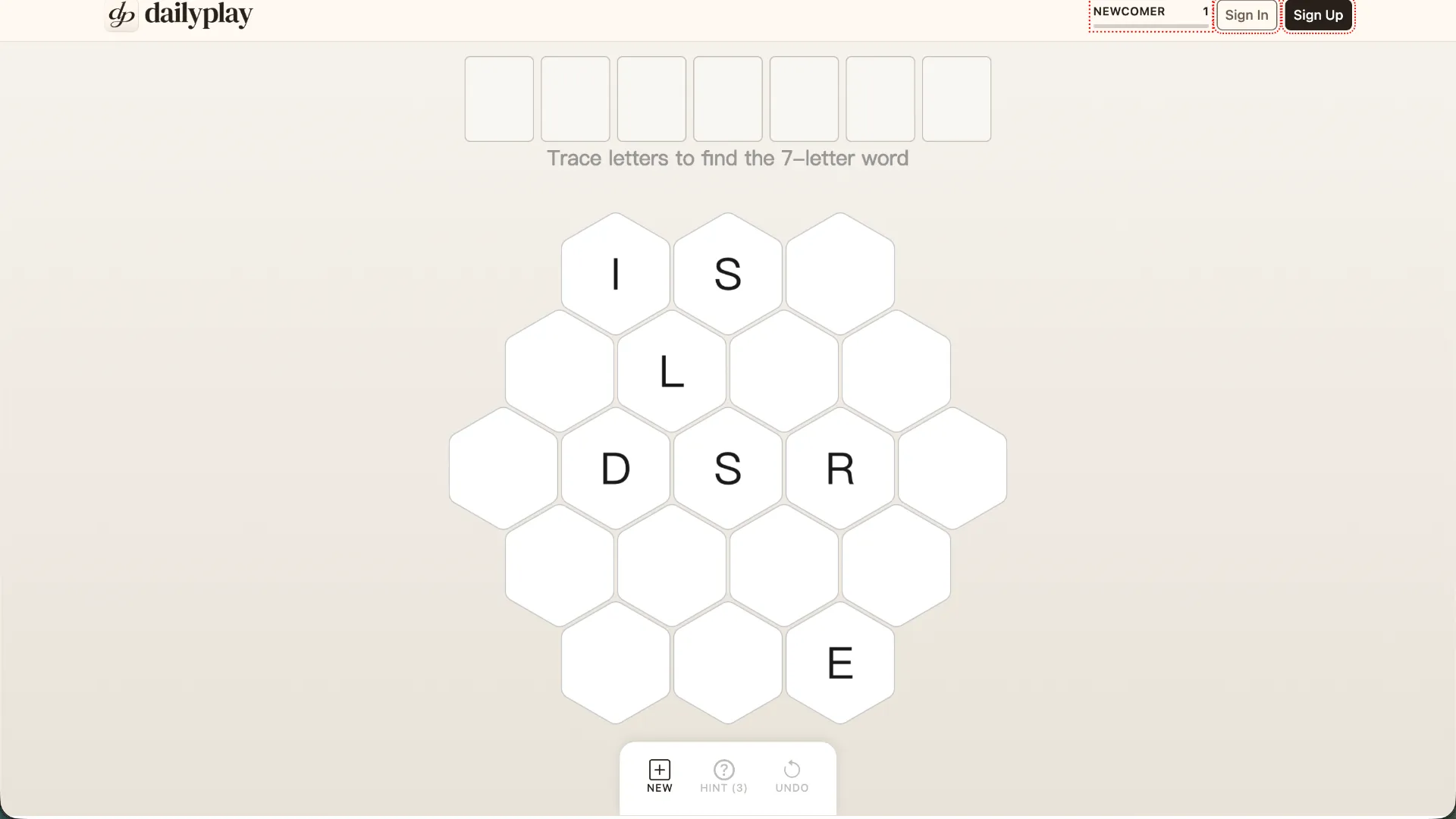
What Is WordSlip?
WordSlip is a free daily browser-based word puzzle that combines anagram solving with spatial pathfinding. Players must discover a hidden seven-letter word and trace a continuous route through a hexagonal grid to spell it correctly.
The game uses a board containing 19 hexagonal cells, seven of which hold letters. The other twelve cells are empty, but they are just as important because your route must pass through every cell on the board.
Unlike a conventional word scramble, finding the correct word is only part of the challenge. You also need to discover a valid path that visits the seven letters in the correct order while passing through all the empty hexagons.
Each complete guess provides feedback. Letters placed in their correct positions lock in green, helping you gradually reveal the hidden answer.
WordSlip is published by DailyPlay, a browser gaming platform operated by GreatGamesNetwork ApS. The website also offers Sudoku, Mahjong, Solitaire, and daily crosswords.
A new WordSlip puzzle appears every day at midnight, and everyone receives the same challenge. The game is free, has no advertisements, and does not require an account.
WordSlip Rules and Core Mechanics
WordSlip combines two challenges: identifying a seven-letter anagram and finding a continuous path across a hexagonal board.
The 19-Cell Hexagonal Grid
Each puzzle contains exactly 19 hexagonal cells arranged in a compact cluster.
- Seven cells contain letters belonging to the hidden word.
- Twelve cells are empty.
- The seven letters must be used in the correct order.
- Your completed path must visit all 19 cells.
- The path must start and end on cells containing letters.
- Each move must connect to a neighboring hexagon.
- A cell cannot be reused within the same completed path.
The empty cells act as bridges between letters. They allow you to connect letters positioned far apart without adding anything to the word itself.
Unscramble the Seven Letters
The seven visible letters form one hidden seven-letter word.
For example, imagine the letters scattered across the grid are:
A, T, P, S, E, L, N
One possible English word using those letters is PLANETS.
Knowing the word tells you the order in which its letter cells must be visited:
P → L → A → N → E → T → S
However, you cannot simply jump directly between those seven cells. You must construct a connected route through the hexagons that visits every cell on the board exactly once.
This is a hypothetical example illustrating the word-solving mechanic, not an actual daily WordSlip answer or a guaranteed valid route for an arbitrary board.
Trace a Continuous Path
Use your mouse or finger to drag across neighboring hexagonal cells.
As your path crosses a letter, that letter appears in the preview row at the top of the screen. Empty cells are included in your route but do not add letters to the preview.
A complete guess must begin on a letter, finish on a letter, and cover all 19 cells.
A route that spells the correct word but leaves empty cells unvisited is not a complete solution.
Green Letters Lock Into Place
After a valid full guess, WordSlip checks the order of the seven letters.
Any letters occupying the correct positions turn green and become locked.
These correctly placed letters remain visible in the preview on later attempts, reducing the number of unknown positions.
For example, if your guess places the first, fourth, and seventh letters correctly, those three positions can become fixed clues for your next attempt.
You can then focus on rearranging the remaining letters while planning a valid route through the board.
No Timer or Guess Limit
WordSlip does not impose a countdown timer or a fixed number of attempts.
You can study the grid, experiment with routes, and make additional complete guesses until you solve the puzzle.
This makes the game more relaxed than many daily word challenges that limit players to a small number of guesses.
How to Play WordSlip
WordSlip runs directly in a web browser and supports mouse and touchscreen controls.
- Open the daily puzzle. Visit WordSlip on DailyPlay. The game displays a hexagonal board containing seven scattered letters and twelve empty cells.
- Find the hidden word. Examine the seven letters and try to rearrange them into a valid English word. Look for familiar prefixes, suffixes, common letter combinations, and possible word endings.
- Plan and trace your path. Start on a letter cell and drag through neighboring hexagons. Pass through all 19 cells exactly once, using the empty cells to connect the letters in your chosen order. Your path must finish on a letter cell.
- Check the feedback. After completing a valid full path, inspect the preview row. Letters in the correct positions lock in green. Use these clues to reconsider the order of the remaining letters and plan another route if necessary.
- Solve the complete word. Continue making full guesses until all seven letters are correctly positioned. Once the puzzle is solved, review your completion result, share it with friends, or explore previous puzzles in the archive.
If a trace is incomplete, the game can indicate problems such as using too few letters or starting or ending on an invalid cell.
Example: Solving a WordSlip Anagram
Suppose a hypothetical WordSlip puzzle contains these seven letters:
T, R, A, I, N, E, R
You might recognize that they can form the word TRAINER.
The required letter order would be:
T → R → A → I → N → E → R
Notice that the word contains two R letters. These are separate letter cells, and each must be visited at the appropriate position in the sequence.
Now imagine that T and the first R are far apart on the hexagonal board. You must find a continuous route connecting them through neighboring cells, possibly crossing several empty hexagons.
The same process applies to every subsequent letter.
Your route must eventually include all seven letter cells and all twelve empty cells without visiting any cell twice.
Even though TRAINER is a valid seven-letter word, whether you can trace it depends on the actual arrangement of the cells.
This illustrates why WordSlip requires both vocabulary knowledge and spatial reasoning. Recognizing the answer does not automatically reveal a valid route.
If your first complete guess is incorrect, any correctly positioned letters lock green. Those fixed positions can help you identify the intended word and refine your next route.
What Makes WordSlip Different?
WordSlip combines several familiar puzzle mechanics in an unusual way.
Anagram Solving
You must rearrange seven scattered letters into a meaningful English word.
Unlike crossword puzzles, there are no written definitions directing you toward a particular answer. The letters themselves provide the starting information.
Hexagonal Pathfinding
Once you have a possible word, you need to find a route across the board.
Hexagonal cells create a different movement pattern from a conventional square grid. Interior hexagons can connect to six neighboring cells, while edge and corner cells have fewer available connections.
This creates routing constraints that can make certain letter orders easier or harder to trace.
Progressive Letter Feedback
Correctly positioned letters become green and remain locked for later attempts.
This gives WordSlip a progressive deduction mechanic. Even an unsuccessful complete guess can provide valuable information.
Complete Board Coverage
You cannot ignore the empty cells.
Every successful full path must cover the entire 19-cell board, adding a second logical challenge beyond simply spelling the right word.
The combination of these mechanics makes WordSlip more than a conventional word search or anagram game.
WordSlip Strategy Tips
1. Identify Common Word Patterns
Before tracing a path, study the seven available letters.
Look for familiar combinations such as TH, CH, SH, ST, ING, ER, ED, and common vowel-consonant patterns.
Recognizing a plausible seven-letter word first makes planning the route much easier.
2. Use Green Letters as Fixed Anchors
When a letter locks green, its position in the target word is confirmed.
Instead of reconsidering every possible arrangement, focus on the remaining unknown positions.
For example, if the first letter is confirmed as S and the final letter is confirmed as E, search for seven-letter words beginning and ending with those letters using the available tiles.
3. Study the Outer Hexagons
Cells near the edge of the board have fewer neighbors than cells near the center.
This makes them important when planning a route that must cover the entire grid.
If you leave an isolated edge cell until late in your path, you may discover that it can no longer be reached without revisiting another cell.
Try to account for awkward edge and corner cells early.
4. Treat Empty Cells as Bridges
The twelve empty hexagons are not obstacles or wasted spaces.
They are essential connectors that allow you to travel between letters positioned on opposite sides of the board.
When two consecutive letters in your suspected word are far apart, identify possible chains of empty cells connecting them.
Remember that using an empty cell now removes it from the available route later.
5. Plan the Entire Route Before Dragging
A path that successfully connects the first four letters can still fail if it leaves the remaining cells unreachable.
Before beginning a long trace, consider whether your proposed route can eventually visit every hexagon.
The strongest route is not necessarily the shortest connection between each pair of letters. It is the route that covers the entire board in the required order.
6. Avoid Trapping Unvisited Cells
Because a cell cannot be reused, careless routing can isolate part of the board.
Be especially cautious about creating small groups of unvisited cells that have only one remaining entrance.
If you enter such a region too early, you may be unable to leave while still completing the rest of the path.
7. Make a Full Guess When Unsure
If you cannot immediately identify the hidden word, a complete guess can still help.
The game reveals which letters are in their correct positions by locking them green.
This feedback reduces uncertainty and provides a foundation for subsequent attempts.
8. Start a New Trace When Needed
WordSlip allows you to begin a new trace by selecting a letter cell.
If your current route becomes awkward or impossible, you can restart the path without needing to undo every individual movement.
9. Consider Different Routes
Even when you know the target word, there may be several ways to approach the spatial challenge.
Try examining the board from different directions and identifying which areas should be visited early or late.
Keep in mind that the completed trace must follow the letters in forward word order, starting with the first letter and ending with the last.
10. Take Your Time
There is no timer or attempt limit.
Rather than rushing through repeated incomplete traces, study the arrangement of letters and empty spaces carefully.
A few moments of planning can prevent a path from becoming trapped near the end.
WordSlip Hints and Controls
The WordSlip interface includes controls labeled Hint, Undo, Notes, Skip, and Finish.
These provide additional ways to interact with the puzzle alongside the main drag-to-trace mechanic.
The most important built-in assistance is the progressive green-letter feedback that appears after a complete guess.
When a letter is confirmed in the correct position, it stays locked for subsequent attempts. This makes it possible to work toward the solution without discovering the entire word immediately.
The interface also allows players to start a new trace by selecting any letter cell.
Because the game has no timer and no limit on guesses, players can experiment and learn from the feedback without the pressure of losing after a fixed number of attempts.
Is WordSlip a Daily Game?
Yes. WordSlip releases one new shared puzzle every day at midnight.
Each daily challenge contains a seven-letter hidden word and a corresponding arrangement of letters across the 19-cell board.
Everyone receives the same puzzle for that day, allowing players to compare their experiences and results.
The official website does not specify a time zone alongside its midnight reset description, so players should use the site's current daily puzzle as the authoritative reference.
WordSlip is designed for short play sessions, making it suitable for a regular daily puzzle routine.
Can You Play Previous WordSlip Puzzles?
Yes. WordSlip includes a built-in archive calendar titled Play Previous Puzzles.
You can select a month and year, then choose an earlier date to open that day's puzzle.
This is useful for players who discover the game after its launch or want more practice without waiting for the next daily challenge.
Previous puzzles use the same core mechanics: seven scattered letters, a 19-cell hexagonal grid, and a complete path that spells the hidden word.
The archive also helps players become more familiar with the spatial patterns that make certain letter arrangements difficult.
Is WordSlip Free to Play?
Yes. WordSlip is completely free to play on DailyPlay.
The publisher states that the game has no advertisements, pop-ups, or gameplay interruptions.
You do not need to create an account or install an application to play the current daily puzzle.
Your progress is saved locally on your device. An optional free DailyPlay account allows you to save progress permanently and access it across devices.
The website also displays player statistics such as current streak, best streak, level, and experience-point progress.
WordSlip can be played using a mouse or touchscreen, making it accessible through desktop and mobile browsers.
WordSlip vs. Wordle, Strands, and Boggle
WordSlip shares ideas with several popular word games but combines them differently.
| Game | Main Objective | Key Difference |
|---|---|---|
| WordSlip | Unscramble seven letters and trace a complete route through 19 hexagons | Combines anagrams, full-board pathfinding, and locked-letter feedback |
| Wordle | Guess a hidden five-letter word | Uses letter-position feedback without spatial routing |
| Strands | Find themed words by connecting letters on a grid | Involves multiple themed words instead of one seven-letter anagram |
| Boggle | Discover words by connecting adjacent letters | Focuses on finding multiple words rather than visiting every cell in one route |
| Squaredle | Find words by tracing connected letters | Rewards discovering multiple words on a letter grid |
| Letter Boxed | Connect letters around a square to build a word chain | Uses alternating sides and chained words instead of a hexagonal full-board route |
WordSlip is particularly distinctive because it combines a word-order problem with a complete path-coverage problem.
A player may correctly identify the hidden word but still need to think carefully about how to trace it through every cell.
Conversely, a player may discover a promising route before knowing the answer and use the resulting green-letter feedback to narrow down the word.
Who Should Play WordSlip?
WordSlip is especially suitable for players who enjoy language puzzles with an additional spatial challenge.
It is a good choice for:
- Anagram enthusiasts who enjoy rearranging letters into meaningful words.
- Wordle fans looking for another daily word puzzle with progressive feedback.
- Pathfinding puzzle players who enjoy planning routes through connected cells.
- Strands and Squaredle players who like tracing paths across letter grids.
- Daily puzzle fans who want a short, repeatable browser challenge.
- Casual players who prefer games without a timer or strict guess limit.
WordSlip does not require specialist trivia knowledge. A reasonable vocabulary, careful observation, and patience with spatial puzzles are enough to get started.
Who Created WordSlip?
WordSlip is published by DailyPlay, a gaming website operated by the Danish company GreatGamesNetwork ApS.
The official site identifies GreatGamesNetwork ApS as the company behind DailyPlay and WordSlip.
DailyPlay offers a collection of free browser games, including Sudoku, Mahjong, Solitaire, WordSlip, and several crossword formats.
WordSlip follows the platform's daily-puzzle approach by providing the same challenge to all players each day, an archive of older puzzles, optional accounts, and progress tracking.
The official WordSlip page describes its central mechanic as unscrambling seven letters on a hexagonal board and tracing a path through every cell.
For the complete rules, visit WordSlip on DailyPlay.
Frequently Asked Questions
What is the goal of WordSlip?
Find the hidden seven-letter word and trace a continuous path through all 19 hexagonal cells so that the letter cells are visited in the correct order.
How many letters are in WordSlip?
Each daily puzzle contains seven letter tiles that form one hidden seven-letter word.
How many cells are on the board?
The grid contains 19 hexagonal cells: seven letter cells and twelve empty cells.
Do you have to visit the empty cells?
Yes. Every valid complete guess must pass through all 19 cells, including the empty ones.
Can you use a cell more than once?
No. The completed route must visit each cell once while moving between neighboring hexagons.
What do green letters mean?
Green letters are in the correct positions in the hidden word. They lock in and remain confirmed on later attempts.
Does WordSlip have a timer?
No. The official rules state that there is no timer or move limit.
How many guesses do you get?
There is no fixed guess limit. You can continue making complete guesses until you solve the puzzle.
Does everyone get the same puzzle?
Yes. WordSlip provides the same daily puzzle to all players.
When does WordSlip reset?
A new puzzle is released at midnight each day. The official instructions do not specify a reset time zone.
Can you play past WordSlip puzzles?
Yes. The official website includes a calendar archive where you can select previous dates.
Is WordSlip free?
Yes. WordSlip is free to play and the publisher states that it contains no advertisements.
Do you need an account?
No. An account is optional and can be used to save progress across devices.
Who made WordSlip?
WordSlip is published by GreatGamesNetwork ApS through its DailyPlay gaming platform.
Conclusion
WordSlip offers a clever combination of two familiar puzzle concepts: unscrambling a hidden word and tracing a route through a grid.
Its central twist is that identifying the seven-letter answer is not enough. You must also find a connected path that visits every one of the 19 hexagonal cells while spelling the word in the correct order.
The progressive green-letter feedback keeps the puzzle approachable, while the full-board routing requirement adds enough depth to challenge experienced word-game players.
With a new shared puzzle every day, no timer, unlimited attempts, a calendar archive, and completely free ad-free gameplay, WordSlip is an appealing choice for fans of anagrams, Wordle, and spatial word puzzles.
Ready to find the hidden route? Visit WordSlip, unscramble today's seven letters, and see if you can trace a perfect path through all 19 hexagons.