4D Chess Guide: How to Play the Four-Dimensional Chess Game
Learn how 4D Chess works, how X/Y/Z/W movement changes every piece, practical beginner tips, special rules, and who should try it.
Quick Answer
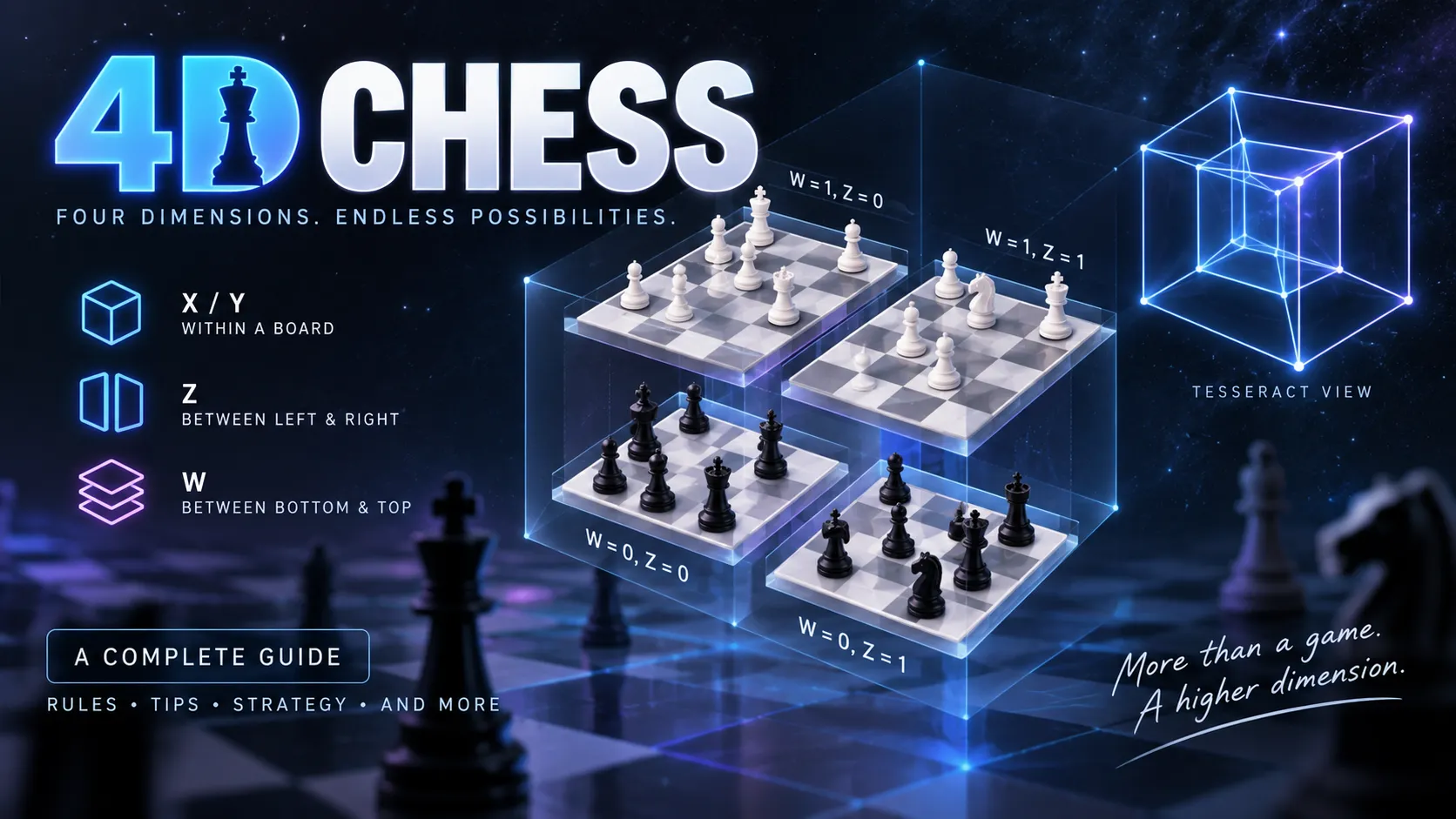
4D Chess is an experimental browser chess variant played across four coordinates: X, Y, Z, and W. Instead of one traditional 8×8 board, this version presents multiple smaller boards as slices of one four-dimensional playing space. X and Y describe positions inside a board, while Z and W represent movement between additional layers.
The objective is still checkmate, but pieces can attack and move across dimensions in ways that do not exist in ordinary chess.
You can play 4D Chess online on DLE Games and use the legal-move indicators to learn how the extra dimensions affect each piece.
The fastest way to understand the game is to stop thinking of the visible boards as separate matches. They are different views of the same position. A rook moving from a1 [0,0] to a1 [0,1], for example, has made a straight move along W even though the move appears to jump between boards on your screen.
What Is 4D Chess?
Traditional chess needs two coordinates: file and rank. 4D Chess adds two more.
- X: horizontal position inside a board.
- Y: vertical position inside a board.
- Z: movement between one set of board layers.
- W: movement between another set of board layers.
A position such as a1 [0,1] therefore describes not only the familiar a1 square but also its location in the Z and W dimensions.
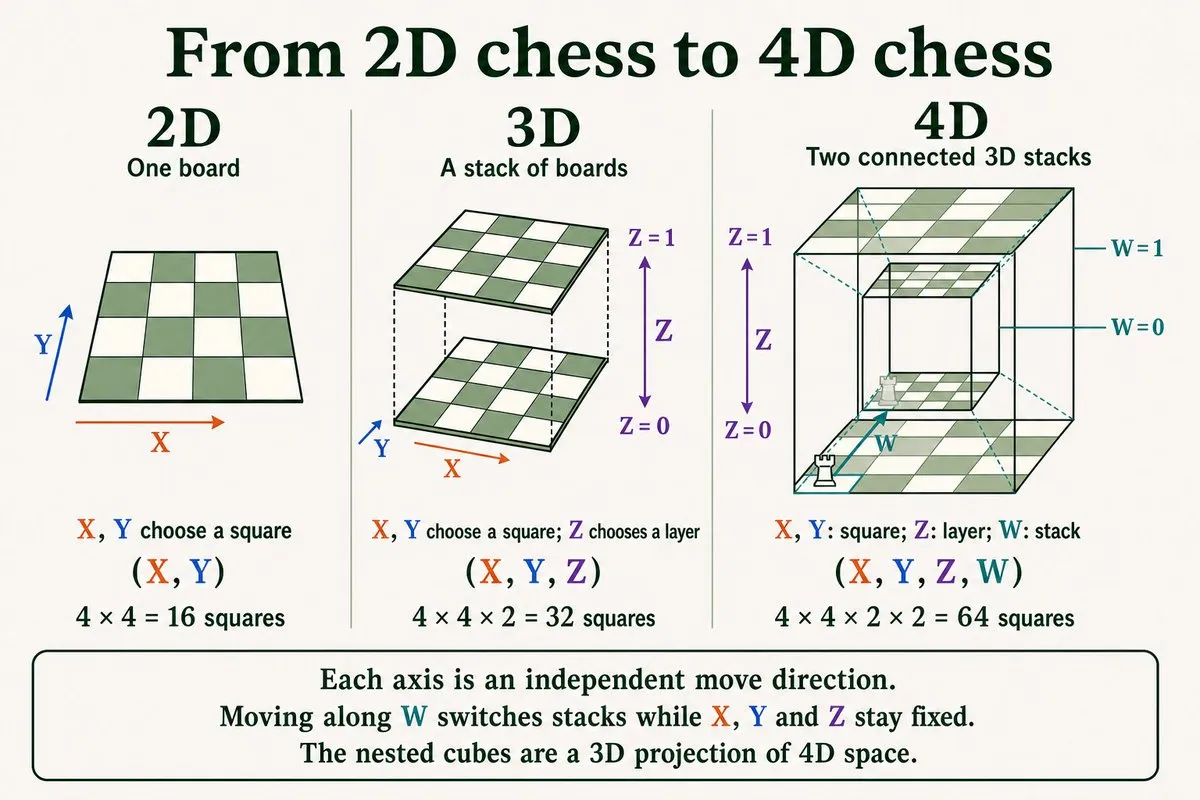
The interface flattens this higher-dimensional space into several visible boards. A tesseract-style projection may also be used to help show how the layers relate to one another.
This visualization is important because screen distance can be misleading. Two pieces that appear far apart may actually be directly adjacent along Z or W.
How to Play 4D Chess
The basic flow remains familiar to chess players: White moves first, players alternate turns, and the goal is to checkmate the opposing king.
Select one of your pieces and then choose one of its legal destinations. The game highlights available moves, which is especially useful while learning how each piece interacts with the extra dimensions.
The most important beginner habit is to read every position as four coordinates rather than judging moves only by the flat board layout.
Rook
A rook moves by changing one coordinate while leaving the others unchanged.
That can mean a familiar horizontal or vertical move inside one board, or a straight move across Z or W.
For example:
a1 [0,0] → a1 [0,1]
Only W changes, so this is a rook-style straight move.
A move that changes both Z and W simultaneously would not be a rook move because more than one coordinate changes.
Bishop
A bishop moves diagonally by changing two coordinates by equal amounts.
Normal X+Y diagonals still exist, but the additional dimensions introduce combinations such as X+W, Y+Z, or Z+W when the board geometry allows them.
This means bishops can threaten pieces on different visible boards even when the move does not look diagonal in the flattened interface.
Knight
The knight keeps the familiar 2-and-1 movement concept: two steps along one coordinate and one step along another.
It can still jump over intervening pieces.
The important difference is that the two axes involved in the move are not limited to X and Y. Depending on the board dimensions, a knight move can involve one of the additional coordinates.
Queen
The queen becomes especially powerful in four-dimensional space.
She combines straight and diagonal movement across multiple valid coordinate combinations, creating attack lines that cannot exist on an ordinary chessboard.
A queen that appears far away on another visible board may still have a direct line toward your king through Z or W.
For that reason, always inspect queens across the entire position rather than only the board containing your king.
King
The king moves one step along a valid combination of the available axes.
The extra dimensions provide more possible escape directions, but they also expose the king to many more possible attack vectors.
A square that looks safe in one 2D slice may still be attacked from another Z or W layer.
Pawn
Pawns retain directional movement but gain capture relationships that can involve the additional dimensions.
This makes pawn structure quite different from standard chess. Pawns may threaten positions that do not appear diagonally adjacent when you look at only one visible board.
Promotion remains important, but familiar concepts such as standard pawn chains and opening structures do not transfer cleanly into four dimensions.
The Rule Beginners Miss Most Often
The biggest mistake is treating each visible board as an independent game.
Imagine your king is on a1 [0,1] and an enemy rook is on a1 [0,0].
The pieces appear on different boards, but their X, Y, and Z coordinates are identical. Only W differs. In four-dimensional space, they are aligned along the same axis, so the rook may attack the king directly.
This is why a position that looks completely safe in one 2D slice can already be check or checkmate when the entire four-dimensional position is considered.
Another common mistake is trusting the projected lines too literally. If two lines overlap visually, that does not necessarily mean the pieces share the same path. Legal movement and blocking depend on the complete X/Y/Z/W coordinates.
Practical Tips for Your First Games
1. Learn One Extra Dimension at a Time
Do not try to visualize four-dimensional space immediately.
Start by understanding moves where X, Y, and Z stay unchanged while only W changes. Once that feels natural, begin looking at moves combining W with another axis.
This creates a much easier learning curve than trying to memorize every possible movement pattern at once.
2. Count Changed Coordinates
When a move looks confusing, compare the starting and ending coordinates.
- One changed coordinate: think rook-like movement.
- Two equally changed coordinates: think bishop-like movement.
- A 2+1 coordinate change: think knight.
- Multiple valid equal changes: think queen.
- One-step combinations: think king.
Coordinate comparison is far more reliable than judging movement from the visual angle of the projected boards.
3. Scan Every Board After Every Move
Ordinary chess players naturally focus on the area surrounding their king. That habit can cause immediate problems here.
After every opponent move, inspect matching positions and potential attack lines across Z and W.
Long-range pieces can create threats from a different visible board that are easy to miss.
4. Use Legal-Move Highlights as a Learning Tool
The game's highlighted legal destinations are useful for more than simply choosing a move.
Before clicking a destination, ask why the game considers it legal.
Compare the starting and ending coordinates and identify which dimensions changed. Doing this repeatedly helps build four-dimensional intuition surprisingly quickly.
5. Treat Queens as Global Threats
A queen can access many combinations of movement axes, making her influence much broader than it first appears.
Before moving a defensive piece, check whether you are opening a cross-dimensional line between an enemy queen and your king.
This is one of the easiest ways to lose material or walk into check.
6. Do Not Rely Too Heavily on Standard Chess Openings
General ideas such as development, king safety, tempo, forks, pins, and discovered attacks still matter.
However, traditional opening theory is much less useful because the geometry has changed fundamentally.
Piece mobility, pawn relationships, and attack directions all behave differently. Learn the geometry before trying to apply memorized chess patterns.
Why 4D Chess Feels So Difficult
The rules are not necessarily the hardest part. Visualization is.
Humans naturally understand two-dimensional grids. Experienced chess players can recognize familiar tactical patterns almost instantly because they have seen similar structures thousands of times.
4D Chess removes much of that advantage.
A useful mental process is:
piece → X/Y/Z/W position → possible axis combinations → attack lines
At first, this makes every move slower. After several games, however, matching coordinates between the visible boards becomes much easier.
A Simple Example
Suppose a rook and a king occupy the same X, Y, and Z coordinates but have different W values.
On the screen, they appear to sit on separate boards.
In four-dimensional space, however, they are aligned directly along W.
This relationship is similar to two ordinary chess pieces sharing the same file. The visual separation exists because the fourth dimension has been flattened onto a two-dimensional display.
Understanding examples like this is much more practical than trying to imagine a literal physical fourth dimension.
Who Should Try 4D Chess?
4D Chess is especially suitable for players who enjoy:
- Chess variants
- Spatial reasoning
- Logic puzzles
- Mathematical games
- Experimental browser games
- Unusual strategy systems
- Games that challenge familiar assumptions
Regular chess experience helps because concepts such as check, checkmate, sliding pieces, knights, promotion, and king safety remain recognizable.
However, being a strong chess player does not automatically make 4D Chess easy. Most of the difficulty comes from learning to reason about threats across several coordinate axes.
It is less suitable if you mainly want standard tournament chess, established opening theory, competitive ratings, or a casual game that can be understood immediately.
For puzzle and strategy fans, however, the unfamiliar geometry is exactly what makes the game interesting.
Final Take
4D Chess works because it changes one of chess's most fundamental assumptions: the board is no longer a single two-dimensional plane.
The game becomes much easier once you stop relying entirely on its visual projection and start comparing X, Y, Z, and W coordinates directly.
Rooks are a good way to learn movement along the additional axes. Bishops introduce cross-dimensional diagonals. Queens demonstrate just how dramatically extra dimensions expand the number of possible threats.
Expect the first few games to feel disorienting. That confusion is part of the experience.
If ordinary chess variants no longer surprise you, 4D Chess on DLE Games is a distinctive browser strategy experiment worth trying.