Dinoris Explained: Why This Dinosaur Falling-Block Game Feels Surprisingly Serious
Discover Dinoris, a free dinosaur falling-block browser game with Survival hazards, 40 Lines, advanced handling, rankings, and replay verification.
Dinoris looks like a cheerful dinosaur-themed block game, but its cute first impression hides a surprisingly serious design. Beneath the hand-drawn trees, sleepy dinosaur companion, pastel pieces, and playful menus is a modern falling-block system with configurable handling, advanced performance statistics, competitive rankings, and server-side replay verification.
It is also an unusually complete debut. The independent creator, known publicly as TenmaTenmadayo or tententen, describes Dinoris as a first game, says every dinosaur and sprite was drawn by hand, and has been open about using Claude Code during implementation. The result is a useful case study in what can happen when tool-assisted coding is paired with a clear game idea, original visual direction, careful testing, and fast responses to player feedback.
Dinoris is free to play in a modern browser and does not require an account for ordinary runs. It currently offers four modes rather than a single endless board, and its most original mode gradually turns familiar stacking into environmental survival.
Dinoris at a Glance
| Feature | What Dinoris Offers |
|---|---|
| Core genre | Modern falling-block puzzle game |
| Main theme | Hand-drawn dinosaurs and a colorful prehistoric world |
| Modes | Survival, Escort, 40 Lines, and Endless |
| Advanced handling | SRS-style rotation, wall kicks, 7-bag, Hold, Next queue, DAS, ARR, and SDF settings |
| Performance tracking | PPS, finesse, combos, back-to-back clears, T-Spins, and Quads |
| Competitive layer | World rankings with replay-based verification |
| Access | Free browser play; sign-in is optional unless a run is meant for the world board |
| Creator | Independent developer using the public handles TenmaTenmadayo and tententen |
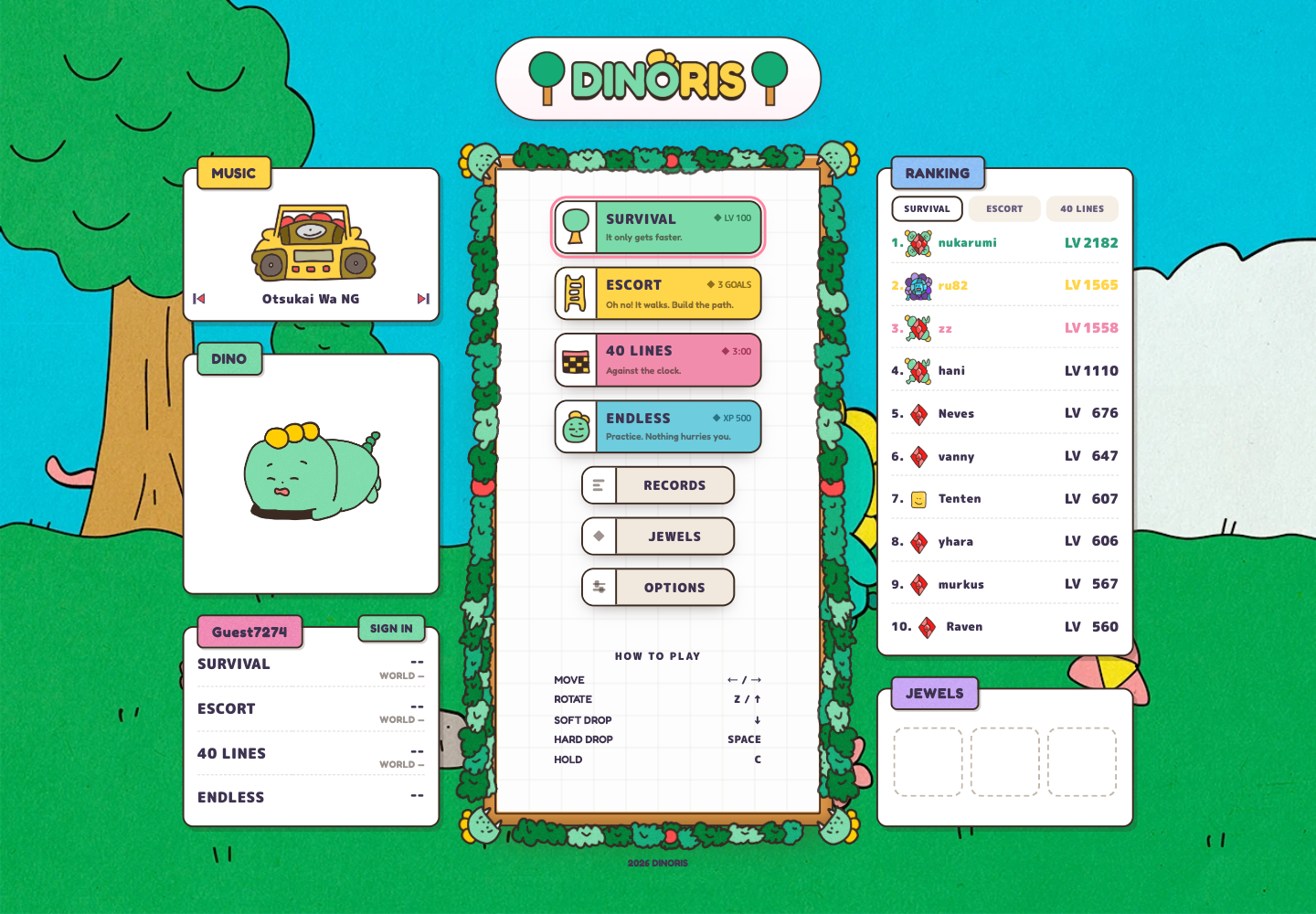
The Dinoris main menu puts Survival, Escort, 40 Lines, Endless, records, settings, and the world ranking on one screen.
Four Modes, Four Different Reasons to Stack
Dinoris does not treat its block system as one score-attack mode with several labels. Each option changes the purpose of the board.
Survival
Survival is the flagship mode. It begins like a recognizable falling-block game, then becomes faster and increasingly hostile. Deeper runs introduce tree-shaped pieces, fire, and rising garbage. The objective is not to finish a prescribed board; it is to remain stable while the game steadily removes the comfort of predictable play.
The menu summarizes Survival with four words: “It only gets faster.” That is accurate, but incomplete. Speed is only one source of pressure. The later hazards force players to manage the board as an environment rather than simply optimize clean line clears.
Escort
Escort introduces a moving character and asks the player to build a usable path. This turns placement into a spatial support problem: the stack is not merely something to erase, but terrain another character must cross.
40 Lines
40 Lines is the most conventional competitive test. Clear forty lines as quickly as possible, then compare the time and quality of the run. It is the mode most immediately legible to sprint players who already care about efficient movement, hesitation, and pieces per second.
Endless
Endless removes the hurry and works as a practice space. It is useful for learning the visual language, adjusting controls, experimenting with unfamiliar handling, or simply enjoying the block system without Survival's escalating punishment.
Players who like familiar block rules compressed into a daily challenge should also look at DayBrix, the closest falling-block game currently listed on DLEGames. Dinoris is not presented as a once-per-day puzzle, but the two games show how much can change when a familiar stacking system receives a new objective.
Why Survival Is More Than a Cosmetic Remix
The clearest example of Dinoris doing something original is the tree hazard. It is not a normal piece wearing a tree texture.
The tree cannot be rotated or placed in Hold. When it lands, it transforms nearby columns into wood blocks. A completed line containing wood does not disappear normally: the first clear cracks the wood, and a later clear is required to remove it completely. Successfully working through that extra layer earns a bonus, while gaps and cliffs can stop the spread.
That changes the decision loop. A standard clean stack rewards flat surfaces, efficient wells, quick downstacking, and planned line clears. A tree creates a local event that can harden several rows and make an apparently safe structure expensive to repair. The player must decide where the infection is least damaging, whether to preserve useful gaps, and how much future effort the wood will demand.
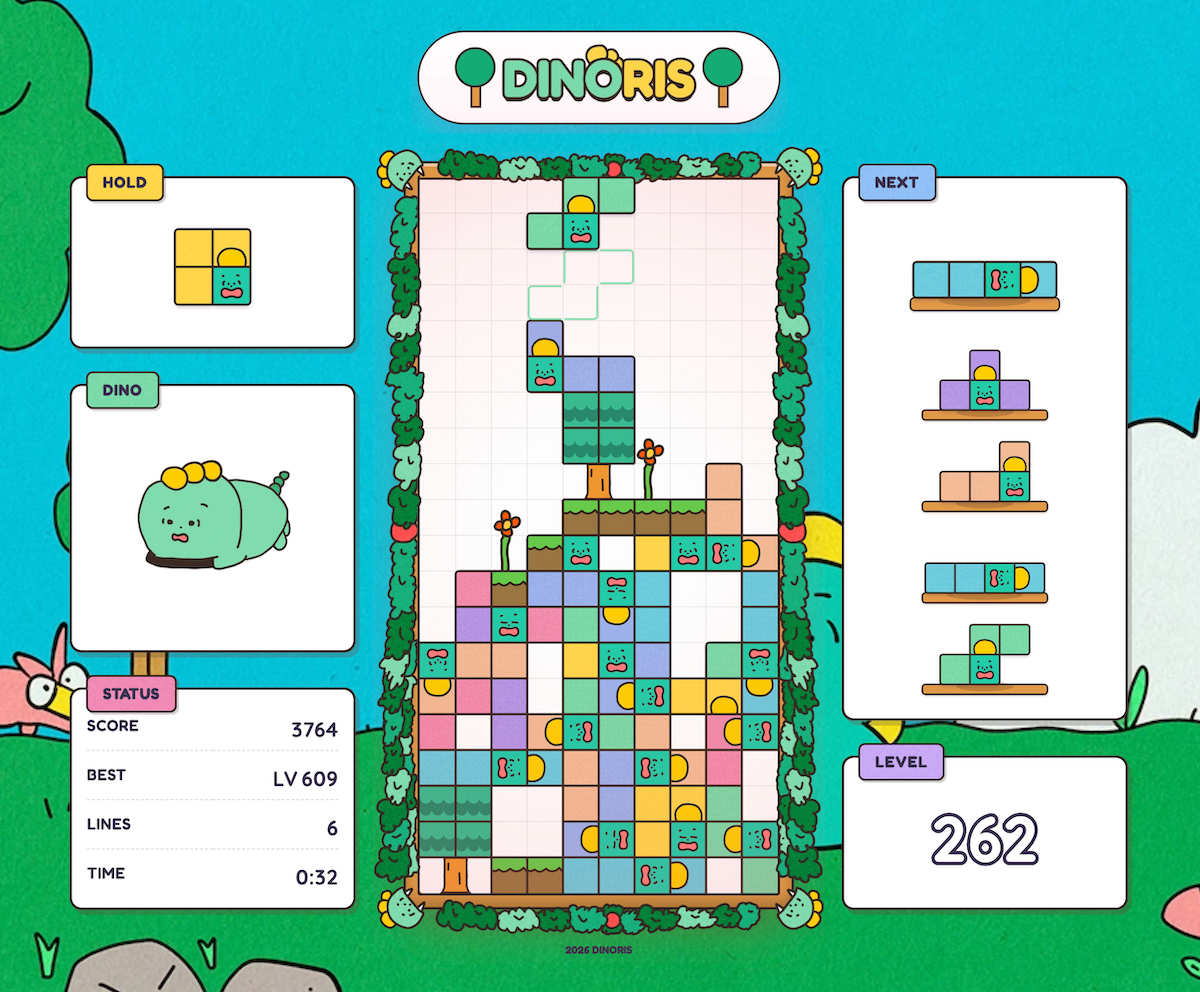
A deep Survival run shows how trees, wood, irregular gaps, and a crowded stack create pressure beyond raw speed.
The result is a light roguelite rhythm:
- Establish a stable stack.
- Adapt to the next environmental complication.
- Spend several clears repairing damage.
- Survive the faster speed long enough to meet the next threat.
Fire and rising garbage push the same idea further. Dinoris gradually moves from execution under known rules toward execution while the rules are making the board less fair. That controlled unfairness is part of the fantasy: Survival is meant to become a story about how the run finally overwhelmed you.
Serious Handling Beneath the Cute Art
Many themed block games stop after implementing rotation, line clears, and a score counter. Dinoris goes much further because its handling is built for players who already have strong expectations from modern competitive clients.
Its publicly described systems include:
- SRS-style rotation with proper wall kicks
- A 7-bag randomizer
- Hold and a visible Next queue
- T-Spin and Quad tracking
- Combo and back-to-back tracking
- Pieces-per-second statistics
- Finesse measurement
- Custom keyboard bindings
- Keyboard, controller, and touch support
The handling panel exposes three especially important values. DAS controls how long a horizontal key must be held before automatic movement begins. ARR controls the repeated horizontal movement after DAS activates. SDF controls soft-drop speed. At launch, the visible defaults were 8 frames for DAS, 1 frame for ARR, and a 36× soft drop factor; setting ARR to zero can move a piece directly to the wall.
This matters because good falling-block handling becomes muscle memory. A player accustomed to a particular delay and repeat speed notices a small mismatch immediately. Dinoris does not assume every player should adapt to one casual preset—it gives them enough control to bring familiar timing into the game.
Why the 8.5-Frame DAS Discussion Matters
One early player asked whether Dinoris could reproduce an 8.5-frame DAS setting used elsewhere. The creator explained that the simulation runs on a fixed 60 FPS tick. Eight ticks are roughly 133 milliseconds and nine ticks are roughly 150 milliseconds, leaving the requested value between two whole simulation steps.
This sounds like a tiny settings question, but it reveals an important technical constraint. Ranked runs are designed to be deterministic: the same inputs must produce the same result when the server simulates them again. Introducing half-frame timing is therefore not just a slider change. It touches input rules, finesse calculations, replay compatibility, and the authority of ranked results.
That response is one of the strongest signs that Dinoris is intended to feel credible to experienced players. The creator is not merely adding settings labels; the timing model, replay model, and leaderboard model are connected.
World Rankings and Replay Verification
Dinoris can be played while signed out. Those runs remain local, but they cannot be converted into ranked submissions later. To place a score on the World board, a player must sign in before beginning the run.
The more notable part is what happens after submission. Ranked records are reconstructed server-side from their replay inputs before they are accepted. In simplified form, the flow is:
- The client records the player's inputs and run data.
- The run is submitted as a replay rather than trusted as a final number.
- The server simulates those inputs using the deterministic game rules.
- The reconstructed result must match before the record reaches the leaderboard.
That is much stronger than accepting a score value produced by the browser. It does not make cheating theoretically impossible, but it establishes the right architecture for a competitive web game: the server validates a reproducible performance instead of trusting the client to report its own success.
The same replay foundation supports local records, replay playback, importing and exporting run data, and detailed post-game statistics. A result card can report level, score, PPS, combo, T-Spins, Quads, back-to-back clears, finesse, and other breakdowns. Casual players can focus on survival and score; advanced players can examine how efficiently they actually moved.
The Art Is Not an Afterthought
Dinoris is memorable before a block moves. The title treatment, tree frames, rounded interface cards, tiny flowers, expressive minos, sleepy dinosaur companion, music player, ranking avatars, and prehistoric backdrop all share the same visual language.
The creator says the artwork—including the sprites and dinosaurs—was drawn personally. That authorship gives the game something template-driven browser projects often lack: a coherent identity that survives outside a single screenshot. A dinosaur can become a companion, a ranking avatar, a reward, or a future character without breaking the world.
The design also solves a product problem. “Another falling-block clone” is difficult to remember, but “the serious block game with the hand-drawn dinosaurs” is specific. The mechanics create depth; the dinosaurs create recall. Readers looking for more strong visual concepts can browse our visual puzzle collection.
What Claude Code Did—and Did Not Do
The creator has been unusually direct about the production process: the code was built with Claude Code, while the creator supplied the concept, game design, art direction, hand-drawn assets, testing, debugging decisions, and live product iteration.
That distinction matters. An AI coding tool can help implement systems, but it does not automatically choose which systems deserve to exist or whether they fit together. Dinoris still required someone to decide that trees should survive one clear, that ranked scores should be replayed on the server, that handling should expose competitive parameters, and that every menu should belong to the same dinosaur world.
This is why Dinoris is more useful as a development case study than as evidence for either extreme claim about AI-made games. The project shows a practical division of labor: automation expands what one creator can implement, while taste, iteration, and responsibility remain product work. That lesson connects directly with our guide to creating a DLE game players actually want to replay: a clear loop and strong feedback matter more than the tool used to type the code.
Fast Feedback Is Already Shaping the Game
The launch discussion produced useful edge cases almost immediately. An AZERTY user discovered that Q, S, and D could not be rebound correctly because legacy alternative keys were taking priority. The creator identified the conflict and shipped the keyboard fix during the same conversation.
A separate controller report turned out to be an interface problem: the game waited for controller input even when no controller was connected, without explaining why nothing happened. The planned remedy was a simple but important “No controller detected” message.
The tree mechanic revealed the larger onboarding issue. A player could see the unusual piece and the wood it created without understanding the two-clear rule. The creator acknowledged that the game explained the system too little and planned a clearer in-game description.
This is a healthy early-stage loop:
Release → specialist players test real setups → edge cases appear → the creator explains or fixes them → the live game improves.
It is also why launch-day completeness should not be confused with final completeness. Dinoris already has a substantial technical foundation, but its tutorial language still needs to catch up with its mechanics.
Anonymous-First Privacy Design
Dinoris takes a relatively restrained approach to player data. Signed-out play does not require an identity, and the site says it does not attach a cookie, device identifier, or address to its simple page-open and referral counts.
Signing in is mainly for the World board and account continuity. The game says it stores the provider ID, the name chosen by the player, scores, jewels, run results, control and display settings, input method, and window-size information used for balancing. It explicitly says an email address is not stored.
That design suits a lightweight browser game. Most players can arrive, play, and leave without creating an account. Competitive players opt into identity only when they want a verified public result.
Where Dinoris Is Strongest
Dinoris currently succeeds in four areas:
- Immediate readability. Falling blocks need little introduction, so the player can focus on what is different.
- A recognizable visual identity. The hand-drawn dinosaur world is cohesive and easy to remember.
- Respect for experienced players. Handling settings, finesse, PPS, replays, and deterministic rankings are not superficial features.
- Escalating stories. Survival creates memorable failures through trees, fire, garbage, and speed rather than relying on a score number alone.
Its clearest weakness is explanation. The more Dinoris departs from standard rules, the more it needs timely, visual teaching. A short interactive example for wood, fire, and garbage would help new players understand that a strange outcome is intentional rather than a bug.
Is Dinoris a Daily Game?
Dinoris currently sits beside daily browser-game culture rather than following a strict one-puzzle-per-day format. Its four modes can be replayed, and the World board encourages repeated attempts. Players looking specifically for a new shared puzzle every day should browse our games like Wordle guide, while Dinoris is better understood as a persistent arcade puzzle with competitive runs.
Final Verdict
Dinoris is not revolutionary because it replaces the falling-block foundation. It is interesting because it understands that foundation well enough to build on top of it.
Survival converts stacking into hazard management. Fine-grained handling keeps advanced players comfortable. Replay verification gives the World board a credible base. Original art turns a familiar ruleset into an identifiable world. The creator's rapid responses show that the current version is the start of an active feedback cycle, not an abandoned prototype.
Most importantly, Dinoris demonstrates how a small independent project can feel authored even when modern coding tools are involved. The dinosaurs, hazards, priorities, compromises, and community responses all point back to a specific creator making decisions.
For more browser games built around game knowledge, mechanical twists, and compact replayable challenges, continue through the DLEGames Gaming collection.