Why Run 3 Still Feels Fun: A Deep Look at Gravity Running, Character Strategy, and Level Design
A deep look at Run 3’s gravity flips, character abilities, modes, and why this classic runner remains so addictive.
Key Takeaways
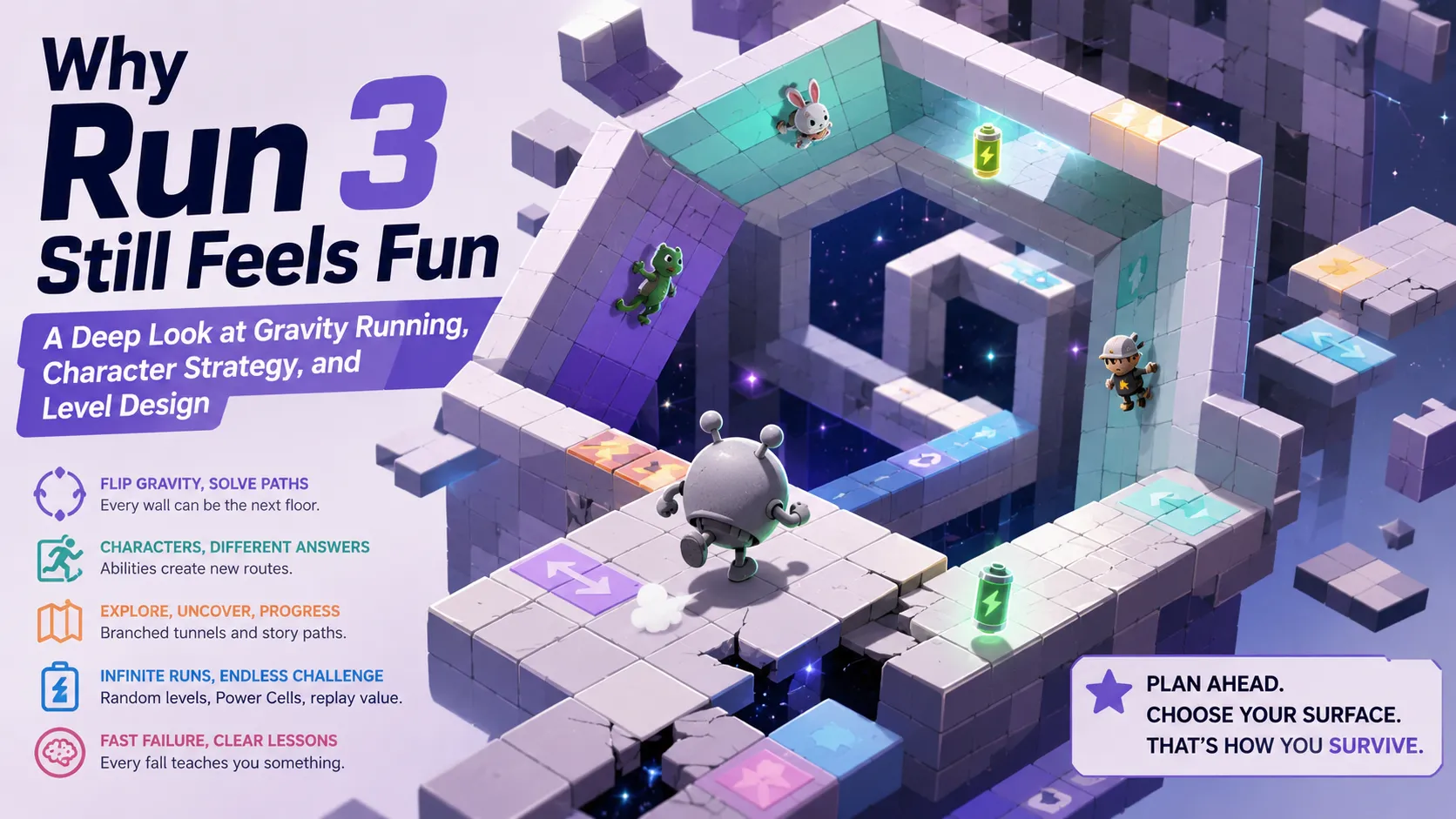
Run 3 may look like a simple tunnel-running game, but its lasting appeal comes from much more than “jump over the gap and don’t fall.” It combines endless running, gravity flipping, character abilities, route prediction, and exploration progress into a game where every failure feels like learning a new spatial rule.
A few key ideas explain why it remains a classic:
- Gravity flipping turns running into spatial puzzle-solving: You are not just jumping forward; you are deciding which wall will become the next floor.
- Characters change how levels are solved: Runner, Skater, Lizard, Bunny, Child, Student, and others are not just skins. They create different playstyles.
- Explore Mode gives the game direction: Fixed levels, tunnel branches, and story progression make it more than a distance-chasing runner.
- Infinite Mode adds replay value: Randomized level combinations and Power Cell collection keep skilled players coming back.
- Failure is fast, but the feedback is clear: Falling usually does not feel random. It tells you that your route, timing, or character choice was wrong.
What Makes It Different?
The most distinctive thing about Run 3 is how it turns traditional runner reflexes into spatial decision-making.
In many running games, players mainly deal with three actions:
- Jump
- Dodge
- Collect items
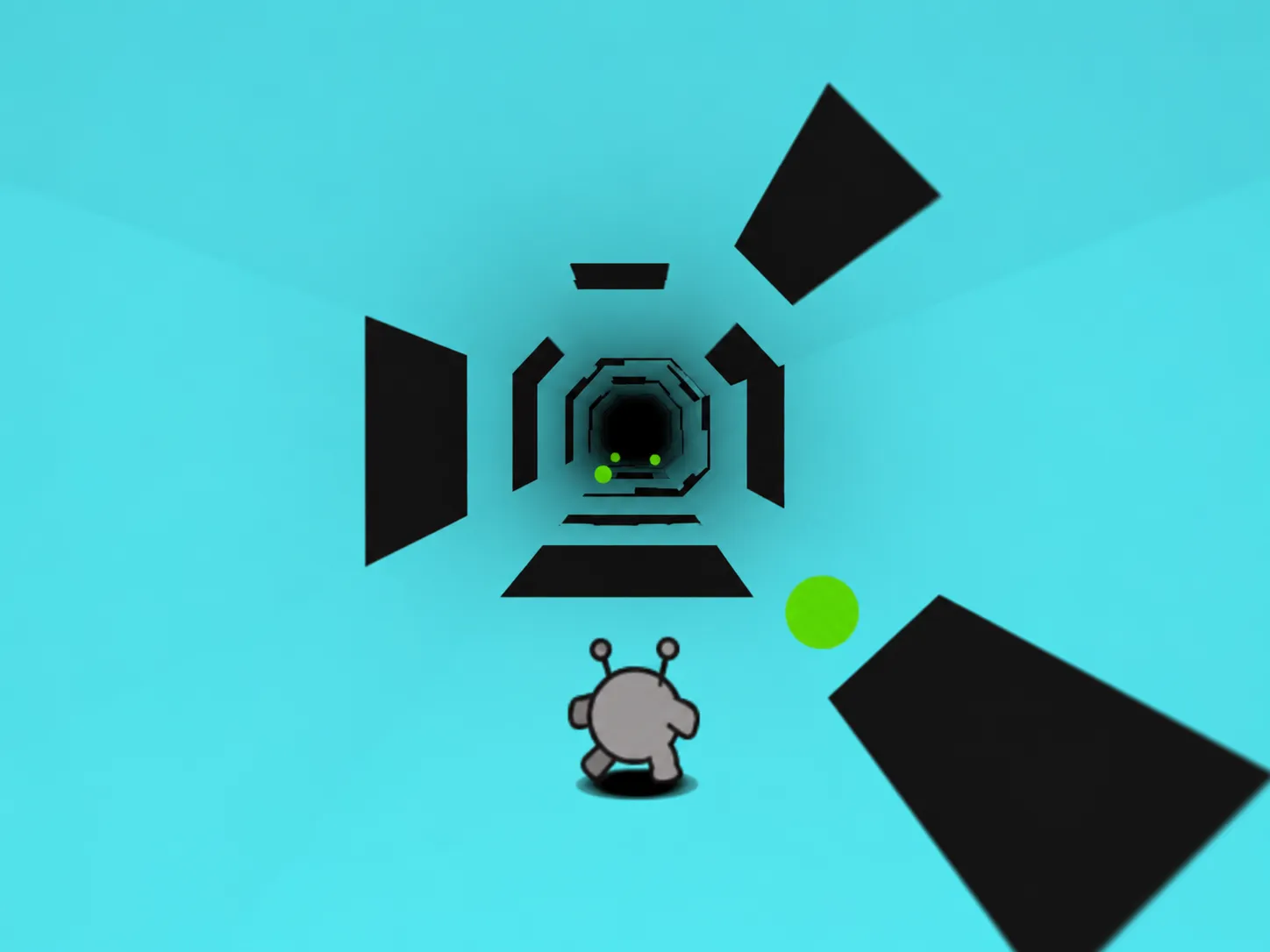
Run 3 adds one defining mechanic: gravity changes when you run onto a wall or ceiling.
That means a gap is not always something you simply jump over. You might instead:
- Run onto the left wall and make it the new floor
- Use the ceiling to bypass a dangerous section
- Rotate around the tunnel to find a safer route
- Change surfaces early to avoid a break in the path ahead
This makes Run 3 feel like a “3D route-choice puzzle” disguised as a runner. You are not only reacting to obstacles. You are constantly asking: Which surface will keep me alive next?
That is the biggest difference between Run 3 and a traditional runner like Temple Run. Temple Run focuses on quick dodges along a fixed path. Run 3 focuses on planning through a rotating space. One asks you not to crash. The other asks you not to choose the wrong gravity direction.
Why It Feels Challenging
Run 3 is not difficult only because it gets faster. It is difficult because it keeps changing what “safe ground” means.
At first, you think the floor is the floor. A few levels later, the wall can become the floor. Then the ceiling, boxes, ice tiles, conveyor tiles, and crumbling tiles all become part of the route.
That creates a strong learning curve.
1. Gaps Are Not Just Obstacles — They Are Route Tests
Run 3 uses gaps cleverly. They rarely test only whether you can press jump at the right moment. More often, they test whether you looked far enough ahead.
For example:
- The floor ahead breaks, but the left wall is intact
- A huge gap blocks the front path, but the ceiling offers a bypass
- Ice tiles make turning harder, so you must decide earlier
- Crumbling tiles punish hesitation and force you to keep moving
The real skill is learning to look 2–3 tiles ahead. Strong Run 3 players are not simply the fastest reactors. They are the players who know where they should be before the danger arrives.
2. Gravity Flips Create Directional Confusion
When the camera rotates, your brain has to quickly rebuild its sense of up, down, left, and right. That moment of adjustment is one of Run 3’s best sources of tension.
You may have only run onto a wall, but the whole world spins around you. What used to be left becomes down. What used to be the ceiling becomes a path. The effect is disorienting without being unreadable.
Good levels use this feeling to create pressure:
- A gap appears immediately after a gravity flip
- A conveyor tile pushes your route off course
- The tunnel becomes narrower while the speed keeps rising
The challenge feels fair because once you fail, you usually understand what happened. The game did not trick you. You simply failed to prepare for the next rotation.
3. Different Characters Create Different Solutions
The character system is one of Run 3’s biggest strengths.
In many games, characters are mostly cosmetic. In Run 3, they directly change how you solve levels.
For example:
- Runner is balanced and reliable for most levels.
- Skater is extremely fast but turns poorly, making him strong on straight paths and ice sections.
- Lizard jumps very high, making large gaps and tall platforms easier.
- Bunny is fast and constantly bounces, powerful but hard to control.
- Child falls slowly and is useful around crumbling tiles.
- Gentleman can attract nearby Power Cells, making collection and certain routes easier.
- Duplicator creates clones that can act like backup platforms or extra chances.
- Pastafarian can create light bridges, changing how void-heavy levels work.
- Student can manually flip gravity, giving advanced players more control.
- Angel can dash and glide, making long-distance jumps more manageable.
This means getting stuck does not always mean “practice more.” Sometimes the better question is: Am I using the wrong character?
That is where Run 3 gains strategic depth. Failure becomes a mix of character choice, route reading, timing, and control.
The Genius of Explore Mode
Explore Mode makes Run 3 feel like more than an endless runner.
Many runner games have a common problem: your distance gets higher, but the long-term goal can start to feel weak. Run 3 solves that with fixed levels, tunnel branches, character unlocks, and story progression.
Players are not just chasing a score. They are moving deeper into a mysterious tunnel system in space.
This structure gives the game three major strengths:
- Every level has a clear goal: Finish this level, not just survive forever.
- Failure has a low cost: You fall, restart quickly, and try again.
- Progress feels meaningful: New tunnels, characters, and story moments give you reasons to continue.
It sits in a smart middle ground. It is faster than a traditional level-based platformer, but less repetitive than a pure endless runner. You get short-session energy with long-term progress.
Why Infinite Mode Still Works
Infinite Mode works because it turns skill into a resource loop.
You are not only chasing distance. You are also collecting Power Cells, which can help unlock characters, skins, and upgrades. That means even a failed run can still feel useful.
That matters.
If Infinite Mode were only about leaderboards, many casual players would lose interest quickly. Instead, Run 3 gives players smaller goals:
- Collect a few more Power Cells
- Unlock a new character
- Try that character in older levels
- Discover a playstyle that fits you better
So Infinite Mode is not just “how far can you run?” It supports the entire progression system.
The Role System Makes Players Experiment
One of the smartest things Run 3 does is encourage experimentation.
If Runner struggles with a level, Lizard might clear the big gaps more easily. If Skater is too fast to control, Child might make the same level more stable. A void-heavy path that seems impossible may suddenly make sense with Pastafarian’s light bridge.
This teaches players an important habit:
Not every level needs to be solved the same way.
That is more interesting than simply making everything harder. It turns failure into a choice problem rather than a punishment.
For example:
- Too many crumbling tiles? Try Child.
- Distances are too long? Try Bunny, Angel, or Lizard.
- Gaps are fragmented and risky? Duplicator may add safety.
- The route is confusing? Student’s manual gravity control may help.
- Power Cells are placed awkwardly? Gentleman may be the better pick.
This character variety gives Run 3 a puzzle-like “choose the right tool” feeling.
Why It Feels Fair Even When It Gets Hard
Run 3 can be difficult, but it usually does not feel unfair.
The reason is simple: the failure feedback is clear.
When you fall, you can usually identify the cause immediately:
- You jumped too early
- You jumped too late
- You failed to switch walls in time
- You chose a poor character for the level
- You missed a crumbling tile ahead
- You tried to turn too late on ice
That clarity makes players want to try again. You believe the next attempt can be better.
A great runner does not just make players fail. It makes them think: I know what to change next time.
Run 3 does that extremely well.
How It Compares to Adjacent Games
Run 3 overlaps with several nearby genres, but its exact combination is unusual.
Compared with Temple Run
Temple Run focuses more on reflexes and obstacle avoidance. You move left and right, jump, slide, and turn along a mostly fixed route.
Run 3 is more about spatial structure. The path is not fixed. Walls and ceilings can become playable surfaces. You are not only dodging obstacles — you are redefining where the path is.
Compared with Geometry Dash
Geometry Dash focuses on rhythm, memorization, and precise timing. It feels more like learning a music-driven obstacle sequence.
Run 3 also has strong rhythm, but it is less dependent on pure memorization. Character abilities and route choices allow for different solutions.
Compared with Platform Puzzle Games
Run 3 has the flavor of a platform puzzle game, but with a much faster pace. You do not get to stop and study the room. You have to solve the route while moving.
That creates a special kind of tension: you are solving a puzzle, but you cannot stop running.
Player Habits That Make Run 3 More Fun
The better you get at Run 3, the less you stare at your character’s feet.
Experienced players usually build these habits:
- Look ahead at upcoming tiles, not just the current landing spot.
- Use short jumps for precision, instead of holding jump too long.
- Switch characters based on terrain, rather than forcing one favorite character everywhere.
- Turn onto walls early, before a gap becomes an emergency.
- Use Infinite Mode to collect Power Cells, especially when unlocking useful characters.
- Treat failure as route learning, especially in later levels.
These habits transform the game from frantic scrambling into planned movement through a dangerous tunnel.
Who Will Enjoy It?
Run 3 is especially good for several types of players.
If you like runner games but find many of them too repetitive, Run 3 offers more variety. Gravity flipping gives every route more spatial depth.
If you enjoy platformers, the jumps, landing control, and character differences will feel satisfying. It is faster than most platformers, but every jump still matters.
If you like unlocking characters and testing playstyles, Run 3 has excellent replay value. Each character feels like a different language for solving levels.
If you like short sessions with long-term progress, the combination of Explore Mode and Infinite Mode works well. You can play a few levels or spend much longer mastering routes and characters.
However, if you dislike fast reactions, rotating perspectives, or repeated failure, Run 3 may feel stressful. It is not a relaxed walking-speed runner. It is a challenge game built around adapting to changing space.
Why Run 3 Still Holds Up
Run 3 remains popular because its core design is strong, not because it relies on flashy graphics.
It has one clear central mechanic: gravity flipping.
Then it expands that mechanic through:
- More tile types
- More character abilities
- More tunnel layouts
- More route choices
- More room to learn from failure
That is what many classic browser games do best: simple rules, deep variation.
The first time you play, all you need to know is how to run and jump. The longer you play, the more you understand the relationship between characters, terrain, gravity, speed, and route planning.
That gradual growth from simple to complex is the real reason Run 3 still feels replayable.
Final Thoughts
Run 3 is a classic runner because it turns simple controls into a surprisingly deep challenge.
It does not rely on complicated buttons or random punishment. Its strength comes from turning “run forward” into a mix of spatial judgment, character choice, and route planning.
The first time you fall into the void, it feels like just another runner.
But once you start running onto walls, switching characters, reading tiles ahead, and using gravity to bypass danger, it becomes a fast spatial puzzle.
That is why Run 3 is still worth playing: it is easy to start, but hard to truly master. Every successful run through a dangerous tunnel feels like you finally understood the rules of its strange little universe.