Tone Tune Game Explained: Why Toon Tone Turns Color Memory Into a Daily Puzzle
A deep look at Tone Tune, likely Toon Tone, the daily color guessing game built around memory, HSB sliders, and cartoon palettes.
Key Takeaways
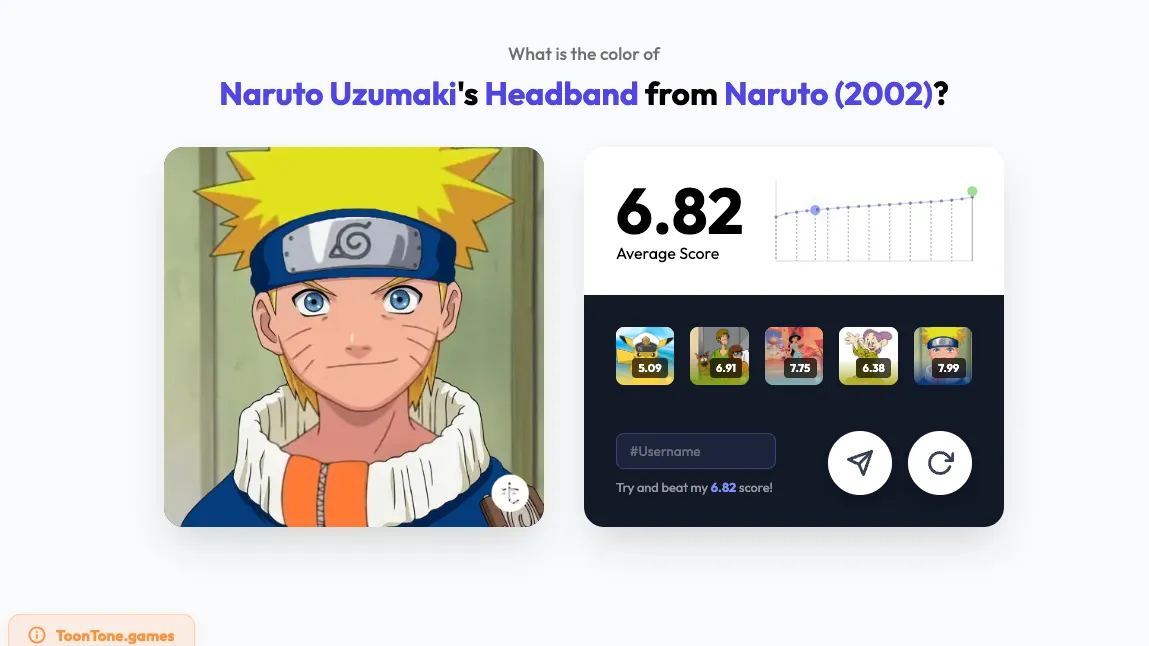
Tone Tune game is most likely a search variation for Toon Tone, a browser-based color guessing game where players try to recreate cartoon-inspired colors from memory.
Instead of guessing words, songs, countries, or movie frames, the game asks a quieter but surprisingly difficult question: how accurately can you remember a color?
That simple twist gives the puzzle its appeal:
- It feels instantly understandable: look at a character color, adjust sliders, submit.
- It tests visual memory instead of trivia knowledge.
- It turns tiny hue, saturation, and brightness differences into meaningful decisions.
- It creates the same “one more try tomorrow” loop as daily Wordle-style games.
The result is a compact daily puzzle that feels calm on the surface but becomes tense once players realize how unreliable their color memory really is.
What Makes It Different?
Most daily guessing games are built around recognition. You identify a word, a flag, a song intro, a movie still, or a character silhouette. Toon Tone works differently because it focuses on reconstruction.
You are not just naming the answer. You are trying to rebuild it.
That changes the entire feel of the puzzle. A player may know exactly which character or object the color belongs to, yet still fail to match the tone closely. Recognition helps, but it does not solve the challenge by itself.
This is what makes the format stand out:
- The answer is visual, not verbal.
- The guess is continuous, not binary.
- Feedback is about closeness, not right-or-wrong correctness.
- Memory matters more than searchable knowledge.
A word game usually asks, “Do you know the answer?” Toon Tone asks, “Can your brain hold the exact shade long enough to reproduce it?”
That is a much stranger and more personal kind of puzzle.
Why the Puzzle Format Works
The design works because it combines three strong puzzle pleasures: familiarity, uncertainty, and measurable improvement.
First, the subject matter is familiar. Cartoon and pop-culture colors live in memory as strong impressions. Players may feel confident about a red hat, a blue outfit, a yellow face, or a green shell because those colors seem obvious.
Then the uncertainty arrives. Once the player opens the sliders, the obvious color suddenly splits into dozens of close alternatives. Is that red warmer or cooler? Is the blue more saturated? Was the yellow closer to orange than expected?
That gap between confidence and precision is where the game becomes satisfying.
Finally, the score gives the player a clean sense of performance. Even when the guess is wrong, it is not a total failure. A near match still feels earned. A low score feels like useful information. The player can immediately understand what went wrong: too bright, too dull, too warm, too pale.
That makes the game easy to replay without feeling random.
Why It Feels Challenging
Toon Tone is challenging because human color memory is weaker than players expect.
People often remember colors as categories: red, blue, yellow, green, purple. But the game rewards exactness inside those categories. A character’s “blue” might actually sit closer to cyan, navy, or violet. A “yellow” might lean gold, lemon, or orange.
The slider interface sharpens that difficulty. Players must think across three dimensions:
- Hue: what color family is it?
- Saturation: how intense or washed out is it?
- Brightness: how light or dark is it?
The hardest part is that these dimensions interact. Increasing brightness can make a color feel less saturated. Shifting hue slightly can make a familiar shade suddenly feel wrong. A player may fix one slider and accidentally reveal that another slider was off.
That is why the game produces so many “I was sure that was right” moments.
The challenge is not that the rules are complex. The challenge is that the player’s own perception is less reliable than it feels.
The Satisfaction of Near Misses
One of the smartest parts of the format is that near misses still feel interesting.
In many guessing games, a wrong answer simply blocks progress. In Toon Tone, a wrong answer can still be satisfying if it is close. The player gets a score that says, in effect, “you were almost there.”
That creates a softer but still competitive loop.
A player might finish a round thinking:
- “I nailed the hue but made it too bright.”
- “I remembered the character, but not the exact shade.”
- “I should have trusted the darker version.”
- “That color was less saturated than I expected.”
This kind of feedback encourages reflection. The game becomes less about brute-force guessing and more about learning how color perception behaves.
That is rare for a casual browser puzzle.
How It Compares to Wordle-Style Games
Toon Tone belongs near the Wordle-inspired daily puzzle family, but it does not copy the Wordle formula directly.
Wordle is built around elimination. Each guess reduces the answer space. Green, yellow, and gray tiles create a logical trail. The player solves by combining vocabulary, probability, and pattern recognition.
Toon Tone is more sensory. There is still feedback, but the main challenge happens before submission. The player must estimate a target from memory, then commit.
Compared with adjacent puzzle types:
- Versus Wordle: less linguistic, more perceptual.
- Versus Heardle-style music games: less about recognition speed, more about precision.
- Versus geography guessing games: less knowledge-heavy, more instinctive.
- Versus trivia games: less about facts, more about visual judgment.
- Versus color picker tools: more playful because the target has cultural memory attached to it.
That cultural memory matters. Guessing a random color swatch is abstract. Guessing a cartoon character color feels personal because players bring nostalgia, fandom, and visual memory into the puzzle.
Player Behavior: Why People Keep Coming Back
The daily format works especially well because the game is short. A full session does not demand a long commitment, but each round gives enough friction to feel meaningful.
Players are likely to return for several reasons:
- Daily comparison: scores make performance easy to discuss.
- Fast sessions: the game fits into a break or commute.
- Low barrier: no deep rules need to be learned.
- Personal pride: color memory feels like a skill people should be good at.
- Shareable frustration: close misses are easy to laugh about.
The best daily puzzles create stories players can tell. Toon Tone does this through tiny failures of perception. A player does not just say, “I got it wrong.” They say, “I thought that character was way more orange,” or “I completely misremembered that blue.”
That makes the result feel memorable.
What Makes a Good Toon Tone Round?
A strong round needs more than a recognizable character. It needs a color that sits in the sweet spot between familiar and slippery.
The best targets usually have:
- A recognizable source so the player has a mental anchor.
- A color with subtle ambiguity so the slider choice matters.
- Enough contrast from generic colors to reward careful memory.
- A reveal that feels fair, not arbitrary.
A plain primary red may be too easy. An obscure shade with no strong association may feel unfair. The most satisfying targets are colors players think they know until the game forces them to be specific.
That is where the puzzle becomes a duel between memory and measurement.
Who Will Enjoy It?
Toon Tone is a strong fit for players who enjoy short daily games but want something different from word puzzles.
It is especially good for:
- Cartoon, anime, superhero, and game fans who enjoy visual nostalgia.
- Players who like perception-based challenges rather than trivia.
- Design-minded players who enjoy color, palettes, and visual detail.
- Wordle fans looking for a daily puzzle with a fresh mechanic.
- Casual players who want something quick but not mindless.
It may be less appealing to players who want strict logic puzzles. There is no perfect deduction path. The fun comes from estimation, memory, adjustment, and reveal.
That makes it feel more like a visual skill test than a traditional puzzle box.
Tips for Playing Better
The biggest mistake is choosing a color category too quickly and then only adjusting brightness. Most misses come from small hue and saturation errors, not just lightness.
A better approach is to think in layers:
- Start with the broad hue: red, blue, green, yellow, purple, etc.
- Ask whether it leans warm or cool: orange-red or pink-red, cyan-blue or violet-blue.
- Set saturation before brightness: decide whether the color is vivid, muted, pastel, or grayish.
- Use brightness last: make the color match the remembered “weight” of the original.
- Pause before submitting: the first confident guess is often too extreme.
Players should also avoid overcorrecting. A character color remembered from a screen, poster, toy, or meme may feel more saturated in memory than it actually is. Nostalgia often brightens colors.
That is part of the trap.
Why the Design Feels Modern
Toon Tone feels modern because it turns a simple interface into a personal measurement tool. It does not need a huge map, a long rulebook, or complex progression. The whole experience is built around a clean question: how close is your remembered color to the real one?
That is a very current kind of browser game design. It is small, shareable, daily, and instantly understandable. But it also has depth because every result teaches players something about perception.
The game also benefits from being visually native. It does not borrow a word-game skin for a non-word idea. The core mechanic, interface, score, and theme all point toward the same concept: matching tone.
That coherence makes the game feel sharper than a simple clone.
Final Thoughts
The Tone Tune game, best understood as Toon Tone, works because it finds a fresh puzzle space hiding in plain sight. Everyone sees color. Everyone thinks they remember familiar characters. But the moment the game asks for precision, confidence starts to collapse.
That is the magic of the format.
It is not difficult because the rules are hard. It is difficult because the target lives in the gap between memory and reality. Each round turns a familiar cartoon color into a tiny perceptual battle, and each score reveals how close the player really was.
For fans of daily browser puzzles, Toon Tone offers something rare: a challenge that is quick, visual, nostalgic, and surprisingly humbling.
It proves that a great guessing game does not always need words, facts, or clues. Sometimes one color is enough.