What Is 3D Artifact?
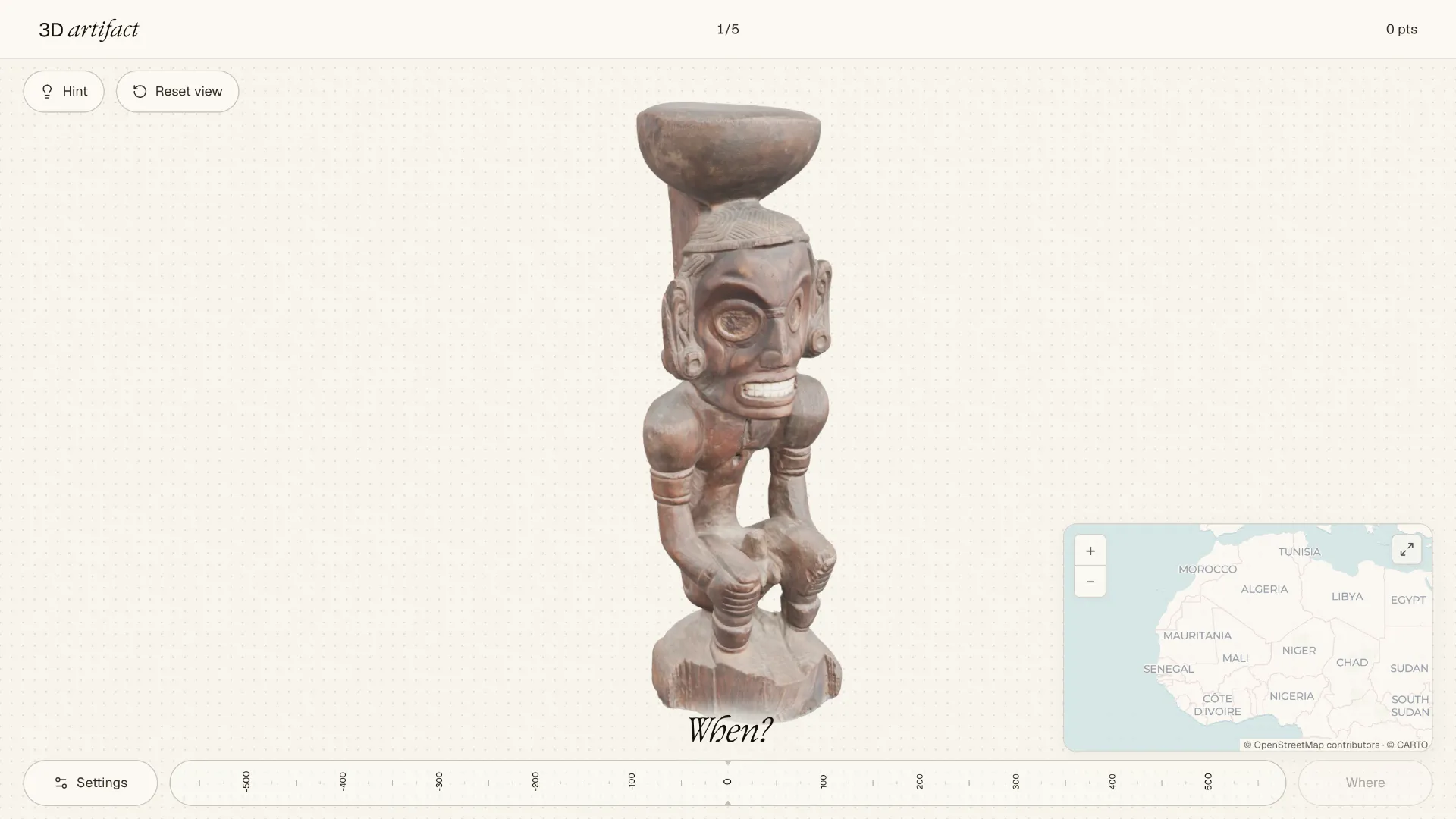
3D Artifact is an online history and geography guessing game that challenges players to identify when and where real museum artifacts were created. Instead of relying on photographs or written historical clues, players can examine detailed three-dimensional scans of objects from museums around the world.
Each game consists of five rounds, with a different historical artifact to investigate. Your goal is to study the object's appearance, identify its possible cultural origin, and estimate when it was made.
The game draws from a collection of approximately 2,461 digitized artifacts across more than 33 museum collections, spanning over 5,000 years of human history. The 3D objects are presented using detailed photographic scanning technology, allowing players to explore their appearance from multiple angles.
It combines the historical deduction of a timeline game with the geographical reasoning of GeoGuessr, but replaces streets and landscapes with museum treasures.
How Does 3D Artifact Work?
The central challenge is to answer two questions about each artifact:
- Where was it made? Identify the geographical origin of the object by examining its design, materials, and cultural features.
- When was it made? Estimate the historical period or date when the object was created.
Unlike traditional history quizzes that rely on multiple-choice questions, 3D Artifact emphasizes visual observation and historical reasoning.
You can examine the 3D representation to look for recognizable details such as pottery shapes, decorative patterns, carved symbols, sculpture styles, and construction techniques.
The game contains five artifact-guessing rounds per session. Its large collection makes the challenge especially interesting because the objects can come from different regions and historical periods.
How to Play 3D Artifact
Step 1: Start a Game
Visit 3d-artifact.com and select Play to begin. The game presents a historical artifact for you to investigate.
Step 2: Explore the Artifact in 3D
Inspect the object's shape, surface, materials, and decorative details. Use the interactive 3D viewer to explore its appearance from different perspectives.
For example, a ceramic vessel might feature distinctive handles, geometric decorations, or painted figures. These details can suggest a particular civilization or historical tradition.
Step 3: Guess Where It Came From
Use the visual evidence to determine the artifact's likely geographical origin and make your location guess using the game's controls.
For example, if you see a decorated ancient pottery vessel with features associated with classical Greek art, you might consider Greece as a possible origin.
Remember that artistic styles and techniques spread between cultures, so the most obvious location is not always correct.
Step 4: Estimate Its Historical Age
Next, determine when the artifact was likely created and enter your estimate.
Consider the object's design, craftsmanship, material, and historical context.
For example, you might estimate that a particular ceramic vessel was produced around 500 BCE rather than during the Roman Imperial period.
This is an illustrative guess, not an answer to a specific round.
Step 5: Submit and Complete All Five Rounds
Submit your location and time estimates, review the result, and continue to the next artifact. Repeat the process until you have completed all five rounds.
The challenge is to make historically informed guesses rather than simply recognize famous museum pieces.
3D Artifact Strategy and Tips
Examine the entire object. Do not judge an artifact from its first visible angle. Look at its shape, underside, decoration, and other distinguishing features before making a guess.
Identify the material first. Bronze, stone, clay, and other materials can provide useful clues about the object's purpose and historical context, although none identifies a precise era on its own.
Look for cultural patterns. Certain artistic traditions feature recognizable forms, motifs, and techniques. Greek pottery, Egyptian sculptures, East Asian ceramics, and other historical objects can provide useful visual references.
Think in centuries rather than exact years. If you recognize a cultural style but cannot identify the specific artifact, estimating its broader historical period is a practical starting point.
Avoid relying on the museum's location. An artifact displayed in a British or American museum may have originated thousands of miles away. The important clue is where the object was created, not where it is currently exhibited.
Use each round to learn. Pay attention to the historical information revealed by the game. Recognizing differences between similar objects becomes easier as you encounter more cultures and periods.
What Makes 3D Artifact Different?
Most historical guessing games use photographs, historical events, or written descriptions. 3D Artifact takes a more interactive approach by letting players explore scanned objects themselves.
Its distinctive features include:
- Interactive 3D exploration: Inspect historical objects from different perspectives instead of studying a single flat image.
- Real museum collections: The artifacts come from digitized cultural collections rather than fictional game objects.
- Two-part historical challenge: Test both geographical knowledge and chronological reasoning.
- Five-round format: Complete a compact set of artifact identification challenges in each game.
- Thousands of objects: Explore a collection spanning more than 33 museums and over 5,000 years of history.
This makes the game particularly appealing to players who enjoy history, archaeology, art, geography, and visual deduction.
Is 3D Artifact Worth Playing?
3D Artifact is a compelling choice for players who enjoy learning through observation. Its combination of real cultural objects, interactive 3D exploration, and historical guessing creates a different experience from conventional question-and-answer quizzes.
You do not need to be an archaeologist or historian to enjoy it. Curiosity, careful observation, and a willingness to make educated guesses are enough to get started.
If you enjoy games such as TimeGuessr, Chronophoto, or other history-based guessing challenges, 3D Artifact offers a fresh variation centered on physical objects from the past.
Play 3D Artifact at 3d-artifact.com and see how accurately you can place five mysterious museum treasures in time and space.