
What Is Anoun?
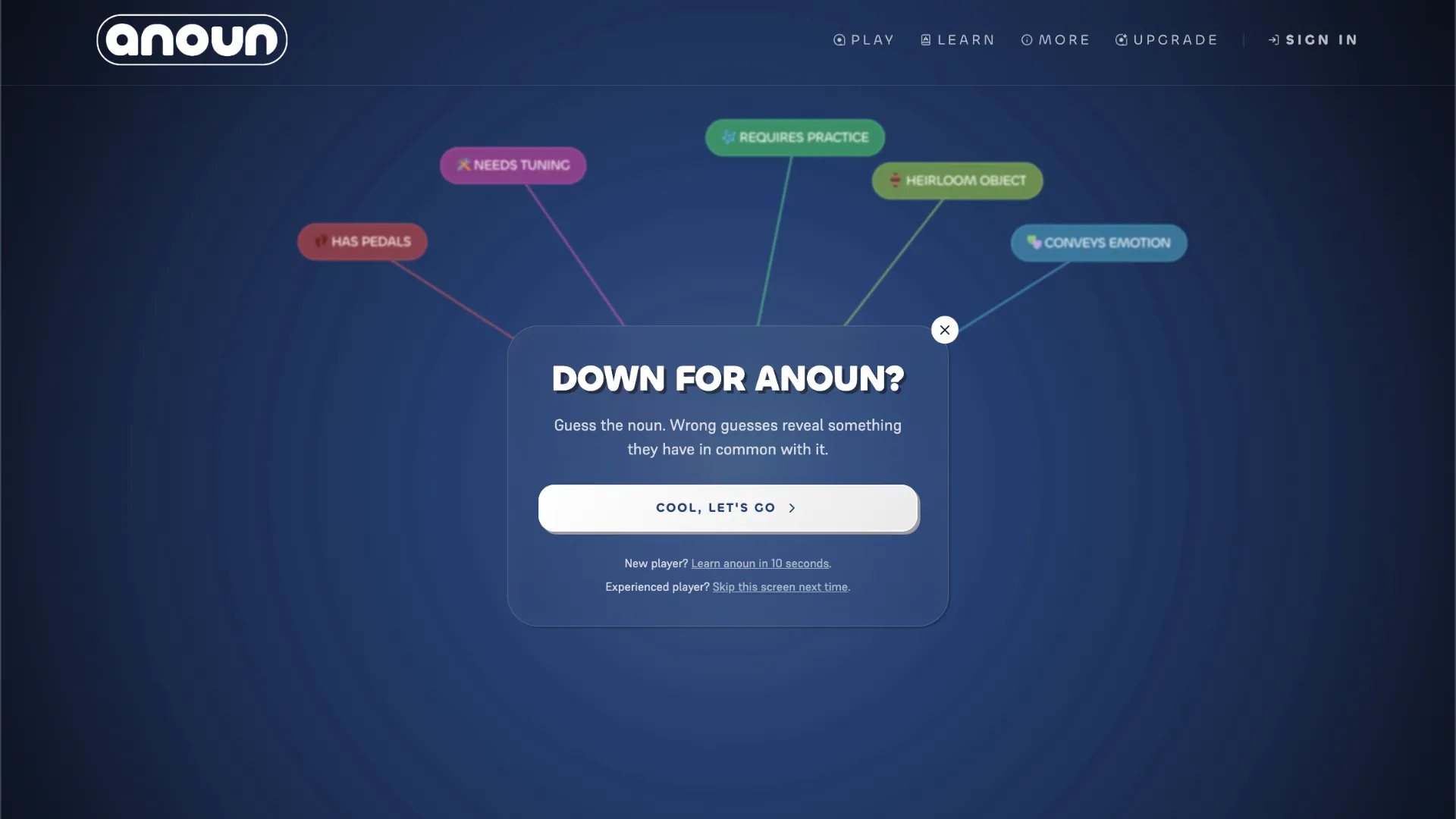
Anoun is a free daily word deduction game with an unusual twist: every incorrect guess gives you a clue about the hidden answer. Rather than revealing matching letters or assigning a numerical similarity score, Anoun explains something your guessed word has in common with the secret noun.
For example, imagine the hidden answer is SHARK. If you guess DOLPHIN, the game might reveal the clue 'Lives in the ocean.' That clue does not tell you which letters are correct. Instead, it provides a meaningful connection between your guess and the answer.
Each new guess helps build a collection of shared characteristics. By combining those clues, you gradually narrow down the possibilities until you identify the hidden word.
Anoun was created by independent developer Koffeinöverdos and is available to play directly in a web browser. It combines vocabulary, lateral thinking, general knowledge, and logical deduction in a game that usually takes only a few minutes.
The game offers daily puzzles, community-created challenges, and the ability to create custom puzzles for other players.
How Does Anoun Work?
Anoun is built around one central mechanic: wrong guesses reveal shared traits instead of simply telling you that your answer is incorrect.
At the beginning of a puzzle, the game provides information about the hidden noun, including its type and number of letters. Depending on the puzzle, the displayed type can be PLACE, THING, BEING, or CONCEPT.
You then submit nouns that might match the hidden answer.
When your guess is incorrect, Anoun generates a clue explaining a characteristic shared by your guess and the secret word.
For example, consider this hypothetical puzzle:
Hidden answer: SHARK
| Your Guess | Possible Clue |
|---|---|
| Dolphin | Lives in the ocean |
| Crocodile | Has sharp teeth |
| Eagle | Is a predator |
| Shark | Correct answer! |
This is an illustrative example, not an actual daily puzzle or a guaranteed sequence of generated clues.
Notice how the clues describe relationships between nouns rather than the spelling of the target word.
A clue such as 'Has sharp teeth' might suggest several different animals. Combined with 'Lives in the ocean' and 'Is a predator,' however, the possible answers become much more specific.
The central challenge is to find useful relationships between your guesses and recognize which hidden noun satisfies all the clues.
Anoun Rules Explained
Anoun has a simple set of rules, but using your guesses efficiently requires careful thinking.
- Find the hidden noun: Each puzzle contains a secret word that you must identify.
- Maximum 20 guesses: You have up to 20 attempts to solve the puzzle.
- Use shared-trait clues: Every incorrect guess can reveal something it shares with the hidden answer.
- Consider the starting information: The word's displayed type and length provide useful constraints before your first guess.
- Connect multiple clues: Use the characteristics revealed by previous guesses to narrow down the possibilities.
- Solve before running out of attempts: Enter the exact hidden noun to complete the challenge.
Unlike traditional Wordle-style games, Anoun does not primarily depend on finding correct letters in correct positions.
The spelling of your guess is less important than its meaning and its relationship to the hidden word.
Another important difference is that the game does not require your initial guesses to be especially close to the answer. Even a seemingly unrelated guess can generate a useful shared characteristic.
How to Play Anoun
Getting started takes only a few steps. Here is a practical walkthrough of the standard daily game.
Step 1: Open the Official Anoun Website
Visit anoun.online in your browser.
Find the Daily Anoun section and select the current puzzle using the available play option.
You can start the standard daily game without downloading an application or creating an account.
Step 2: Examine the Hidden Word Information
Before making your first guess, check the information displayed for the puzzle.
The game can show the word's type, its length in letters, and the number of guesses you have used.
For example, a puzzle labeled BEING with five letters tells you that the answer belongs to that category and contains five letters.
This information helps eliminate unlikely possibilities before you spend an attempt.
Step 3: Make Your First Guess
Enter a noun in the guessing field and submit it.
Your first guess does not need to be perfect. Its purpose is to establish an informative relationship with the hidden answer.
For example, guessing 'Dolphin' might produce a clue about living in water, being an animal, or another characteristic shared with the answer.
The exact clue depends on the hidden word and the game's generated feedback.
Step 4: Connect Clues and Refine Your Guesses
Read the returned clue carefully and think about what it reveals.
After several attempts, you might have clues such as:
- Lives in the ocean
- Has sharp teeth
- Is a predator
Instead of treating each clue separately, look for nouns that satisfy all three characteristics.
Anoun allows you to move clues around visually, which can make it easier to organize competing ideas.
Continue submitting guesses that test your strongest possibilities or reveal different characteristics.
Step 5: Solve the Hidden Noun
When you believe you have identified the answer, submit the noun.
If it is correct, you complete the puzzle. Otherwise, use the new commonality clue to improve your next guess.
You must find the answer within the 20-guess limit.
After finishing, you can explore community challenges or return for the next daily puzzle.
Understanding Anoun's Clue System
The clue system is what makes Anoun different from many other word guessing games.
Instead of showing green and yellow letter tiles, each incorrect guess generates a short statement about the relationship between two nouns.
Shared Characteristics
Clues can describe properties such as:
- Physical characteristics
- Typical environments or locations
- Functions and uses
- Behaviors or activities
- Membership in broader categories
- Other meaningful similarities
For example, if the hidden noun and your guess are both objects made from a particular material, the game might identify that shared property.
If both are animals living in similar environments, the clue might describe their habitat.
The important distinction is that a clue identifies a similarity, not necessarily an exclusive property of the answer.
A statement such as 'Can fly' could fit birds, insects, aircraft, and other things. You need additional clues before making a confident deduction.
AI-Generated Clues
Anoun uses a large language model to generate commonality clues dynamically.
This allows the game to respond to a wide variety of guesses instead of relying exclusively on a fixed set of manually written hints.
However, clue generation may occasionally take a moment, especially when the relationship between two nouns is difficult to identify.
The developer also acknowledges that generated clues are not always perfect. Occasionally, a clue may be vague, repetitive, or questionable.
Some previously generated clues are cached, which can make repeated guess-and-answer combinations return feedback more quickly.
Players can provide feedback on problematic clues after playing, helping improve future clue quality.
Daily Anoun and Custom Puzzles
Anoun includes more than a single daily guessing challenge.
Daily Anoun
The main mode offers a fresh hidden noun every day.
According to the game's instructions, the daily word renews at midnight in your local timezone.
You have 20 guesses to solve the current puzzle. Your progress is saved on your device, allowing you to leave and return during the same daily session.
However, an unfinished daily game should be completed before the next local midnight reset.
Custom Anoun
The game also includes community-created puzzles.
Players can browse custom challenges created by other users. The community section supports browsing games by options such as newest and most popular.
Custom puzzles provide additional challenges beyond the daily word and can be especially appealing to players who finish the standard puzzle quickly.
Some access limits apply to unsigned-in players. The site indicates that visitors can play the daily puzzle and a limited number of community challenges without an account, while additional access and certain account-based features require signing in.
Create Your Own Anoun
Anoun also allows players to create custom challenges by choosing a hidden answer and publishing a puzzle for others to solve.
This makes it possible to challenge friends with a specific noun rather than waiting for the next official daily word.
The exact availability of creation and publishing features can depend on the site's current account requirements.
Anoun Tips and Strategies
1. Use the Word Type and Length First
Before making your first guess, examine the available information.
If the puzzle indicates a particular type and length, focus on candidate nouns that fit those constraints.
A broad clue becomes much more useful when combined with the word's category and number of letters.
2. Start with Familiar Nouns
The developer generally selects recognizable nouns rather than highly specialized vocabulary.
Everyday objects, familiar living things, and commonly understood places can therefore be useful starting points.
You do not need an enormous vocabulary of obscure words to play well.
3. Make Diverse Guesses Early
One of the most useful strategies is to test different semantic directions.
If you repeatedly guess similar animals, you may receive several clues describing nearly the same characteristic.
Instead, consider trying nouns from different groups to discover less obvious relationships.
For example, if you have been guessing animals without making progress, a guess involving an object or location might uncover a useful new connection.
4. Combine Clues Instead of Following Only the Latest One
A single clue rarely identifies the answer by itself.
If one guess reveals that the noun is associated with water, do not immediately assume the answer is a fish.
Wait for additional information and identify what all the clues have in common.
Treat the game as a process of accumulating evidence rather than reacting to each clue independently.
5. Organize Your Clue Board
Anoun supports dragging clues around the play area.
You can group similar clues together and separate contradictory-looking or less useful information.
Double-clicking or double-tapping a clue can reveal the guessed word associated with it.
On desktop, you can use Ctrl plus scrolling or trackpad gestures to zoom. Touch devices support pinch-to-zoom, and you can drag empty space to pan around the board.
This interactive layout is especially helpful when you have collected many clues.
6. Change Direction When You Get Stuck
If several guesses produce nearly identical clues, your current approach may not be revealing enough new information.
Instead of guessing another closely related noun, deliberately explore a different category.
An unexpected shared characteristic can sometimes reveal the answer more effectively than another obvious guess.
7. Treat AI Clues as Helpful Evidence, Not Perfect Logic
Because Anoun generates clues using an AI model, an occasional clue may be ambiguous or inaccurate.
If one clue seems inconsistent with everything else, avoid letting it dominate your reasoning.
Look for interpretations supported by multiple clues and use additional guesses to test your theory.
Is Anoun Like Wordle, Contexto, or Semantle?
Anoun belongs to the broader family of daily word deduction games, but its feedback system is different.
| Game | Main Objective | Feedback Mechanic |
|---|---|---|
| Anoun | Guess a hidden noun | Reveals a characteristic shared by your guess and the answer |
| Wordle | Guess a hidden five-letter word | Shows correct and misplaced letters |
| Contexto | Find a hidden word | Ranks guesses by semantic similarity |
| Semantle | Find a semantically related secret word | Provides numerical similarity feedback |
The key difference: Anoun gives players natural-language explanations of relationships between words.
For example, Contexto may tell you that a guess is relatively close to the target in its semantic ranking. Anoun might instead explain that your guess and the target share a habitat, physical feature, or purpose.
That makes Anoun particularly interesting for players who enjoy reasoning from clues rather than optimizing numerical similarity scores or testing letter combinations.
Is Anoun Free to Play?
Yes. Anoun is free to play online through its official website.
The game runs directly in a web browser and is also available through the developer's itch.io page.
The standard daily puzzle does not require installing software.
Additional account-based features and community-game access limits may apply, but the main daily challenge is accessible without a purchase.
Anoun supports keyboard, mouse, and touchscreen interaction, making it suitable for both desktop and mobile browsers.
Frequently Asked Questions
What is the goal of Anoun?
The goal is to identify a hidden noun in 20 guesses or fewer. Every incorrect guess provides a clue describing something your guessed word shares with the answer.
How many guesses do you get in Anoun?
You have a maximum of 20 guesses for each puzzle.
Does Anoun have a new word every day?
Yes. The standard daily puzzle renews at midnight in your local timezone.
Does Anoun reveal letters like Wordle?
No. Anoun focuses on semantic relationships rather than Wordle-style letter-position feedback. It provides natural-language commonality clues instead of colored letter tiles.
Are Anoun clues generated by AI?
Yes. Anoun uses a large language model to generate clues explaining similarities between your guesses and the hidden noun. Some clues may take a moment to appear, and occasional mistakes are possible.
Can I play Anoun more than once a day?
The main daily challenge changes once per day, but the website also offers custom puzzles created by other players. Access to additional games may depend on account status.
Can I create an Anoun puzzle for my friends?
Yes. Anoun includes a custom-puzzle creation feature that allows players to choose a hidden noun and make a challenge for others. Publishing options may require signing in.
Is Anoun available on mobile?
Yes. Anoun is playable in a mobile browser and supports touchscreen gestures, including moving clues and zooming around the puzzle board.
Will I lose my progress if I leave the page?
The developer states that the current session is saved on your device, so you can return later. However, you must finish the daily challenge before the word changes at midnight in your timezone.
What kinds of words appear in Anoun?
The developer manually curates the hidden words, generally favoring familiar, concrete nouns rather than highly technical or obscure vocabulary. The game's interface also identifies puzzle types such as places, things, beings, and concepts.
Why does an Anoun clue sometimes take a long time?
New commonality clues can require processing by the game's language model. Cached clues may appear much faster. The delay depends partly on the difficulty of identifying a meaningful relationship between the guess and the hidden word.
Conclusion
Anoun offers a distinctive alternative to traditional daily word guessing games. Instead of searching for matching letters or chasing semantic similarity numbers, you solve each puzzle by discovering meaningful connections between nouns.
Its 20-guess limit, dynamically generated clues, interactive clue board, and daily challenges reward curiosity, flexible thinking, and careful deduction.
Whether you enjoy Wordle, Contexto, Semantle, or classic word riddles, Anoun is worth trying for its unusual approach to turning every wrong answer into useful information.
Ready to solve today's mystery? Play Anoun for free and see how quickly you can uncover the hidden noun.