
What Is Castle?
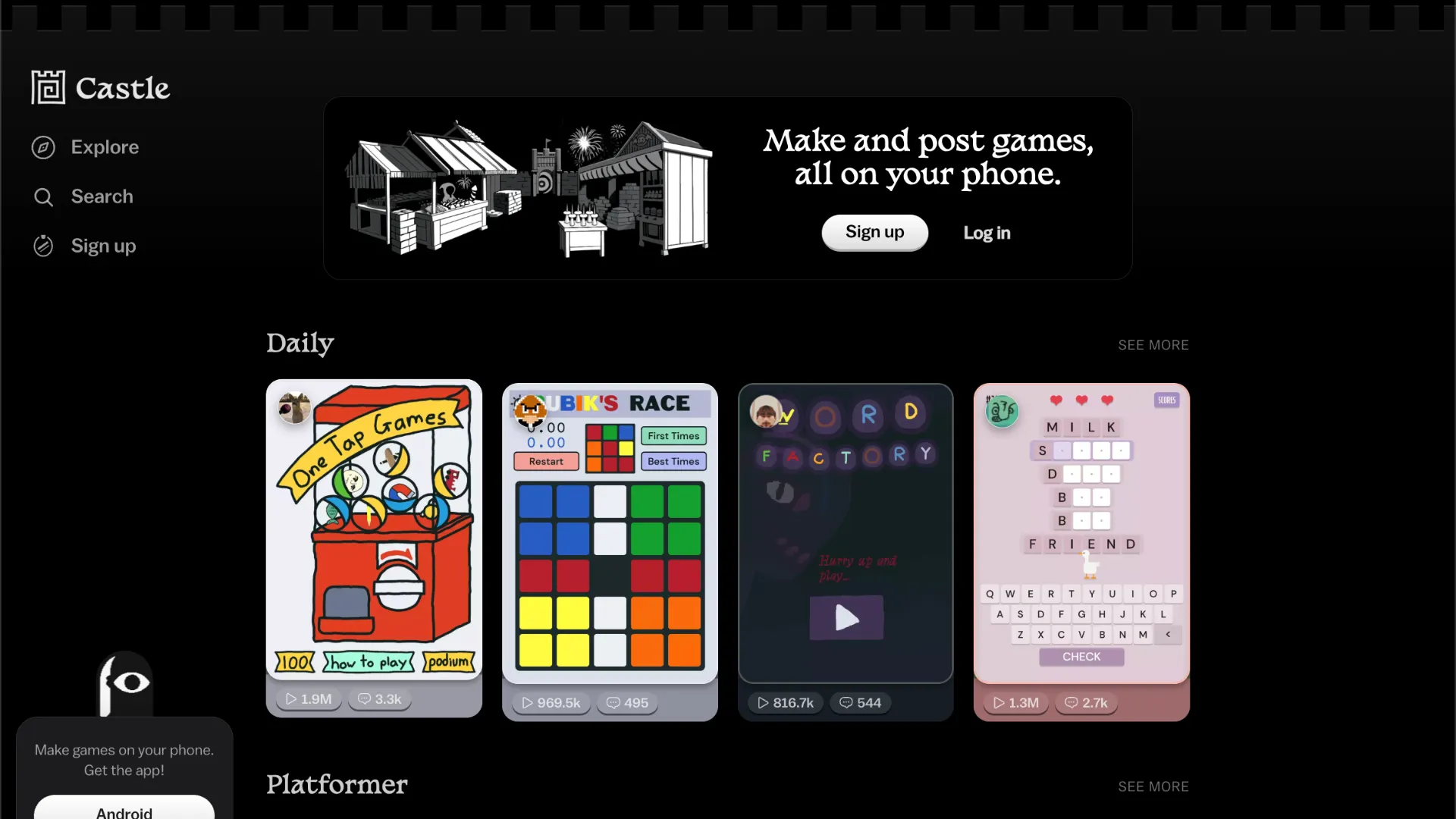
Castle is different from a typical daily browser game. It is a community-driven platform for creating, sharing, and playing small games and interactive creations. Players can explore millions of community-made games spanning puzzle, arcade, action, strategy, platformer, narrative, simulation, and other genres.
The Castle website works primarily as a place to discover creators and games. Individual game pages direct players to Play in App, with Castle available for iOS and Android.
Because every creation can come from a different community member, there is no single Castle ruleset. One deck might be a score-chasing arcade game, another a puzzle, and the next an interactive story or experimental animation.
How Castle Works
Castle's main twist is that the games themselves are made by its community. Instead of opening the app to play one permanent game, you move through a constantly changing feed of interactive creations.
A typical Castle experience can include:
- Short arcade and action games
- Puzzle and strategy challenges
- Platformers
- Interactive stories and narrative games
- Simulations and experimental projects
- Leaderboards and high-score challenges
- Games that can be remixed into new creations
Players can also follow creators, react to creations, comment, collect achievements, and compete on leaderboards when a game supports them.
How to Play Castle
Browse the Castle catalog. Visit Castle and explore sections such as Puzzle, Arcade, Action, Narrative, Strategy, and Platformer. Each tile represents a separate community-made creation rather than another level of one larger game.
Pick a game that looks interesting. Open its page to see the creator, genre, play count, reactions, comments, and—where supported—leaderboard information.
Open the game in the Castle app. Castle game pages provide a Play in App option for iOS and Android. The exact controls and objective depend on the game you selected.
Learn that game's mechanic. A puzzle might ask you to manipulate objects or solve a visual challenge, while an arcade game may focus on survival, movement, collecting items, or beating a high score. There is no universal control scheme across Castle.
Move on, compete, or explore the creator. After finishing a game, try related creations, check the leaderboard, follow its creator, or continue through Castle's discovery feed.
What Makes Castle Different?
Castle is closer to a playable social network than a conventional standalone game. Its appeal comes from variety: a player can move from a tiny puzzle to a platformer, interactive artwork, or strange experimental game within a few minutes.
The platform also gives creators built-in tools for art, physics, logic, music, and sound, so many Castle games have the handmade and experimental feel of small indie projects rather than polished commercial releases.
Tips for Finding Good Castle Games
Start with a genre you already enjoy
Castle separates creations into categories such as Puzzle, Arcade, Action, Narrative, Strategy, and Platformer. Genre browsing is usually more useful than opening random creations when first exploring the platform.
Check popular creations
Play counts, reactions, comments, and leaderboard activity can help identify games that other Castle players are actively enjoying.
Follow creators, not just individual games
If one creation matches your taste, check its creator's profile. Castle is strongly creator-driven, so a creator whose puzzle or art style you enjoy may have several similar projects.
Expect experimentation
Castle contains polished games alongside prototypes, animations, interactive art, and unusual experiments. That unpredictability is a major part of the experience.
Castle is best suited to players who enjoy discovering small indie-style games and do not mind jumping between completely different mechanics. It should be treated as a platform containing many games, rather than as one browser game with a fixed daily challenge.