
What is Centroid?
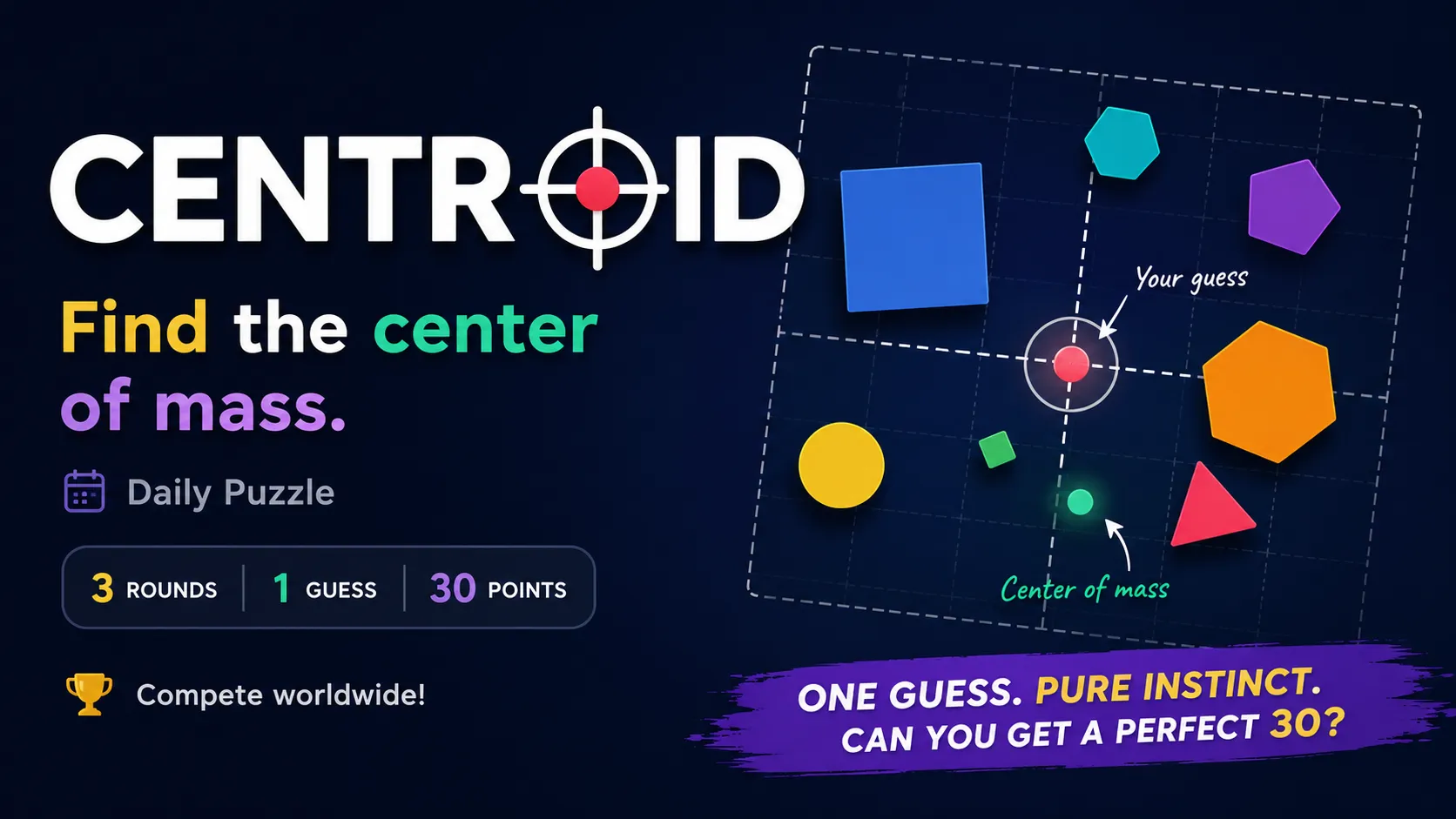
Centroid asks one innocent-looking question: where would this entire arrangement balance? Each round scatters several geometric shapes across a square play area, and your job is to place a marker at their combined center of mass.
The trap is that the obvious middle is rarely the correct answer. Large shapes create more visual weight, isolated pieces pull the balance outward, and overlapping clusters can make your instincts betray you. Centroid gives you three increasingly difficult rounds each day, but only one submitted guess in each round.
Centroid Game Rules (The Catch / The Trap)
- Centroid contains three rounds: Easy, Medium, and Hard.
- Easy uses 3–4 shapes, Medium uses 5–6 shapes, and Hard uses 7–8 shapes.
- You MUST click where you believe the combined center of mass is located.
- You receive one submitted guess per round. Once confirmed, that round is LOCKED IN.
- Each round awards up to 10 points based on how accurately you placed the marker.
- Your three scores combine into a final result out of 30 points.
- You can compare your total with players around the world.
A typical arrangement might feel like this:
`text ◇
□                 ▣
         ⬡
`
The answer is not automatically the center of the board or the midpoint between the outermost shapes. You are searching for the point where the whole collection's visual mass would balance.
How To Play Centroid?
Inspect the Easy round
Three or four shapes appear. Notice their sizes, positions, and how tightly they are grouped.
Imagine the balance point
Player sees: a small square on the left and several larger shapes on the right.
What this means: the center of mass should sit right of the board's geometric middle.
Place and confirm your marker
Click your estimated point, check its position, and select Confirm Guess when you are ready to commit.
Read the result
Result: the real centroid is revealed and your accuracy becomes a score out of 10.
Next clue: if the correct point was farther toward a large cluster, give shape size more influence in the next round.
Survive Medium and Hard
More shapes enter the board, the visual balance becomes harder to judge, and your three round scores combine into a final total out of 30.
Centroid Strategy & Tips
Start by ignoring the border of the play area. The board itself has no mass; only the displayed shapes matter.
Mentally divide the arrangement into a left side and a right side, then compare their visual weight. Repeat the process vertically. The intersection of those two imagined balance lines is a strong first estimate.
Do not treat every shape equally. A large polygon generally pulls the centroid more strongly than a tiny square, while a distant shape can drag the answer farther away from the main cluster than expected.
Finally, pause before confirming. Centroid does not punish slow thinking, but it gives you no rescue guess after you commit.