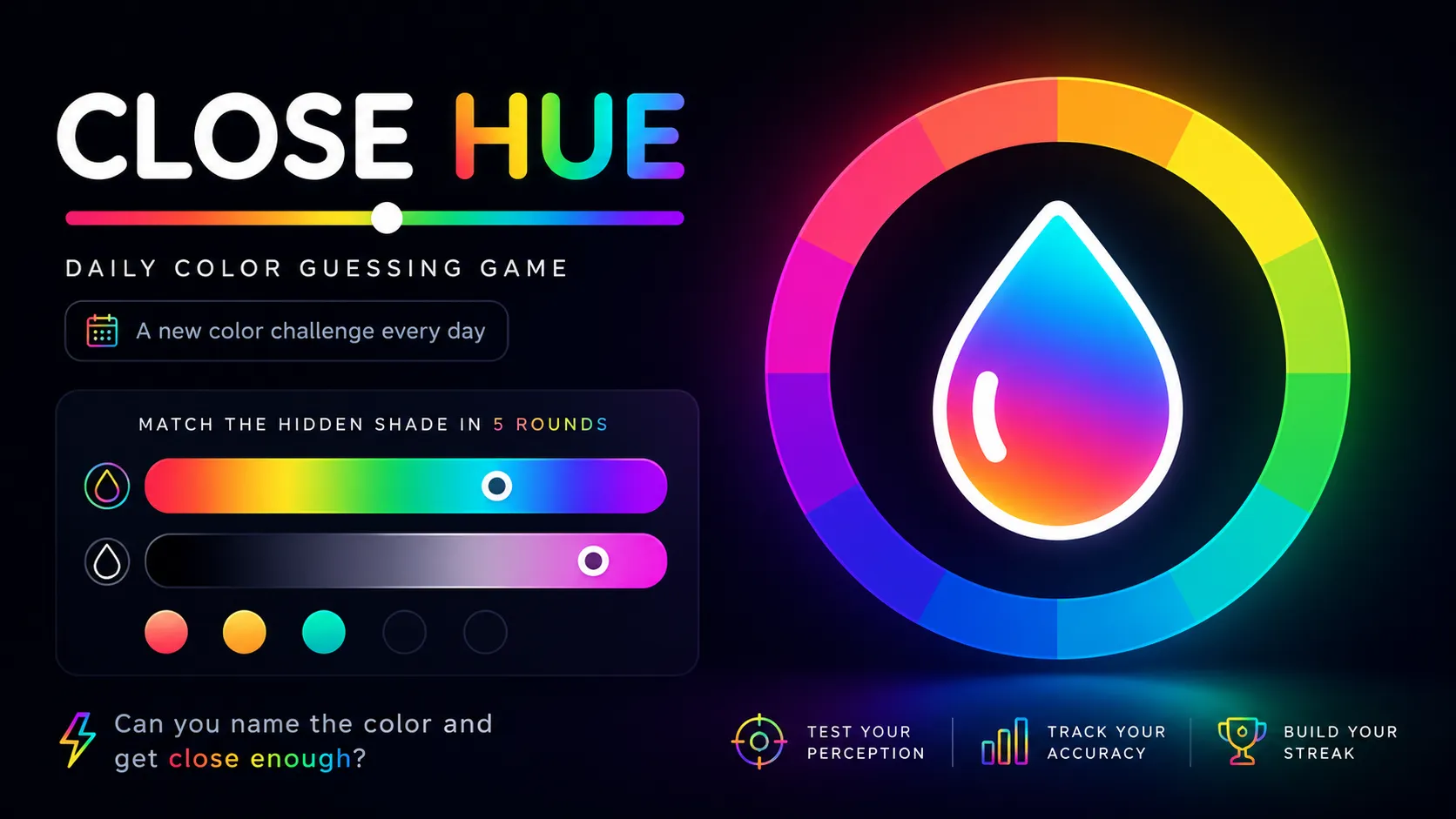
What is Close Hue?
Close Hue asks a dangerous little question: do you actually know what colors such as Goldenrod, Glaucous, or Coquelicot look like? Each round shows only a color name, leaving you to reconstruct the hidden shade with nothing but memory, instinct, and a color picker.
There are five colors in the daily challenge, and every selection is measured by perceptual accuracy. A guess can feel almost perfect yet lose points because it is slightly too dull, too bright, or drifting toward the wrong part of the spectrum. The result is a fast visual duel that exposes exactly how unreliable color memory can be.
Close Hue Game Rules (The Catch / The Trap)
Each daily game contains five rounds, with the same five colors presented to players worldwide.
For every round, the flow is:
COLOR NAME → ADJUST HSB → SUBMIT → TARGET REVEALED → SCORE
Use three controls to construct your answer:
- H — Hue: Choose the position on the color wheel, from red through yellow, green, blue, and purple.
- S — Saturation: Control whether the shade looks muted and grayish or vivid and intense.
- B — Brightness: Make the color darker or push it toward its brightest form.
Only your submitted selection counts. After you commit, Close Hue places your guess beside the true color and awards 0–100 points based on their perceptual distance.
The score bands make the damage easy to read:
- Green — 90–100: Excellent; almost indistinguishable.
- Yellow — 70–89: Good; the correct neighborhood.
- Orange — 40–69: Related, but visibly off.
- Black — 0–39: A spectacular color catastrophe.
Your five scores combine into a daily total out of 500. The target stays hidden until submission, so once you press the button, your decision is LOCKED IN for that round.
How To Play Close Hue?
Read the hidden color’s name.
Prompt:GLAUCOUS
What You Know: It sounds muted and cool, but the actual shade remains concealed.Build your visual guess.
Move the hue toward blue, reduce saturation for a grayish quality, and set medium-high brightness.
Player Selection:Blue-gray | Muted | Medium-brightCommit to the color.
Press Submit. You CANNOT keep adjusting once the guess has been scored.Read the comparison.
Your Guess: cool gray-blue
Target: a stronger, slightly more saturated blue-gray
Result: Yellow band—the hue was close, but the saturation was too low.Survive the remaining rounds.
Repeat the process for four more names, then view your total score, streak, and spoiler-free share grid.
Close Hue Strategy & Tips
Solve each name in three passes: hue first, saturation second, brightness last. Getting the broad color family correct usually matters more than obsessing over tiny brightness changes while sitting in the wrong section of the color wheel.
Pay attention to linguistic clues. Words such as pale, deep, dusty, electric, or midnight can suggest brightness and saturation before you touch the picker. For obscure names, trust the live preview and ask whether the shade visually feels like something that could carry that name.
Close Hue also offers Unlimited mode for practicing random colors and Multiplayer rooms where friends receive the same five names and compare final scores.