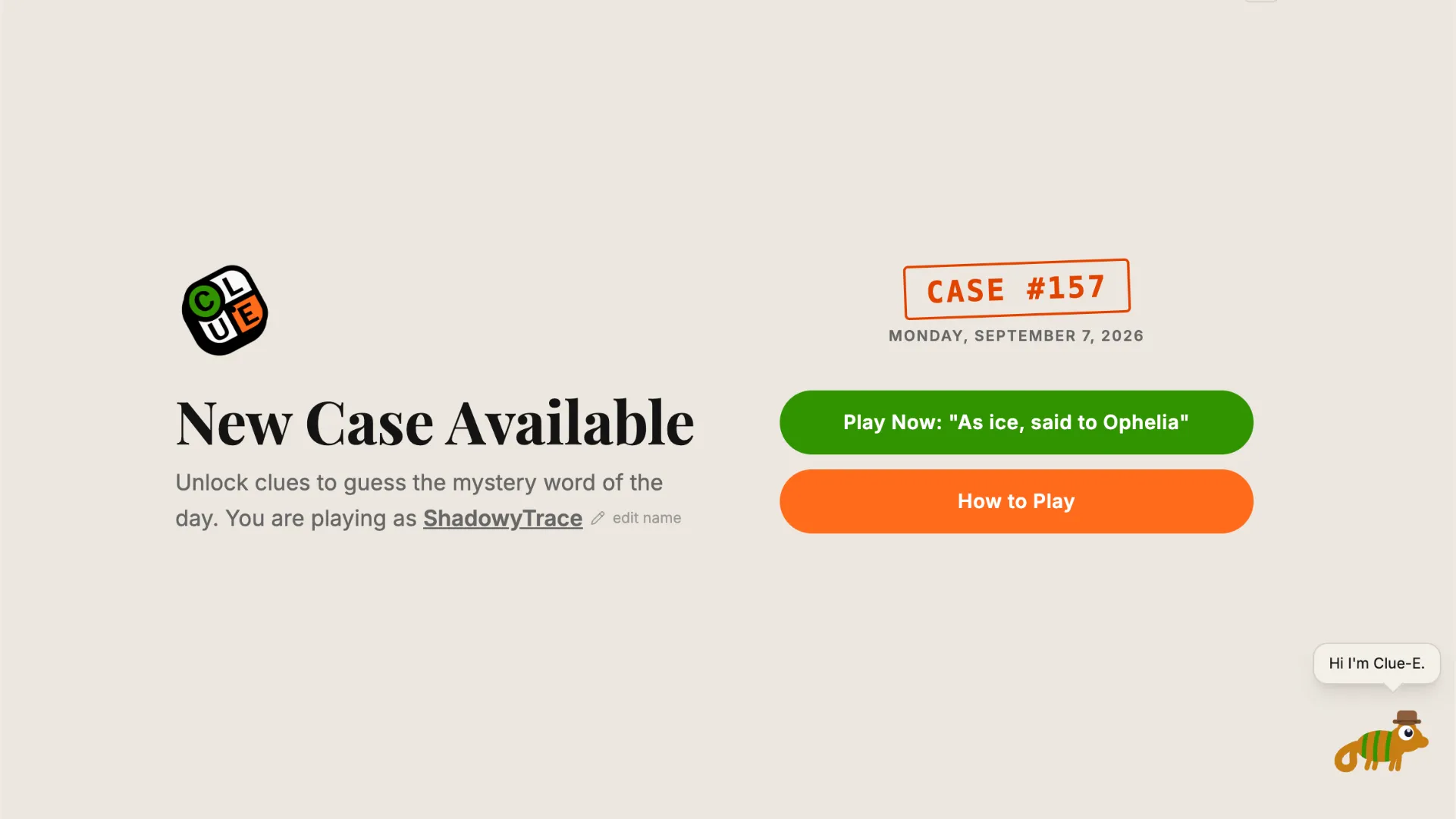
What Is ClueDay?
ClueDay is a daily browser word game built around one six-letter mystery word and five clues.
You begin with only the first clue. Make a wrong guess and another clue becomes available, gradually giving you more ways to interpret the answer. At the same time, your submitted letters provide positional feedback, so each attempt gives you both a new semantic clue and more information about the spelling.
That combination is ClueDay's main twist. You are not solving purely from letter patterns, and you are not solving purely from riddles. You need to combine both.
The target is a common six-letter word rather than a proper noun, so the challenge usually comes from the clue's ambiguity rather than obscure names.
The Core ClueDay Twist
A ClueDay case consists of:
- One six-letter answer
- Five clues
- Up to five guesses
The early clues are deliberately less direct. Later clues narrow the meaning and can become much easier.
For example, imagine the first clue is:
Football move
Several six-letter answers could initially seem reasonable:
HEADER
FUMBLE
TACKLE
You are not expected to identify the answer with certainty from that clue alone. Instead, you make the best guess you can and use the resulting letter feedback plus the next clue to refine your theory.
A later clue might point toward handling a problem or taking on a task. Suddenly TACKLE fits both the sporting meaning and the broader meaning.
That multi-meaning clue design is what makes ClueDay feel closer to a small crossword-style mystery than a standard Wordle clone.
How Letter Feedback Works
Every submitted word also gives spelling information.
- Green: the letter appears in the answer and is already in the correct position.
- Orange: the letter appears in the answer but belongs somewhere else.
- Unmarked: the letter is not part of the solution in that position according to the normal feedback rules.
Suppose you guess:
BRIDGE
If the game marks I orange, you know the mystery word contains I, but not where you placed it.
If a letter appears green, you can lock that position into future guesses.
This creates two parallel sources of information:
clue meaning + letter structure
Strong solves use both rather than relying on only one.
How to Play ClueDay
1. Read the First Clue Carefully
Start by asking what different meanings the clue could have.
If the clue is:
Football move
avoid assuming immediately that it refers to only one version of football or one specific action. Think about verbs, nouns, sporting terminology, and words with secondary meanings.
Remember that the target always has six letters.
2. Submit a Plausible Six-Letter Word
Choose an answer that fits the clue reasonably well.
Your first guess does not have to be perfect. A useful guess can expose several new letters and test one interpretation of the clue.
For example:
HEADER
might be a sensible opening attempt for a football clue even if it is not the final answer.
3. Combine the New Clue With Letter Feedback
After a wrong attempt, another clue unlocks.
Do not treat it as a completely separate riddle. Look for a word that can satisfy both clues simultaneously.
At the same time, carry forward any green or orange letters from your previous guesses.
If your known pattern begins looking like:
T A _ _ L E
and multiple clues point toward confronting something, TACKLE becomes much stronger than a random sports term.
4. Keep Narrowing the Meaning
Each additional clue should reduce the number of plausible interpretations.
By clue three or four, stop brainstorming hundreds of words. Build a shortlist that explains all revealed clues and fits the known letter information.
5. Solve Before the Fifth Guess
You have five clues and a limited sequence of guesses to identify the day's mystery word.
Solving from an early clue is more satisfying, but waiting for additional information is often smarter than forcing a weak guess.
Why ClueDay Is Different From Wordle
Wordle gives you almost no semantic information. You learn primarily through letter placement.
ClueDay gives you a reason to think about meaning from the first move.
A Wordle player might ask:
Which six-letter word tests useful vowels and consonants?
A ClueDay player should first ask:
Which six-letter word actually makes sense for this clue?
That difference changes good opening play.
Throwing in a statistically efficient word that has nothing to do with the clue can waste one of your limited guesses. A slightly less efficient spelling guess may be much better if it tests a strong semantic hypothesis.
Why the Clues Can Feel Cryptic
ClueDay's clues often reward flexible interpretation.
A clue may point toward:
- A literal definition
- A second meaning of the same word
- Wordplay
- An anagram-style idea
- A hidden-word relationship
- A reversal
- Pop-culture knowledge
- Misdirection
You do not need to be an expert cryptic-crossword player, but it helps to avoid reading every clue literally.
If a clue seems strangely phrased, ask whether the wording itself is doing something useful.
Strategy Tips for Better ClueDay Solves
Use All Revealed Clues Together
A common mistake is trying to solve only the newest clue.
The target must explain the entire clue set.
If three clues suggest three apparently unrelated ideas, look for a six-letter word with multiple meanings connecting them.
That intersection is often the intended breakthrough.
Respect the Six-Letter Constraint
The fixed length is powerful information.
If an otherwise perfect answer has five or seven letters, do not keep trying to force it into the puzzle. Use the concept to search for a six-letter synonym instead.
Preserve Confirmed Positions
Green letters are extremely valuable.
If you already know the second letter is A and the final letter is E, build candidates around:
_ A _ _ _ E
rather than starting from meaning alone every time.
Use Orange Letters as Constraints, Not Decorations
An orange letter tells you two things:
- The answer definitely uses that letter.
- The position you tried is wrong.
If you have several orange letters, actively rearrange them when generating candidates.
Look for Double Meanings
Many of the strongest ClueDay answers work because one ordinary word satisfies very different clues.
A word such as TACKLE, for example, can belong to sports vocabulary and also mean dealing with a difficult task.
When two clues appear unrelated, a polysemous word is often worth considering.
Do Not Burn Guesses Just to Test Letters
Because ClueDay gives you clues as well as letter feedback, every guess should ideally test a meaningful candidate.
Pure information guesses can be useful in Wordle, but they are less attractive here when you have only a small number of attempts.
Let Later Clues Rescue You
You do not need to solve every case from clue one.
If the opening clue is too ambiguous, make a defensible guess and use the next clue. The difficulty curve is designed to reveal more information as the case progresses.
Expert Mode
ClueDay includes an Expert Mode for players who find the normal positional feedback too generous.
In the standard game, correctly placed letters are shown separately from letters that are merely present elsewhere.
Expert Mode removes that positional advantage: correct letters are shown without telling you which ones are already in their exact locations.
That puts more pressure on the clues themselves and makes the puzzle substantially closer to pure deduction.
It is worth switching on once the standard daily cases start feeling consistently easy.
Who Should Try ClueDay?
ClueDay is a particularly good fit for players who enjoy:
- Daily word games
- Wordle-style deduction
- Crosswords
- Cryptic clues
- Riddles
- Taboo-style word association
- Vocabulary puzzles
- Short daily challenges
It is more clue-driven than Wordle and more structured than a standalone riddle.
Players who enjoy finding connections between different meanings of an ordinary word are likely to get the most from it.
If you mainly want an anagram game or a pure vocabulary test, ClueDay may feel more interpretive than expected. The clues—and the way their meanings overlap—are central to solving each case.
Final Take
ClueDay takes a familiar daily word-game foundation and gives it a meaningful second information channel.
You are simultaneously solving:
What word fits these clues?
and:
What word fits this letter evidence?
The five-clue structure gives difficult cases a natural progression instead of leaving you stuck with one opaque riddle, while the six-letter format keeps every guess focused.
The result is a compact daily puzzle that works especially well for players who like Wordle but want more language, wordplay, and deduction involved in finding the answer.