What Is Cluword?
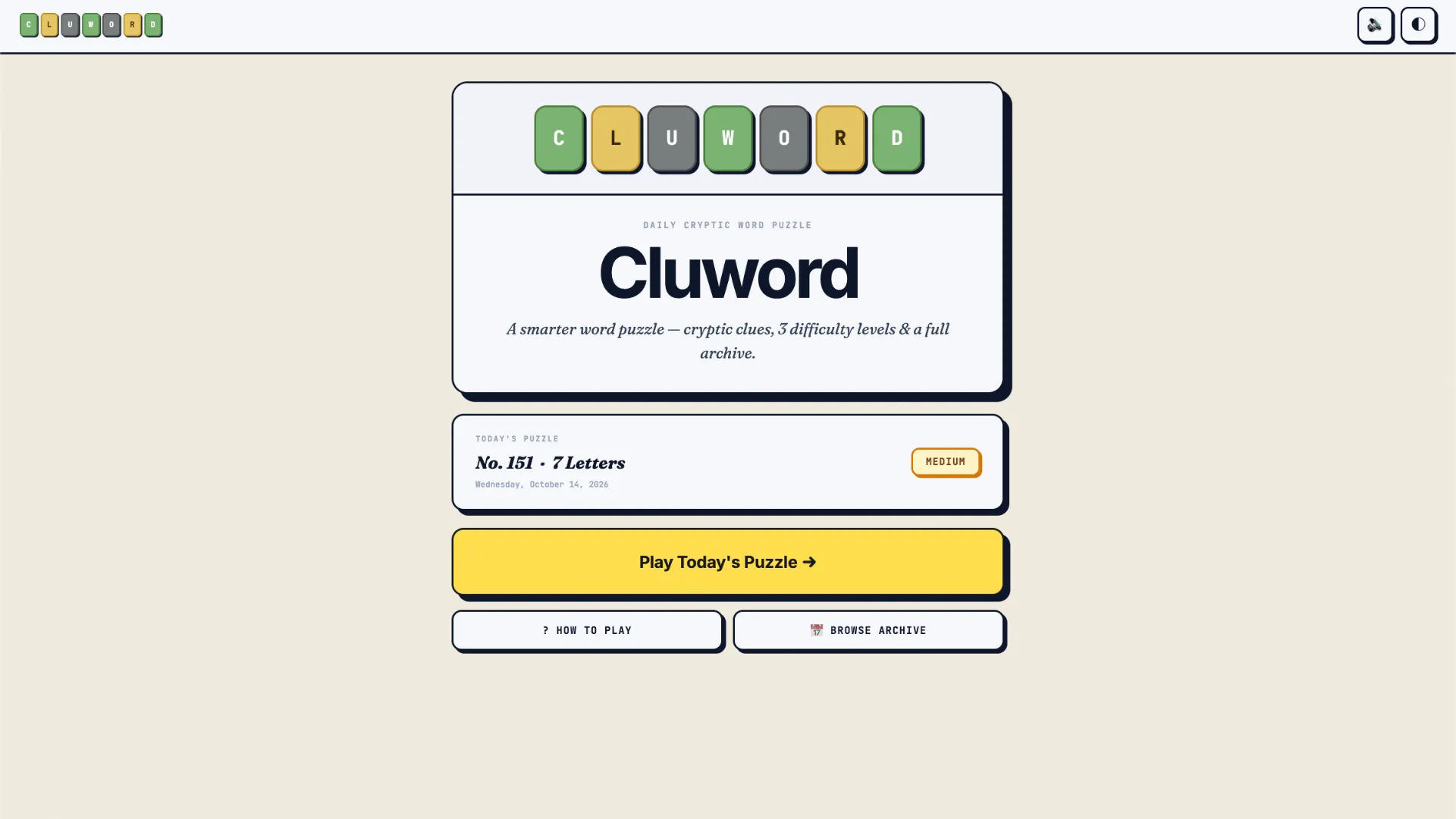
Cluword is a free daily word-guessing game created by OneAppleFall that combines the familiar letter-deduction mechanics of Wordle with cryptic, crossword-style clues.
Instead of beginning with a completely unknown word, every Cluword puzzle provides an opening clue related to the answer's meaning. Players must interpret that clue, enter possible words, and use color-coded letter feedback to identify the hidden answer in five attempts.
The game's central twist is its progressive hint system. If the initial clue is too difficult, you can reveal up to three additional clues that become increasingly specific. However, each extra clue costs one of your five guesses, forcing you to decide whether another hint is more valuable than another attempt.
Cluword also changes difficulty according to the day of the week. Monday and Tuesday feature easier puzzles, Wednesday and Thursday offer medium challenges, and Friday through Sunday introduce harder words and more demanding clues.
Unlike standard Wordle, Cluword does not always use five-letter answers. The word length changes between puzzles, with archived challenges featuring words of different lengths.
The game is free, requires no account, and includes a complete archive of previous daily puzzles.
Cluword Game Rules
The objective is to discover the hidden word using the opening clue, letter-position feedback, and optional additional hints.
The main rules are:
- One new puzzle every day: Each day introduces a different hidden word and a cryptic or crossword-style clue.
- Five guesses: Players have five attempts available for solving the word.
- Variable word length: The required number of letters changes between puzzles.
- Real-word guesses: Enter a valid word that matches the displayed answer length.
- Green tiles: A letter is correct and occupies the correct position.
- Gold or amber tiles: A letter appears in the answer but belongs in another position.
- Grey tiles: A letter is not present in the hidden word, subject to normal repeated-letter interpretation.
- Three additional hints: You can unlock up to three progressively clearer clues.
- Hints consume guesses: Every additional clue uses one of your remaining attempts.
- Rotating difficulty: Easy, Medium, and Hard puzzles follow a weekly schedule.
The puzzle ends when you identify the correct word or exhaust the available attempts.
The key strategic decision is whether to use a guess to test another word or spend that opportunity revealing a more informative clue.
How to Play Cluword
- Open today's puzzle: Visit Cluword and read the opening cryptic clue. Check the number of letters required for the answer.
- Interpret the clue: Think about the possible meanings, associations, and wordplay suggested by the clue. Identify a few candidate answers before submitting anything.
- Enter your first guess: Type a real word of the required length and submit it. Examine the resulting green, gold, and grey letter tiles.
- Refine your answer or unlock a hint: Use the letter feedback to eliminate impossible words. If the clue remains unclear, reveal another clue, remembering that doing so costs one guess.
- Solve the hidden word: Combine the semantic clues with the letter information to identify the answer before your five attempts are exhausted. Return tomorrow for another puzzle or explore the archive for more challenges.
Example: How Cluword Works
Consider this fictional five-letter puzzle:
Opening clue: 'It runs without legs and has banks without money.'
The hidden answer is RIVER.
Suppose your first guess is RINSE.
| Letter | Feedback | Meaning |
|---|---|---|
| R | Green | R is in the correct position. |
| I | Green | I is in the correct position. |
| N | Grey | N is not in the answer. |
| S | Grey | S is not in the answer. |
| E | Gold | E appears in the answer but not in position five. |
Your feedback pattern would look like this:
RINSE → 🟩🟩⬜⬜🟨
You now know that the answer starts with RI and contains an E somewhere other than the fifth position.
Your second guess might be RIDER:
RIDER → 🟩🟩⬜🟩🟩
This confirms four correctly positioned letters and eliminates D.
The obvious remaining solution is RIVER.
RIVER → 🟩🟩🟩🟩🟩
You have solved the word in three guesses without unlocking an additional clue.
If the opening clue had been confusing, you could instead have spent one attempt revealing a clearer hint, such as 'A natural waterway flowing toward a lake or sea.'
This example is illustrative rather than an actual Cluword daily puzzle. It demonstrates how semantic clues and Wordle-style letter feedback work together.
Understanding Cluword's Progressive Hints
Cluword begins each puzzle with one cryptic clue. Players may unlock up to three additional hints, for four clues in total.
The hints generally become more direct as they progress.
Opening Clue: Interpret the Wordplay
The initial clue points toward the meaning or concept behind the hidden word.
It may involve a double meaning, an indirect definition, or a familiar expression.
Rather than immediately guessing random words, spend some time considering how the clue could describe different objects, actions, or ideas.
Additional Hint 1: Narrow the Meaning
The first optional hint provides more context about the answer.
This may help you identify a subject, meaning, or association that was not immediately obvious from the opening clue.
Because unlocking this hint consumes one attempt, it is most useful when you cannot identify a promising candidate from the information already available.
Additional Hint 2: More Specific Guidance
The second optional hint becomes more literal and helps narrow the answer further.
By this point, the combination of clue information and colored letters may already restrict the possible words substantially.
Additional Hint 3: Letter-Level Help
The final optional hint often provides a direct letter clue, such as the word's starting letter.
This can be extremely useful when several candidate words fit the same meaning, but it also consumes another valuable attempt.
Important: Additional clues are not free. If you reveal multiple hints, you will have fewer opportunities to test possible answers.
Cluword Difficulty Levels
One of Cluword's defining features is its automatic weekly difficulty rotation.
| Day | Difficulty | What to Expect |
|---|---|---|
| Monday | Easy | Familiar vocabulary and accessible clues |
| Tuesday | Easy | Approachable wordplay and common answers |
| Wednesday | Medium | More interpretation and deduction required |
| Thursday | Medium | Moderately challenging clues and vocabulary |
| Friday | Hard | Trickier clues and potentially less common words |
| Saturday | Hard | More demanding wordplay |
| Sunday | Hard | A challenging end-of-week puzzle |
Easy: Monday and Tuesday
Easy puzzles emphasize familiar vocabulary and more approachable clue interpretation.
These days are suitable for beginners, casual word-game players, and people learning how cryptic-style clues work.
Medium: Wednesday and Thursday
Medium puzzles introduce more demanding clues and a greater need to combine word meanings with letter deductions.
You may recognize the general concept behind a clue without immediately knowing the exact word.
Hard: Friday Through Sunday
Hard puzzles use trickier clues and may involve less common vocabulary.
The challenge is not necessarily the number of letters. A short but unfamiliar word can be harder to solve than a longer, recognizable one.
Experienced players who enjoy crosswords and lateral-thinking puzzles may find the harder days particularly rewarding.
Cluword Strategy and Tips
1. Read the Clue Before Guessing
Cluword rewards interpretation as much as letter elimination.
A good first step is to identify what the clue might mean, including any possible double meanings or misleading phrasing.
If you can identify two or three plausible answers before making your first guess, you have a stronger starting position than someone relying only on letter frequencies.
2. Use Common Letters When the Clue Is Vague
If the opening clue is too abstract to suggest a likely answer, consider testing common letters.
For five-letter puzzles, words such as CRANE, SLATE, and TRACE contain useful vowels and frequently occurring consonants.
However, because Cluword uses variable-length answers, these opening words are not suitable for every puzzle.
Always respect the displayed word length and favor a clue-related answer when one is available.
3. Lock Green Letters in Place
Green feedback confirms both the presence and position of a letter.
Keep those letters in the same positions when constructing your next serious candidate.
This allows you to concentrate on the unresolved positions instead of reconsidering information already established.
4. Reposition Gold Letters
A gold or amber tile confirms that the letter occurs in the answer but not where you placed it.
Use the next guess to test that letter in another possible position.
For example, if E appears as gold in the fifth position, consider candidates that place E earlier in the word.
5. Pay Attention to Repeated Letters
Repeated letters can complicate Wordle-style feedback.
If a guessed word contains a letter twice but the answer contains it only once, one occurrence may receive positive feedback while the additional occurrence appears grey.
Do not automatically conclude that a letter is absent simply because one duplicate instance is grey.
6. Treat Hints as a Strategic Resource
The biggest mistake beginners can make is revealing every hint immediately.
Each unlocked clue costs one guess. Spending three attempts on hints can leave very little room for testing candidate answers.
Before requesting help, ask whether another word guess would provide enough new information to make progress.
A hint becomes more valuable when the available letter feedback leaves several plausible candidates and the original clue remains ambiguous.
7. Adapt to the Day's Difficulty
On Easy days, direct clue interpretation may be sufficient to solve the puzzle quickly.
On Hard days, expect more ambiguity and less familiar vocabulary. Consider multiple meanings of the clue before committing to your first answer.
The changing difficulty schedule means a strategy that works on Monday may need adjustment on Saturday.
8. Practice With Archived Puzzles
Cluword provides a free archive containing previous daily puzzles.
Each archived puzzle page includes the original clue, progressive hints, the answer, and an explanation of how the clue works.
Reviewing older puzzles can help you become familiar with common patterns in cryptic and crossword-style wordplay.
Be aware that archive pages may reveal previous answers, so avoid opening their solution sections before attempting those puzzles if you want to solve them independently.
Cluword vs Wordle
Cluword uses familiar Wordle-style letter feedback, but its clue system changes how players approach the puzzle.
| Feature | Cluword | Wordle |
|---|---|---|
| Main objective | Guess a hidden word | Guess a hidden word |
| Guess limit | 5 attempts | 6 attempts |
| Word length | Varies by puzzle | Always 5 letters |
| Opening clue | Yes | No |
| Extra hints | Up to 3, costing guesses | No comparable built-in hint system |
| Letter feedback | Green, gold, grey | Green, yellow, grey |
| Difficulty schedule | Easy, Medium, Hard by weekday | No fixed weekday difficulty schedule |
| Daily puzzles | Yes | Yes |
| Free archive | Yes | Not part of the standard free daily game |
Why Cluword Feels Different
Wordle primarily tests vocabulary, letter-frequency knowledge, and deductive reasoning.
Cluword adds another dimension: understanding language through definitions, associations, and wordplay.
An experienced Wordle player may quickly identify the correct letter pattern but still struggle to recognize the word suggested by a particularly indirect clue.
Conversely, someone who enjoys crosswords may interpret the clue correctly and solve the puzzle with relatively few guesses.
This combination makes Cluword an appealing alternative for players who want more than a traditional five-letter guessing challenge.
Is Cluword Free to Play?
Yes. Cluword is completely free to play in a browser.
The official website states that the game requires no account, login, email address, subscription, or payment.
It works in modern desktop and mobile browsers, and players can add the site to their mobile home screen as a Progressive Web App.
Cluword also stores statistics locally in the browser, including win streaks, total games played, win rate, and guess distribution.
Because statistics are saved locally rather than through a user account, changing devices or clearing browser storage may affect your saved progress.
Cluword Puzzle Archive
The Cluword Puzzle Archive provides access to previous daily challenges.
Archived puzzle pages include:
- The original daily clue.
- The day's difficulty rating.
- The answer's letter count.
- Three progressive hints.
- The hidden answer.
- A short explanation of the clue's meaning or wordplay.
This makes the archive useful for practicing difficult clue types and learning from puzzles that initially seemed impossible.
It also allows players who missed a day to explore earlier challenges without waiting for another daily release.
Frequently Asked Questions
What is Cluword?
Cluword is a free daily cryptic word puzzle that combines crossword-style clues with Wordle-like letter feedback. Players have five attempts to find the hidden word.
How many guesses do you get in Cluword?
You get five attempts per puzzle. Each optional hint also uses one of those attempts.
How many clues are available?
Every puzzle begins with one cryptic clue. You can unlock up to three additional progressive hints, making four clues available in total.
Do hints cost guesses?
Yes. Each additional clue consumes one guess. Players must balance the usefulness of extra information against the number of attempts remaining.
Does Cluword have a new puzzle every day?
Yes. A new puzzle is published daily, with difficulty rotating through Easy, Medium, and Hard according to the day of the week.
Is every Cluword answer five letters long?
No. The answer length varies between puzzles. Archived challenges include words of several different lengths.
What do the colors mean?
Green means a correct letter in the correct position. Gold or amber means the letter belongs in the word but is in the wrong position. Grey generally means the letter is absent, accounting for repeated-letter behavior.
Can you play previous Cluword puzzles?
Yes. Cluword includes a free archive of past daily puzzles, with clues, hints, answers, and explanations.
Is Cluword harder than Wordle?
It can be. Cluword has fewer available attempts and adds the challenge of interpreting cryptic-style clues. However, its Easy puzzles use more familiar vocabulary, and optional hints can help players who get stuck.
What days are the hardest?
Friday, Saturday, and Sunday are designated Hard days. Monday and Tuesday are Easy, while Wednesday and Thursday are Medium.
Do you need an account to play Cluword?
No. The game is free and does not require registration. Progress and statistics are stored in your browser.
Can you play Cluword on mobile?
Yes. Cluword supports modern mobile browsers and can be added to a phone's home screen as a Progressive Web App.
Who Should Play Cluword?
Cluword is a good choice for players who enjoy Wordle, crosswords, cryptic clues, vocabulary challenges, and daily word puzzles.
Its weekday difficulty rotation makes it approachable for beginners while providing more demanding challenges for experienced solvers.
Players who enjoy understanding clever definitions and unexpected word meanings may particularly appreciate its clue-based approach.
The complete puzzle archive also makes Cluword suitable for anyone who wants more than one short word challenge during a gaming session.
Conclusion
Cluword adds a clever twist to the familiar daily word-guessing format by combining letter deduction with crossword-inspired clues and progressive hints.
With five attempts, variable word lengths, a rotating difficulty schedule, and a strategic trade-off between guesses and hints, it offers a more varied experience than a conventional Wordle clone.
The combination of free access, browser-based play, and a full puzzle archive makes it an appealing option for casual players and dedicated word-game enthusiasts alike.
Ready to crack today's clue? Play Cluword for free and see whether you can solve the hidden word before your five attempts run out.
For detailed instructions, visit the official Cluword How to Play guide.