
What Is Halfsies?
Halfsies is a free daily 3D estimation game that challenges players to divide everyday objects into two pieces of equal weight. Instead of simply cutting an object through its visual center, you must estimate how its shape, thickness, and material density affect the weight on either side of your knife.
The objective is simple: make one cut that divides an object into two pieces weighing as close to 50/50 as possible. However, the middle of an object's shape is not always the middle of its weight.
Every day, Halfsies presents five objects to cut, ranging from relatively simple shapes to irregular objects with more complicated weight distributions. Players receive the same daily lineup, making it possible to compare accuracy with friends and other players.
You position a virtual knife, adjust the cutting line, inspect the object, and commit to your slice. Afterward, the two pieces are weighed on a scale, revealing how close your estimate came to an even division.
Created by independent developer Isaac Audet, Halfsies belongs to the same family of browser games as Amountle, Flipsies, and Stackdle. It combines visual estimation, basic physics concepts, and satisfying 3D cutting animations into a short daily challenge.
The game is available at halfsies.dev and can be played without creating an account or installing an app.
How Does Halfsies Work?
Halfsies is based on one important principle: equal size does not necessarily mean equal weight.
Imagine cutting a perfectly uniform wooden cylinder into two pieces. If both halves have the same volume and density, dividing the cylinder at its midpoint would also divide its weight equally.
Now imagine an object with a heavy metal component at one end and lightweight material at the other. Cutting it at the geometrical midpoint could produce two pieces with very different weights.
Halfsies turns this distinction into a game.
Each object is represented as a three-dimensional shape. Your job is to choose the position and orientation of a cutting plane that divides its estimated mass as evenly as possible.
The main gameplay elements include:
- 3D objects: Everyday items with different shapes, dimensions, and sometimes multiple materials.
- Adjustable cutting line: A visible line indicates where your knife will slice the object.
- Drag handles: Circular handles allow you to refine the position and angle of your cut.
- Peek control: Hold Peek to rotate and inspect the object before committing.
- Material indicators: Some objects display material information indicating differences in density or relative weight.
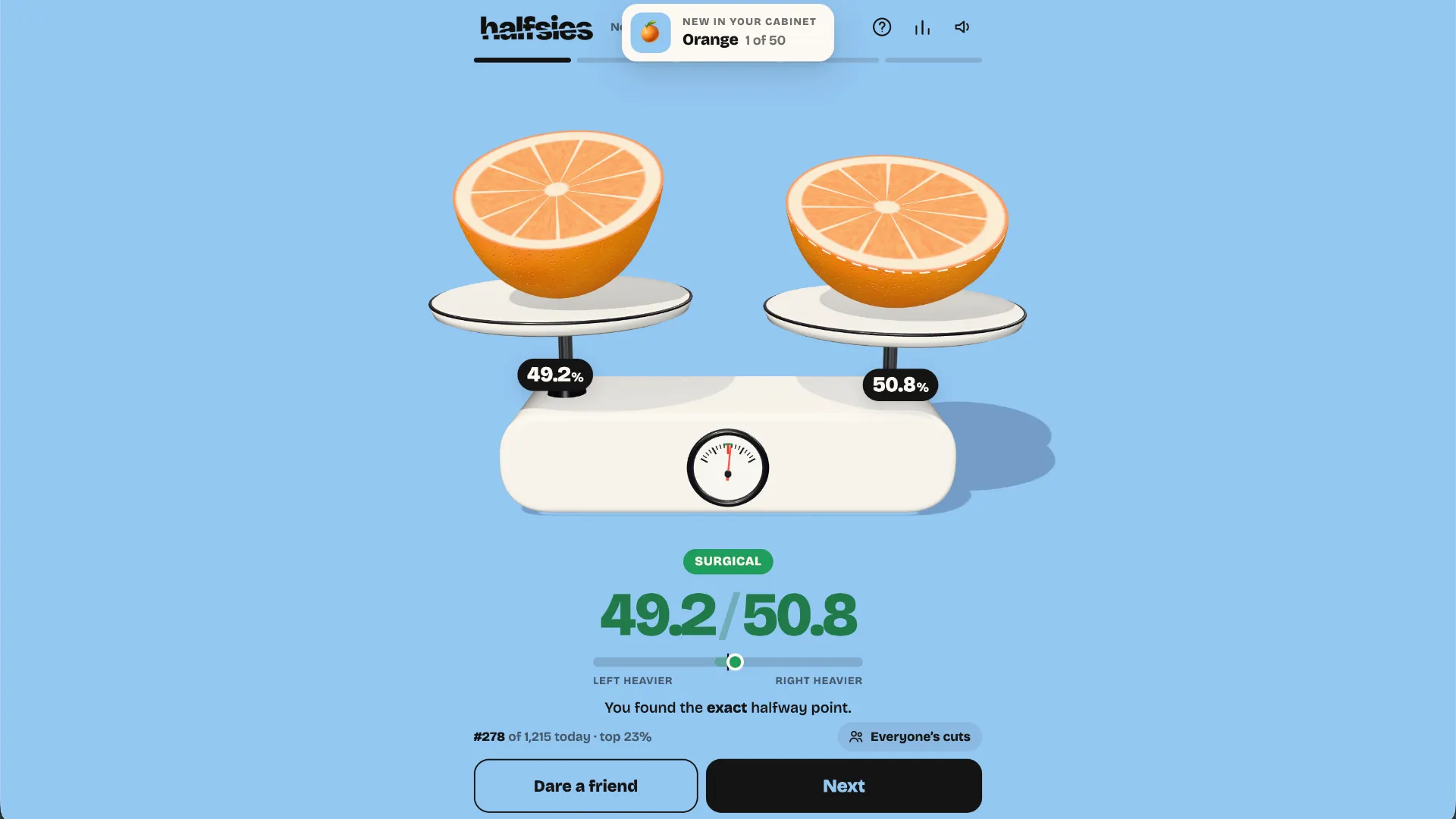
- Balance scale: After cutting, the game reveals the weight distribution between the resulting pieces.
- Accuracy results: The game reports the percentage of weight on each side and tracks your average deviation from an even split.
The challenge is not simply to recognize the center of a picture. You must reason about the mass of a three-dimensional object.
How to Play Halfsies
Halfsies is easy to learn, and a daily session generally takes only a few minutes.
- Open the daily challenge. Visit Halfsies in your browser and start the daily game. You will be presented with the first of five objects.
- Inspect the 3D object. Study its overall shape, thickness, and visible materials. Hold the Peek control to rotate the object and examine details that may not be obvious from the initial viewing angle.
- Position your cutting line. Drag across the object to establish a cut. Use the circular handles to fine-tune its placement and angle. Invalid cutting directions are highlighted in red.
- Commit to your cut. Once you are satisfied with the position, select Cut. The object splits into two pieces, which are weighed to reveal the percentage of total weight on each side.
- Complete all five objects. Continue through the daily lineup and review your results. The game calculates your average miss from an ideal 50/50 split and allows you to share your performance or challenge a friend.
A good starting strategy is to aim for the center of the object's mass rather than the center of its visible outline.
Halfsies Rules: Weight Matters More Than Size
The most important rule in Halfsies is that the two pieces should weigh the same, not necessarily look the same size.
Rule 1: Aim for a 50/50 Weight Split
The target result is 50% of the object's total weight on each side of the cut.
A result of 50.0% / 50.0% represents a perfect balance. A result of 49.5% / 50.5% is extremely close, while 35.0% / 65.0% indicates a significantly uneven division.
Rule 2: Consider the Object's Shape
Irregular shapes can distribute mass unevenly even when they consist of a single material.
For example, imagine a carrot with a thick end and a long, narrow tip. Cutting it halfway along its length may leave much more weight on the thicker side.
A more accurate cut may need to be positioned closer to the thick end to produce two equal-weight pieces.
Rule 3: Account for Material Density
Some objects contain materials with different densities. A small metal component may weigh more than a larger piece made from foam or another lightweight material.
Halfsies uses material indicators to help players recognize when the visible volume of an object may not accurately represent its weight distribution.
Rule 4: Make a Valid Cut
The virtual knife must pass across the object in an allowable direction.
Lines that run along an object's length can turn red, indicating that the proposed cut is invalid. Reposition or rotate the cutting line until the game accepts the orientation.
Rule 5: Commit to Your Estimate
Once you select Cut, the game reveals the actual balance of the resulting pieces. Use the available inspection and adjustment controls before committing rather than relying on an unexamined first guess.
How Is Halfsies Scored?
Halfsies evaluates how far each cut differs from the ideal 50/50 division.
Each result displays the percentage of weight in the two pieces. The game also calculates an average miss across the daily five-object challenge.
Example Weight Splits
| Cut Result | Deviation From 50/50 | Assessment |
|---|---|---|
| 50.0% / 50.0% | 0.0 percentage points | Perfect balance |
| 50.5% / 49.5% | 0.5 percentage points | Extremely close |
| 52.0% / 48.0% | 2.0 percentage points | Close |
| 55.0% / 45.0% | 5.0 percentage points | Noticeably uneven |
| 60.0% / 40.0% | 10.0 percentage points | Significantly uneven |
These assessments are illustrative rather than official score-grade thresholds.
The deviation for an individual cut can be calculated as the absolute difference between one piece's weight percentage and 50%.
For example, a 47.3% / 52.7% result misses the ideal midpoint by 2.7 percentage points.
Understanding Average Miss
After completing the five daily objects, Halfsies reports your average miss.
Suppose your five cuts have deviations of 2.0, 0.5, 4.0, 1.5, and 3.0 percentage points.
Your average miss would be 2.2 percentage points.
A lower average miss is better, because it indicates that your cuts were consistently closer to equal weight.
The game's shareable results can show individual weight splits and your position among the day's players.
Why Is Cutting an Object in Half So Difficult?
Halfsies works because people are generally better at estimating visible length and area than hidden mass.
Objects Are Three-Dimensional
A photograph or initial camera angle does not fully reveal an object's volume.
Two sections may appear equally large from the front while having different depths. Rotating the object can reveal that one side is substantially thicker than the other.
Mass Is Not Always Evenly Distributed
An object may have heavier components concentrated in one area.
For example, consider a hypothetical object with a dense metal base and a lightweight upper section. A geometrically symmetrical cut might leave the heavier base almost entirely on one side.
An Accurate Cut Can Look Off-Center
For irregular objects, the line that divides total mass into two equal parts may not pass through the apparent visual center.
A cut placed closer to the wider or denser end can produce a better balance than one centered along the object's length.
This is what makes Halfsies an estimation game rather than simply a test of hand-eye coordination.
Halfsies Game Modes
Daily Challenge
The main Daily mode presents five shared objects each day.
The lineup can progress from approachable shapes toward more challenging objects with irregular forms or mixed materials.
Your performance is measured by how closely the resulting pieces match in weight. At the end, you can compare your average miss with other players and share a summary of your results.
Because everyone receives the same daily objects, the challenge supports direct comparisons between players.
Endless Mode
Endless mode allows you to continue cutting new objects beyond the daily five.
The mode uses a three-life system. Your goal is to keep making sufficiently accurate cuts and survive for as long as possible.
This is useful for players who want additional practice or prefer a longer challenge without waiting for the next daily lineup.
Dare a Friend
Halfsies includes a sharing feature that lets you challenge someone to cut the same object from the same starting pose.
This makes for a direct comparison between two players attempting the same estimation problem.
You can send a challenge link and see whether another player can place a more accurate cut.
Cabinet
The game also includes a Cabinet section for exploring objects beyond the current daily challenge.
It offers another way to revisit the game's collection and experiment with different shapes or cuts.
Weekend Thirds
The official Halfsies mobile app also advertises a Weekend Thirds variation, which changes the goal from two equal-weight pieces to three.
That format requires each piece to contain approximately one-third of the total weight. Availability may differ between the mobile app and browser version.
Halfsies Strategy Tips
1. Inspect the Object From Multiple Angles
Do not trust the initial viewing angle.
Use Peek to rotate the object and identify thick sections, narrow sections, and unusual shapes. A visually symmetrical silhouette may hide an uneven distribution of volume.
2. Identify the Heaviest Region
Look for areas that are likely to contain more mass.
A large solid section generally contributes more weight than a smaller section made of the same material. When materials differ, a dense component can outweigh a larger lightweight component.
3. Check the Material Indicators
Pay attention to the material information displayed beneath the object's name when available.
These indicators can help you recognize heavier materials or components. If one end contains denser material, consider shifting the cut toward that end.
4. Do Not Automatically Cut at the Geometric Center
A midpoint cut is a reasonable starting idea for a uniform, symmetrical object, but it can be misleading for irregular shapes.
Instead, imagine the total mass on either side of your proposed line. Ask whether moving the line slightly toward the heavier region would make the two sides more balanced.
5. Fine-Tune With the Circular Handles
Your first drawn cutting line does not have to be your final choice.
Use the round handles to make smaller adjustments to its position and angle. Fine-tuning is particularly valuable when an object is asymmetrical or has different materials.
6. Avoid Invalid Cutting Directions
If the line becomes red, it may be running along the object's length instead of cutting across it.
Change its orientation before attempting to cut. Valid placement is a separate requirement from achieving equal weight.
7. Estimate Mass, Not Surface Area
A wide but thin section can weigh less than a small, thick section.
Think in terms of three-dimensional volume and material density rather than the number of pixels on each side of the proposed cut.
8. Learn From the Scale
After every cut, study the weight percentages.
If one piece contains 58% of the weight, consider which assumptions led you to underestimate that side. Was it thicker than expected? Did it contain denser material?
This feedback can improve your intuition for the next object.
9. Focus on Consistency
A perfect cut on one object is satisfying, but the daily result depends on your performance across five objects.
Five reasonably accurate cuts can produce a better average miss than several exceptional cuts combined with one extremely uneven split.
10. Practice in Endless Mode
Endless mode provides additional opportunities to recognize how shapes and materials influence weight.
Try to identify common patterns across objects rather than memorizing one particular cutting position.
Can You Share Halfsies Results?
Yes. Halfsies provides shareable daily results that show your performance without requiring friends to watch your entire game.
A typical shared result includes the puzzle number, an emoji representing each object, the weight percentages of the two pieces, and the overall average miss.
For example, an illustrative result might look like this:
halfsies · daily challenge 🍊 50.5 / 49.5 🥝 52.0 / 48.0 🍍 55.0 / 45.0 🧀 49.2 / 50.8 ✏️ 47.3 / 52.7 avg miss 2.2%
This example uses illustrative numbers, not a real daily score.
Actual shared results may also include daily ranking and streak information.
The game supports challenge links and saved images, making it easy to compare your cuts with friends.
Is Halfsies Free to Play?
Yes. Halfsies is free to play in a web browser at halfsies.dev.
Players can access the daily five-object challenge without creating an account.
The game uses visual controls suitable for desktop and mobile browsers. You can drag the cutting line, adjust its handles, and use the Peek control to inspect objects.
A separate iPhone and iPad version, titled Halfsies: Daily Slicing, is also published by Isaac Audet. The browser version does not require downloading that app.
Halfsies vs. Other Daily Estimation Games
Halfsies belongs to a group of visual challenges that test physical intuition rather than vocabulary or factual knowledge.
| Game | Main Objective | Core Skill |
|---|---|---|
| Halfsies | Divide 3D objects into two equal-weight pieces | Estimating mass distribution |
| Amountle | Estimate how many objects are inside a container | Visual quantity estimation |
| Flipsies | Flip objects and land them upright on a target | Spin and landing accuracy |
| Stackdle | Stack shapes as high as possible without excessive falls | Balance and spatial planning |
Halfsies is distinctive because an accurate visual midpoint does not necessarily produce a successful result.
It asks players to infer properties that are partly hidden from the camera, including three-dimensional volume and differences in material density.
Unlike Flipsies, which rewards controlled movement and landing precision, Halfsies emphasizes judgment before committing to a cut.
Who Should Play Halfsies?
Halfsies is a good choice for players who enjoy quick visual challenges with clear goals and measurable results.
It is particularly suitable for:
- Estimation game fans who enjoy testing their intuition against numerical results.
- Daily puzzle players looking for a short challenge with a new lineup each day.
- Physics enthusiasts interested in weight distribution, balance, and density.
- Visual thinkers who enjoy analyzing 3D shapes and identifying hidden asymmetry.
- Competitive players who want to compare average misses and daily rankings.
- Casual players who prefer games without complicated controls, registration, or installation.
You do not need advanced mathematics or physics knowledge to play. The basic objective is understandable immediately, while accurate cuts become more satisfying as your intuition improves.
Who Created Halfsies?
Halfsies was developed by independent creator Isaac Audet, who also works on Amountle and other short browser-based games.
In September 2026, the developer introduced Halfsies alongside Flipsies and Stackdle as part of a collection of free daily physics and estimation challenges.
The official Halfsies: Daily Slicing iOS app also credits Isaac Audet as its developer.
Frequently Asked Questions
What is the goal of Halfsies?
Cut each 3D object into two pieces that weigh as close to the same amount as possible. The ideal result is 50% of the weight on each side.
How many objects are in the daily challenge?
There are five objects in each daily challenge, and all players receive the same daily lineup.
Does Halfsies measure size or weight?
Weight. Two pieces can look different in size and still form a perfect split if they contain equal mass.
Can I rotate objects before cutting?
Yes. Use the Peek control to inspect the object from another angle before committing your cut.
What do the material indicators mean?
They provide information about materials or relative weight, helping you recognize when one region may be denser than another.
Why does my cutting line turn red?
A red line can indicate an invalid cutting direction, such as a cut running along the object's length rather than across it.
What is a perfect Halfsies cut?
A 50.0% / 50.0% weight split is perfect. Results closer to that balance produce a smaller miss.
How is the daily result calculated?
The game tracks the deviation of each cut from a 50/50 balance and reports an average miss across the daily objects. Lower is better.
Can I play more than five objects?
Yes. Endless mode provides additional challenges beyond the daily five-object lineup.
How many lives are in Endless mode?
Endless mode uses a three-life system. The aim is to keep making accurate cuts and survive as long as possible.
Can I challenge a friend?
Yes. Halfsies supports shared challenges that let another player attempt to cut the same object from the same starting pose.
Is Halfsies available on mobile?
Yes. Halfsies can be played in a mobile browser, and a separate iPhone and iPad app is also available.
Is Halfsies free?
Yes. The daily browser game is free and does not require an account.
Conclusion
Halfsies turns an everyday question—where should you cut something in half?—into an entertaining test of visual judgment and physical intuition.
Its defining twist is that players must divide objects by weight rather than visible size. Irregular shapes, hidden thickness, and different material densities make the correct cutting position surprisingly difficult to predict.
With five daily objects, satisfying 3D slicing animations, immediate balance-scale feedback, and shareable accuracy results, Halfsies offers a refreshing alternative to traditional word and logic puzzles.
The additional Endless mode and friend challenges provide more opportunities to practice after finishing the daily lineup.
Think you can find the perfect halfway point? Visit Halfsies, slice today's five objects, and see how close you can get to a perfect 50/50 balance.