What Is HistoriaQuest?
HistoriaQuest is a free daily history puzzle game that challenges players to arrange historical figures, inventions, and important events in chronological order. Instead of answering traditional multiple-choice questions or memorizing exact dates, players must decide what happened first, what came next, and what belongs at the end of a historical timeline.
Each daily puzzle presents five illustrated cards. Your objective is to drag them into the correct sequence, from the oldest to the most recent, and submit your arrangement.
The challenge sounds simple, but recognizing a historical event is very different from knowing exactly when it happened. Two famous inventions might have appeared only a few decades apart, while two historical figures may have lived during overlapping periods.
HistoriaQuest turns these uncertainties into a quick daily challenge that rewards historical knowledge, logical reasoning, and careful comparisons.
The game is part of the Daily Quest Games collection, which also includes TerraeQuest, StatesQuest, AtomixQuest, and other daily knowledge puzzles.
HistoriaQuest is playable directly at historiaquest.com without downloading an app or creating an account.
How Does HistoriaQuest Work?
The central mechanic of HistoriaQuest is chronological sorting.
Every daily challenge presents five cards representing historical subjects. Depending on the day's theme, those cards may feature:
- Historical figures: People associated with different periods of history.
- Inventions: Technologies and discoveries that appeared at different points in time.
- Historical events: Important moments that changed politics, societies, cultures, or scientific understanding.
The game provides a category-specific instruction explaining how the cards should be arranged.
Each card occupies one of five numbered positions on the timeline. Your task is to reorder the cards until their sequence matches the correct historical chronology.
Position 1 represents the earliest item, while position 5 represents the most recent.
When you are satisfied with your arrangement, select SUBMIT to check it.
HistoriaQuest emphasizes accurate ordering and rewards efficient solutions. Completing a challenge with fewer attempts can produce a better score.
Unlike games that ask players to guess a specific year, HistoriaQuest focuses on relative chronology. You may not remember the exact date of every event, but recognizing that one development occurred before another can be enough to build the correct timeline.
HistoriaQuest Rules Explained
The standard daily puzzle follows a straightforward format:
- Five historical cards: Each puzzle gives you five items to arrange.
- Chronological ordering: Place the cards from oldest to newest.
- Drag-and-drop controls: Move cards between the five numbered positions.
- Submit your sequence: Press SUBMIT when you believe the entire timeline is correct.
- Aim for an efficient solution: Fewer attempts help improve your performance.
- New daily challenge: A fresh puzzle becomes available every day.
The historical category changes between puzzles, so players may encounter inventions on one day and historical events or famous figures on another.
The game also offers competitive features, including leaderboards and private leagues, allowing players to compare their results with others.
Example: Put These Historical Events in Order
Imagine a HistoriaQuest puzzle featuring five major moments from modern history.
The cards might initially appear in this shuffled arrangement:
| Starting Position | Historical Event |
|---|---|
| 1 | Apollo 11 Moon landing |
| 2 | French Revolution begins |
| 3 | Berlin Wall falls |
| 4 | Sputnik 1 launches |
| 5 | First powered airplane flight |
Your objective is to rearrange these events from earliest to latest.
The correct chronological sequence would be:
| Correct Position | Historical Event | Year |
|---|---|---|
| 1 | French Revolution begins | 1789 |
| 2 | First powered airplane flight | 1903 |
| 3 | Sputnik 1 launches | 1957 |
| 4 | Apollo 11 Moon landing | 1969 |
| 5 | Berlin Wall falls | 1989 |
This is an illustrative example, not a verified puzzle from the live game.
Notice that you do not necessarily need to remember all five dates to solve the sequence. Knowing that the French Revolution preceded aviation, that Sputnik launched before the Moon landing, and that the Berlin Wall fell near the end of the twentieth century already provides several useful ordering relationships.
That is the reasoning skill HistoriaQuest tests: understanding how different historical developments fit together in time.
How to Play HistoriaQuest
HistoriaQuest is designed for short browser-based sessions. Here is how to complete a daily challenge.
Step 1: Open the Official Game
Visit historiaquest.com using your preferred browser.
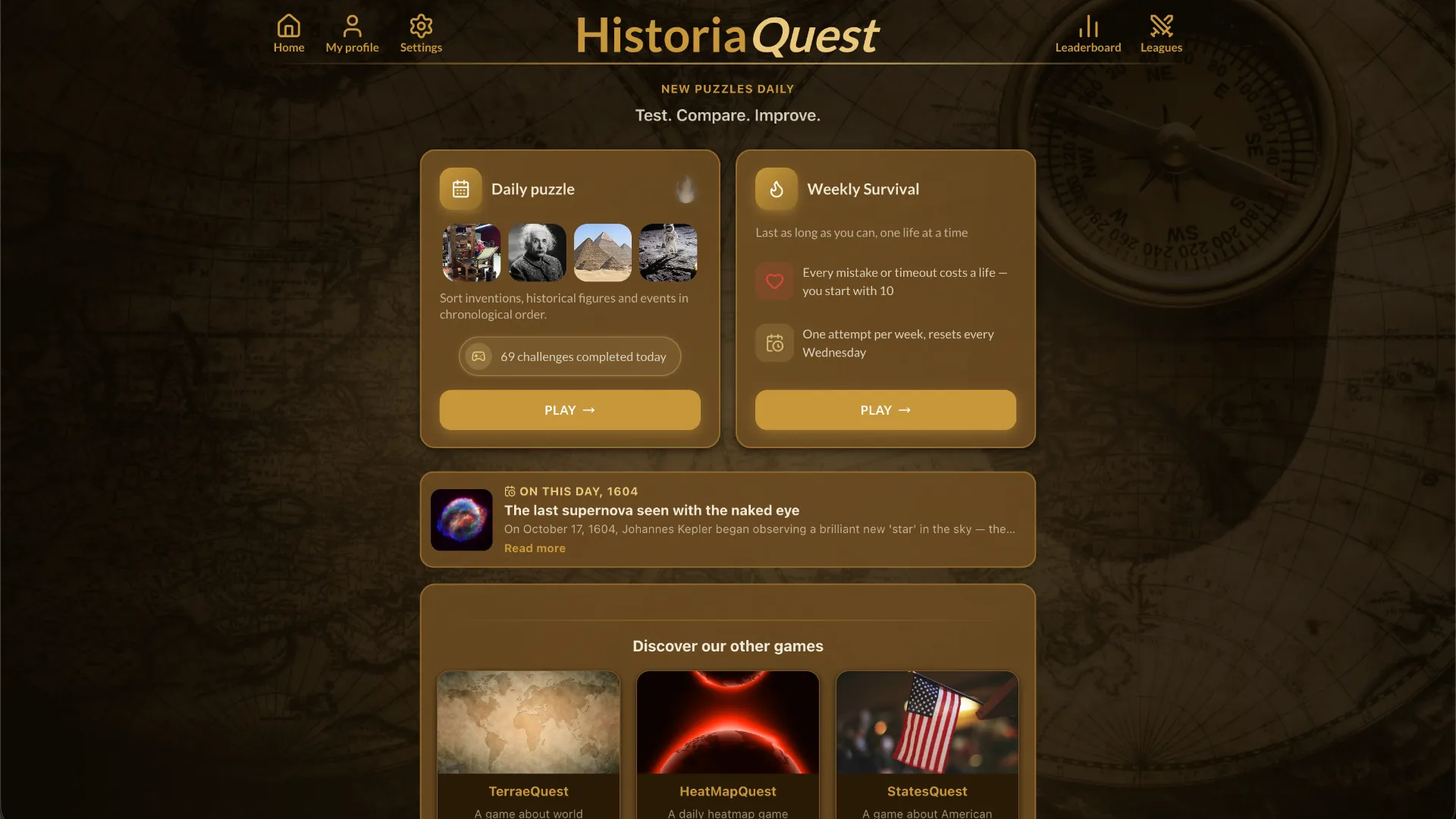
On the homepage, locate the Daily Puzzle section and select PLAY.
No account registration is required to begin the standard daily challenge.
Step 2: Read the Historical Category
Before moving any cards, read the instruction displayed above the puzzle.
The category tells you what kind of historical knowledge you need to apply. You might be arranging important inventions, notable people, or historical events.
Pay particular attention to the chronological direction: the earliest item belongs first, and the most recent belongs last.
Step 3: Arrange the Five Cards
Examine each illustrated card and estimate its historical period.
Start by identifying any obvious chronological anchors. An ancient historical figure clearly belongs before an invention from the Industrial Revolution, for example.
Drag the cards between the numbered positions until they form your best estimate of the correct timeline.
The five cards are already present in the puzzle area, so you are reordering an existing set rather than searching for additional answers.
Step 4: Submit Your Timeline
Review your complete sequence before committing.
Make sure all five positions are occupied in the order you intend, then press SUBMIT.
The game evaluates your arrangement. Follow the displayed results or feedback to understand your performance and make further adjustments if the current challenge permits another attempt.
Step 5: Check Your Results and Return Tomorrow
After finishing, review your score and compare your performance with other players through the game's competitive features.
Your recorded progress can contribute to your statistics and streak.
A new daily challenge becomes available at midnight UTC, giving players around the world the same daily puzzle.
HistoriaQuest Game Modes
HistoriaQuest offers both a regular daily puzzle and an additional survival-style challenge.
Daily Puzzle
The Daily Puzzle is the game's main attraction.
Each day, players receive a historical ordering challenge involving five cards. The objective is to arrange the items from oldest to newest as accurately and efficiently as possible.
The daily format makes it easy to build a short routine around the game. You can test your knowledge, compare your performance, and return the following day for another set of historical subjects.
Weekly Survival
Weekly Survival introduces a more demanding challenge with limited lives and time pressure.
The mode's stated rules include:
- You begin with 10 lives.
- Each incorrect answer costs one life.
- Running out of time also costs one life.
- You have one attempt at the weekly challenge.
- The weekly challenge resets on Wednesday.
Unlike the standard daily puzzle, Weekly Survival explicitly introduces a clock alongside its life system.
This makes the mode particularly suitable for players who want a more intense test of historical knowledge.
Because the weekly attempt cannot simply be repeated immediately, it is worth playing when you have time to concentrate.
Leaderboards and Private Leagues
HistoriaQuest also includes competitive features through the Daily Quest Games platform.
Players can compare results on weekly and monthly leaderboards, while private leagues let friends compete within their own group.
These features turn a short individual history puzzle into a recurring competition without changing the central chronological-ordering mechanic.
HistoriaQuest Scoring and Daily Streaks
HistoriaQuest rewards players for accurate historical ordering and efficient completion.
The number of attempts required to solve a puzzle matters, so discovering the correct timeline early is preferable to repeatedly submitting uncertain arrangements.
A game directory guide also describes a daily streak bonus that increases points by 2% for each consecutive day, up to a maximum bonus of 25%. Such scoring details may change as the game evolves.
The wider Daily Quest Games platform tracks player statistics, stars, and streaks through automatically generated anonymous player identities.
This means players can build a history of their performance without creating a traditional account.
Daily streaks also encourage consistent play. Returning regularly provides more opportunities to recognize historical periods and improve your chronological reasoning.
HistoriaQuest Tips and Strategies
1. Identify the Earliest and Latest Items First
Instead of immediately trying to arrange all five cards, look for the two easiest chronological anchors.
For example, if a puzzle includes an ancient civilization and a twentieth-century invention, their relative positions may be obvious.
Placing these extremes first makes the remaining three items easier to compare.
2. Think in Centuries Before Exact Years
Exact historical dates can be difficult to remember, but broad periods are often easier.
Try identifying whether each item belongs to:
- Ancient history
- The Middle Ages
- The Renaissance or early modern period
- The eighteenth or nineteenth century
- The twentieth century or later
Once you have grouped the cards into broad eras, refine their order using more specific knowledge.
3. Look for Historical Cause and Effect
History contains many chronological relationships.
An invention may have enabled a later technological development. A political revolution may have preceded a new government, while a scientific discovery may have occurred before a famous expedition.
Recognizing these relationships can reveal the correct sequence even when you cannot recall exact dates.
4. Watch Out for Overlapping Lifetimes
Historical figures can be especially tricky because famous people from the same broad era may have lived at overlapping times.
When arranging people, consider which relevant date the puzzle is asking you to compare, such as birth or death years.
The game's publisher describes historical figures using information including birth and death years, historical era, nationality, and field of influence.
Always follow the specific ordering criterion shown in the current puzzle rather than assuming every figure-based challenge uses the same date.
5. Separate an Invention from Its Later Popularity
Invention timelines are particularly deceptive.
A technology might have been invented decades before it became widely available. Similarly, an early prototype may have existed long before commercial adoption.
When comparing inventions, distinguish between the initial invention, successful demonstration, and widespread adoption.
This can help avoid mistakes involving technologies that became famous much later than their original development.
6. Compare Neighboring Cards Carefully
Some of the hardest ordering decisions involve two items from similar periods.
If you are confident about three of the five cards, concentrate on the remaining pair rather than second-guessing the entire timeline.
For example, two nineteenth-century inventions might seem nearly contemporary, but understanding their sequence may determine whether your final arrangement is correct.
7. Prepare Before Starting Weekly Survival
Weekly Survival introduces time pressure and a ten-life limit.
Practice chronological comparisons in the daily game before attempting the weekly challenge. During a timed round, avoid spending too long on a single uncertain decision because a timeout also costs a life.
8. Use Mistakes as Learning Opportunities
If you discover that two historical developments occurred in the opposite order from what you expected, remember that relationship for future puzzles.
Over time, playing HistoriaQuest can help build a more connected mental timeline of world history.
What Makes HistoriaQuest Different from Other History Games?
Many history games focus on recalling dates, selecting answers from multiple-choice questions, or identifying famous historical personalities.
HistoriaQuest instead concentrates on relative chronology.
Rather than asking 'In what year did this happen?', it challenges you to determine whether one historical event, figure, or invention came before another.
This has several advantages for players:
- You can use contextual knowledge even when exact dates are unfamiliar.
- Each puzzle requires comparing several historical facts rather than recalling a single answer.
- Drag-and-drop interaction makes the challenge feel like a visual logic puzzle.
- Changing daily categories introduce variety across historical subjects.
- Leaderboards, streaks, and leagues provide reasons to return regularly.
The format is especially enjoyable for people who like timeline puzzles, historical trivia, and deduction-based browser games.
Is HistoriaQuest Free to Play?
Yes. HistoriaQuest is free to play through its official website.
According to the Daily Quest Games publisher, its collection of daily games is offered without advertisements and without requiring players to register an account.
The platform automatically generates an anonymous player ID and nickname after a player's first game.
Statistics and progression are associated with that identity and are saved for future visits on the same device.
No separate installation is required to access the web game.
Frequently Asked Questions
What is HistoriaQuest?
HistoriaQuest is a daily browser-based history game where players arrange five historical figures, inventions, or events in chronological order, from oldest to newest.
How many cards are in each HistoriaQuest puzzle?
The standard daily puzzle contains five illustrated cards arranged in numbered positions from 1 to 5.
What kinds of historical subjects appear?
Puzzle themes include historical figures, inventions, and important events. The category changes between daily challenges.
Do I need to know exact historical dates?
Not necessarily. The main challenge is determining chronological order. Knowing approximate periods and which developments happened before others can be enough to solve many arrangements.
Is HistoriaQuest a multiple-choice trivia game?
No. Its main mechanic is dragging historical cards into chronological order rather than choosing answers from a list of multiple-choice options.
How often does HistoriaQuest update?
A new daily puzzle becomes available every day. The publisher states that its daily games reset at midnight UTC.
Is HistoriaQuest free?
Yes. The standard browser game is free to play, with no required account or download.
Can I compete against friends?
Yes. The platform supports leaderboards and private leagues, allowing players to compare scores and participate in friendly competition.
What is HistoriaQuest Weekly Survival?
Weekly Survival is an additional mode featuring ten starting lives. Mistakes and timeouts each cost a life. Only one attempt is available per week, and the challenge resets on Wednesday.
Does HistoriaQuest save my progress?
The Daily Quest Games platform automatically saves player statistics, streaks, and other progress using an anonymous player ID. Progress is associated with the same device, so changing devices or clearing stored browser information may affect access to previous results.
Can I play HistoriaQuest on my phone?
HistoriaQuest is a web-based game. You can open its website in a mobile browser, although the experience of dragging cards may differ between touchscreens and desktop devices.
Is HistoriaQuest good for learning history?
HistoriaQuest can be a useful way to practice chronological reasoning and reinforce knowledge of historical periods. Its puzzles encourage players to compare events, inventions, and people rather than memorize dates in isolation.
Conclusion
HistoriaQuest gives traditional history trivia a simple but engaging twist: instead of remembering one answer, players must build an entire chronological sequence.
With five illustrated cards, changing historical themes, daily puzzles, leaderboards, and a challenging Weekly Survival mode, it offers a quick and rewarding experience for history enthusiasts and casual puzzle fans alike.
The combination of historical knowledge and logical ordering makes every puzzle an opportunity to discover how important events, people, and inventions relate to one another across time.
Think you know what happened first? Play HistoriaQuest for free and put your historical knowledge to the test.