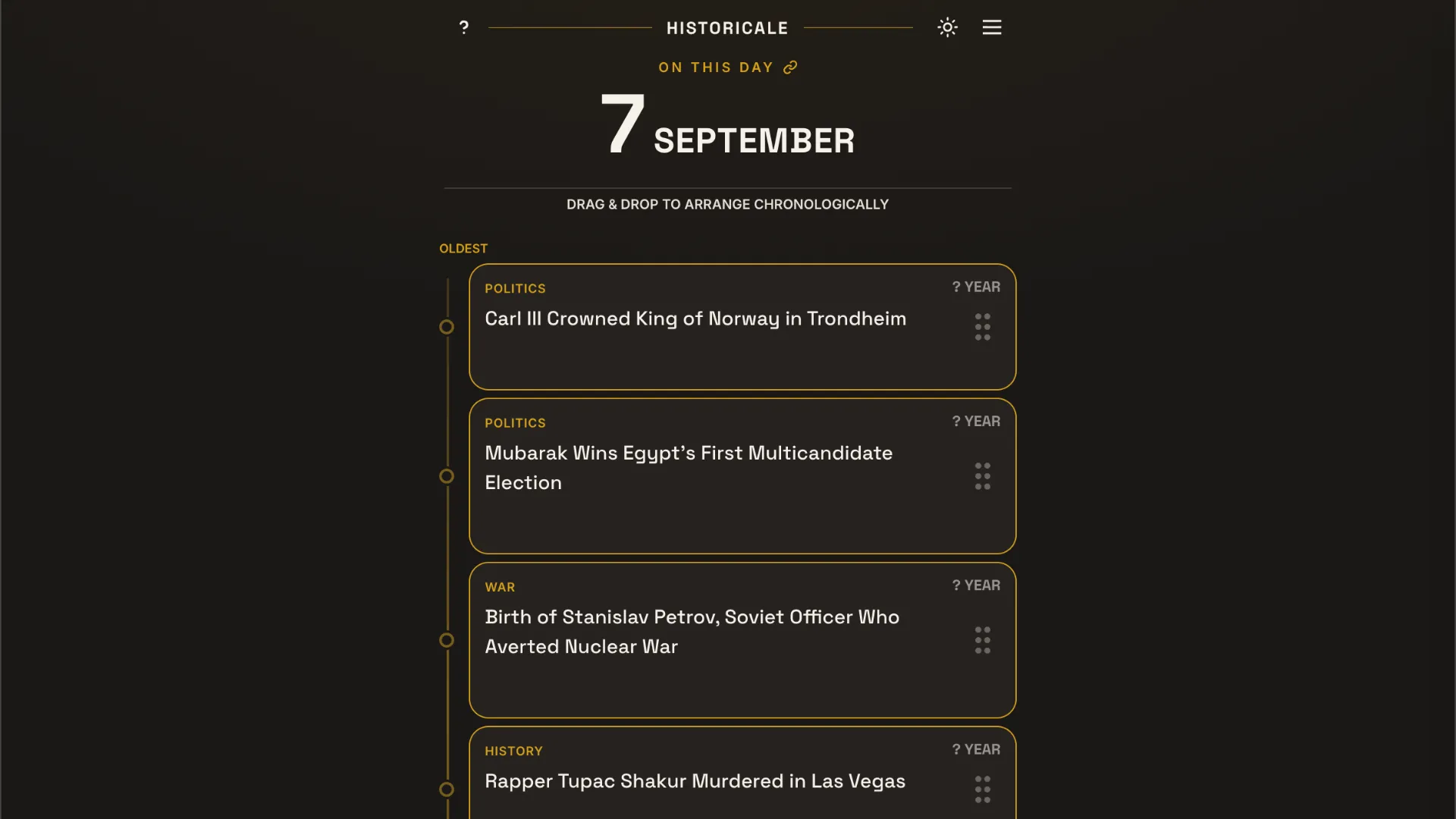

What Is Historicale?
Historicale is a daily history timeline game from Teuteuf Games. Instead of asking you to remember one exact date, it gives you six historical events and challenges you to arrange them in chronological order from oldest to newest.
The clever part is that all six events are connected by the same calendar date. They happened on the same month and day, but in different years and often in completely different periods of history.
That makes each puzzle feel like a compact version of an on-this-day history quiz mixed with a timeline puzzle.
The Core Historicale Twist
Historicale is about relative chronology rather than simply recalling exact years.
The basic challenge is:
6 events from the same calendar date -> compare their historical periods -> arrange oldest to newest
For example, a puzzle could theoretically mix an event involving a medieval ruler, an eighteenth-century revolution, a nineteenth-century invention, a World War II event, and two developments from recent decades.
You may not know the exact year of every event. You can still solve the puzzle by identifying which eras they belong to and comparing them with one another.
That distinction is important. Historicale rewards questions such as:
- Did this happen before or after World War I?
- Was this ruler medieval or early modern?
- Did this invention appear before commercial aviation?
- Was this political event part of the Cold War?
You are building a timeline from historical context rather than answering six independent trivia questions.
How To Play Historicale
- Read all six historical events. Do not immediately focus on exact dates. First identify the general century, era, conflict, ruler, invention, or movement associated with each event.
- Find the obvious anchors. Put events that clearly belong to ancient, medieval, early modern, modern, or contemporary history into rough chronological groups.
- Compare the difficult events. When two events seem close together, use contextual clues such as political leaders, wars, technologies, countries, and historical movements to decide which came first.
- Arrange the six events from oldest to newest. Review the sequence as one complete timeline and correct any ordering that looks historically inconsistent before finishing the daily challenge.
A Simple Historicale Example
Imagine being given six fictionalized event descriptions covering these periods:
Roman Empire
European Renaissance
American Revolution
World War I
Apollo era
Early internet era
Even without knowing a single exact year, the broad order is manageable:
Roman Empire -> Renaissance -> American Revolution -> World War I -> Apollo era -> Early internet era
Real Historicale puzzles are harder because some events can sit much closer together. You might need to distinguish two nineteenth-century events or determine whether one Cold War development occurred before another.
Strategy Tips
Build the Timeline in Layers
Do not try to determine all six exact years at once. Start by separating the events into broad periods such as ancient, medieval, 1700s, 1800s, early twentieth century, and postwar history.
Once the broad sequence is established, concentrate on the uncertain neighboring events.
Look for Historical Anchors
Certain names immediately narrow the possible period. Historical figures, monarchs, presidents, wars, empires, scientific discoveries, and technologies can provide strong chronological anchors.
For example, an event involving Napoleon must fit into a much narrower period than a generic description involving a European city.
Use Technology as a Clock
References to railways, telegraphs, automobiles, radio, television, satellites, computers, or the internet can help establish a rough historical period even when you do not recognize the event itself.
Watch for Political Geography
Country names and political entities can reveal whether an event occurred before or after major historical changes. References to the Soviet Union, East Germany, the Ottoman Empire, Yugoslavia, or other former states can provide useful chronological boundaries.
Compare Events Instead of Guessing Years
Historicale becomes much easier when you stop asking what exact year an unfamiliar event happened and instead ask whether it happened before or after another event in the puzzle.
You only need the correct relative order.
What Makes Historicale Different From Date Guessing Games?
Historicale does not primarily test whether you can type an exact year. Its central skill is chronology: understanding how historical events relate to one another across time.
That makes it different from photo-dating games such as WhenTaken or TimeGuessr. There is no need to inspect visual clues and estimate a year from clothing, cars, or architecture. Historicale gives you the events themselves and asks you to construct the correct sequence.
It also differs from standard multiple-choice history trivia because several events interact with one another. Correctly identifying one event's approximate period can help you place several others.
Why the Same-Date Format Matters
Because the events share today's calendar date, each puzzle doubles as a miniature on-this-day history lesson.
The six events can span centuries, showing how many unrelated political, scientific, cultural, military, and social developments happened on the same date in different years.
This gives Historicale more variety than a timeline game restricted to a single war, country, or historical period.
Is Historicale Worth Playing?
Historicale is a strong choice for players who enjoy history but prefer deduction to obscure trivia. Knowing exact dates certainly helps, but it is not required. A good understanding of historical eras, famous people, major conflicts, technologies, and political changes can carry you through much of the puzzle.
It is also short enough to work well as a daily game. Six events provide enough uncertainty to create a meaningful challenge without turning the puzzle into a long history quiz.
If you enjoy putting events in order, learning what happened on today's date, or testing whether your mental timeline of world history is actually accurate, Historicale is an easy daily game to add to your routine.